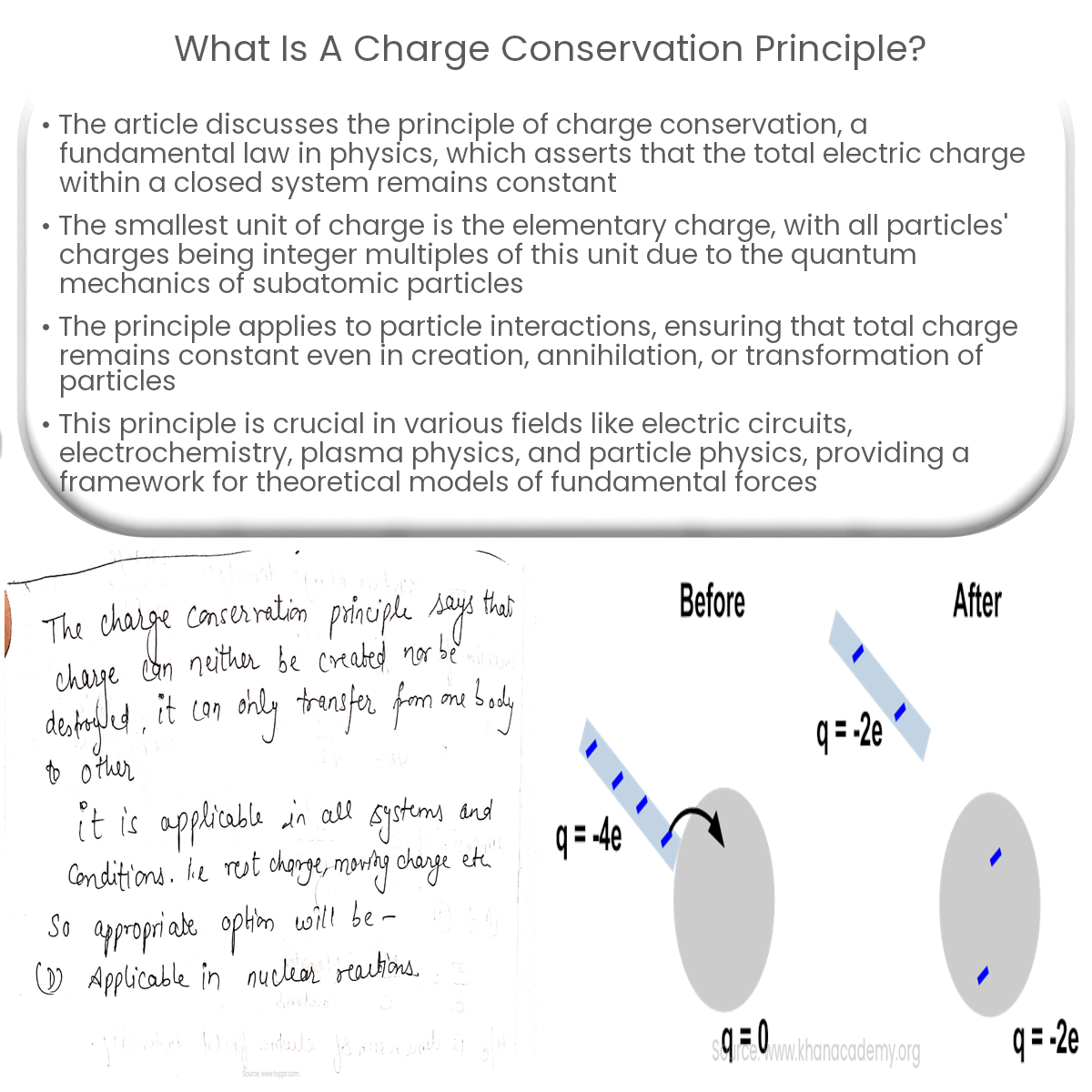
Charge conservation principle states that the total electric charge within a closed system remains constant over time, neither created nor destroyed.
Charge Conservation Principle
The charge conservation principle, also known as the conservation of charge, is a fundamental law in physics that states the total electric charge within a closed system remains constant over time. This principle is based on the observation that electric charge is a conserved quantity, meaning that it cannot be created or destroyed.
Charge conservation is a direct consequence of one of the four fundamental forces of nature, the electromagnetic force. The force is governed by Maxwell’s equations, which describe the behavior of electric and magnetic fields.
Elementary Charges and Charge Quantization
The smallest unit of electric charge is the elementary charge, represented by the symbol e. It is the magnitude of the charge carried by a single electron or proton. Charge quantization refers to the fact that the electric charge of any particle is always an integer multiple of the elementary charge.
This quantization property is a result of the underlying quantum mechanics governing the behavior of subatomic particles, such as electrons and quarks.
Conservation of Charge in Particle Interactions
In particle interactions, the total charge before and after the interaction must remain the same. This principle applies to all processes, whether they involve the creation or annihilation of particles, or the transformation of one type of particle into another.
- Particle creation and annihilation: When particles are created or annihilated, the total charge of the system is conserved. For example, when an electron and a positron (its antiparticle) annihilate, they produce two photons, which are neutral. The initial total charge (zero) is conserved.
- Particle transformation: In processes such as beta decay, a neutron transforms into a proton, an electron, and an antineutrino. The total charge before and after the decay remains constant.
Implications of Charge Conservation
The principle of charge conservation has important implications in various fields of science and engineering. For instance, it plays a crucial role in understanding and predicting the behavior of electric circuits, electrochemistry, and plasma physics.
Charge conservation also has consequences for the study of fundamental particles and their interactions. It helps to determine the possible reactions between particles and provides a framework for the development of theoretical models that describe the fundamental forces in the universe.