
What is a capacitive humidity sensor?

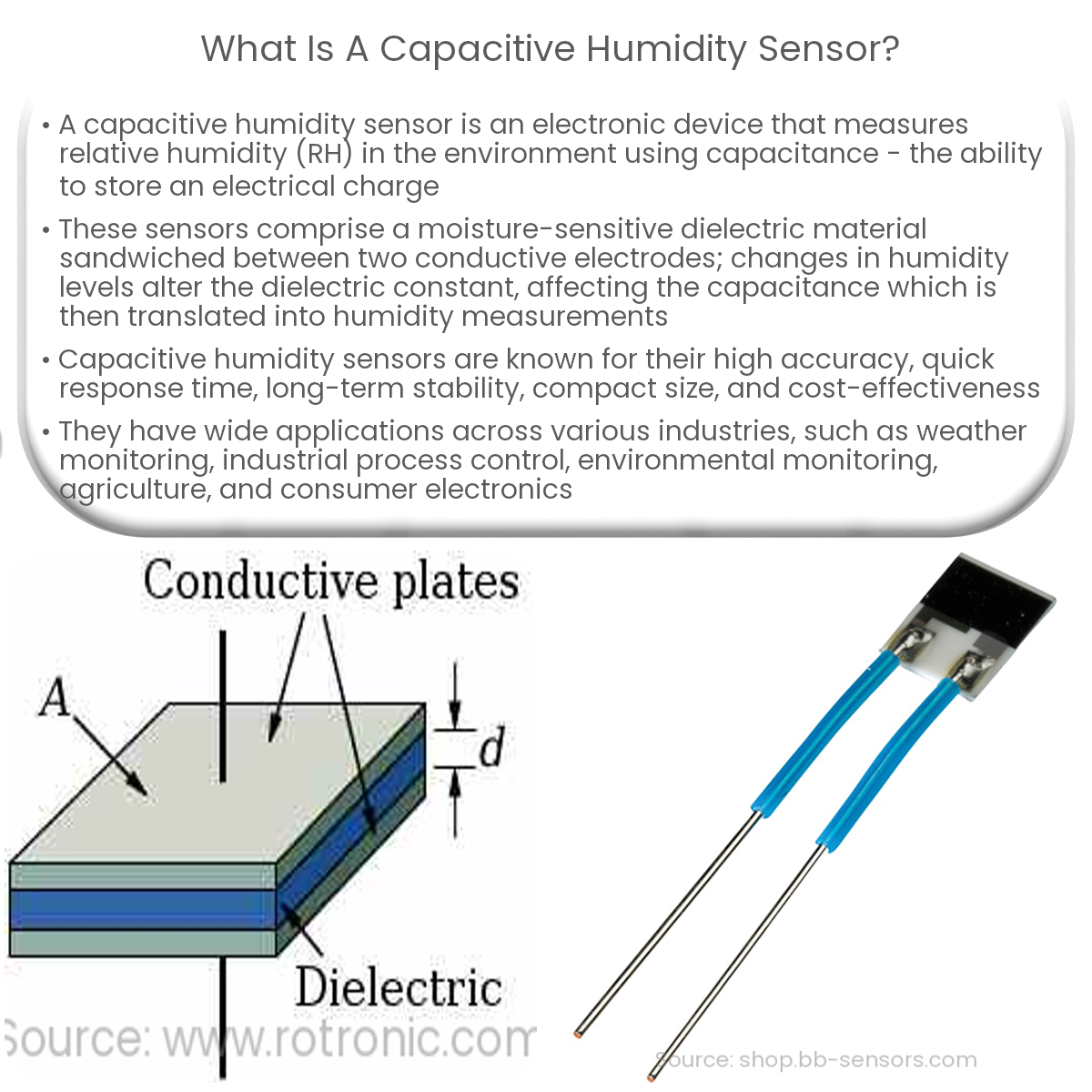
A capacitive humidity sensor measures relative humidity by detecting changes in capacitance of a moisture-sensitive dielectric material.

What is a Capacitive Humidity Sensor?

A capacitive humidity sensor is a widely-used electronic device that measures relative humidity (RH) in the environment. It operates on the principle of capacitance, which is the ability of a system to store an electrical charge. This article delves into the working mechanism and applications of capacitive humidity sensors.

Working Principle of Capacitive Humidity Sensors

Capacitive humidity sensors typically consist of a sensing element, which is a thin layer of a moisture-sensitive dielectric material, sandwiched between two conductive electrodes. The sensing element’s dielectric constant changes with the variation in humidity levels. As the humidity in the environment increases, more water molecules get absorbed by the sensing layer, causing its capacitance to increase. Conversely, when humidity decreases, the capacitance reduces.

An oscillator circuit connected to the sensor measures the change in capacitance and converts it into a voltage or frequency output. This output is then processed by a microcontroller or signal conditioning circuit, which translates the output into a humidity measurement in percentage (%RH).

Advantages of Capacitive Humidity Sensors

  • Accuracy: Capacitive humidity sensors are known for their high accuracy, especially in the mid-range of humidity levels.
  • Fast Response Time: These sensors respond quickly to changes in humidity levels, providing real-time measurements.
  • Long-term Stability: Capacitive sensors demonstrate excellent stability over time, ensuring reliable and consistent performance.
  • Compact Size: Due to their small size, capacitive humidity sensors can be easily integrated into various applications.
  • Cost-effectiveness: These sensors are relatively affordable, making them an attractive choice for a wide range of applications.
  • Applications of Capacitive Humidity Sensors

    Capacitive humidity sensors are employed in a variety of industries and applications, including:

  • Weather Monitoring: They are used in meteorological stations for measuring humidity levels, aiding in accurate weather forecasting.
  • Industrial Process Control: Capacitive sensors help maintain optimal humidity levels in manufacturing and processing plants, ensuring product quality and safety.
  • Environmental Monitoring: They are utilized in air quality monitoring systems for assessing humidity levels and providing valuable data for pollution control.
  • Agriculture: Capacitive humidity sensors play a vital role in monitoring soil moisture, greenhouse humidity, and irrigation systems to optimize crop growth and yield.
  • Consumer Electronics: These sensors are found in everyday devices like smartphones, tablets, and smart home systems for monitoring indoor air quality and controlling HVAC systems.
  • In conclusion, capacitive humidity sensors are essential devices for accurate humidity measurement across various industries. Their compact size, high accuracy, and cost-effectiveness make them a popular choice in numerous applications.

    What is a capacitive humidity sensor?

    header - logo

    The primary purpose of this project is to help the public to learn some exciting and important information about electricity and magnetism.

    Privacy Policy

    Our Website follows all legal requirements to protect your privacy. Visit our Privacy Policy page.

    The Cookies Statement is part of our Privacy Policy.

    Editorial note

    The information contained on this website is for general information purposes only. This website does not use any proprietary data. Visit our Editorial note.

    Copyright Notice

    It’s simple:

    1) You may use almost everything for non-commercial and educational use.

    2) You may not distribute or commercially exploit the content, especially on another website.