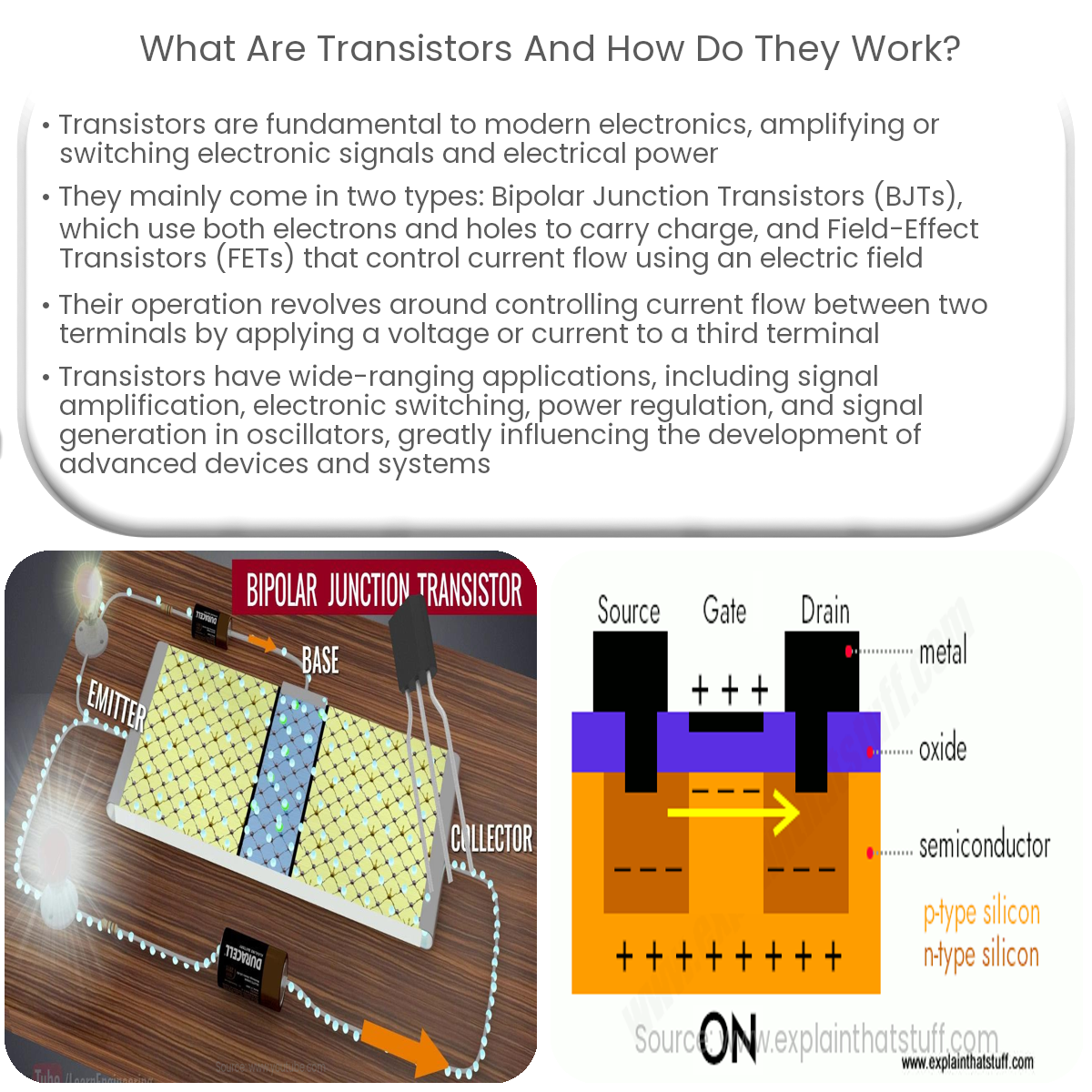
Transistors are semiconductor devices that amplify or switch electronic signals, with applications in amplification, switching, power regulation, and oscillators.
Transistors: A Brief Introduction
A transistor is a semiconductor device used to amplify or switch electronic signals and electrical power. It is the fundamental building block of modern electronic devices and plays a crucial role in the functioning of various circuits.
Types of Transistors
Transistors are mainly divided into two types:
- Bipolar Junction Transistors (BJTs): These transistors have three layers of semiconductor material, with two types of charge carriers, electrons and holes. They are further divided into NPN and PNP types.
- Field-Effect Transistors (FETs): These transistors use an electric field to control the flow of current. FETs are further classified into Junction-Gate FETs (JFETs) and Metal-Oxide-Semiconductor FETs (MOSFETs).
How Transistors Work
Transistors have three terminals: the base (B), the collector (C), and the emitter (E) in BJTs; and the gate (G), the drain (D), and the source (S) in FETs. The basic principle of operation is the control of current flow between two terminals (C and E, or D and S) by applying a voltage or current to the third terminal (B or G).
In a BJT, a small current entering the base allows a much larger current to flow between the collector and the emitter. This current amplification property makes BJTs suitable for use as amplifiers or switches in various electronic applications.
In a FET, the voltage applied to the gate terminal controls the flow of current between the drain and source terminals. FETs are known for their high input impedance, low power consumption, and high-speed switching capabilities.
Transistor Applications
Transistors have numerous applications, some of which include:
- Amplification: Transistors amplify weak signals in applications like audio amplifiers, radio frequency circuits, and sensor signal processing.
- Switching: Transistors act as fast electronic switches in digital circuits and computer processors.
- Power Regulation: Transistors control the flow of power in voltage regulators, motor controllers, and power supplies.
- Oscillators: Transistors are used in oscillators to generate precise frequency signals in communication systems and electronic devices.
Transistors have revolutionized the world of electronics, enabling the development of advanced devices and systems that continue to shape our daily lives.