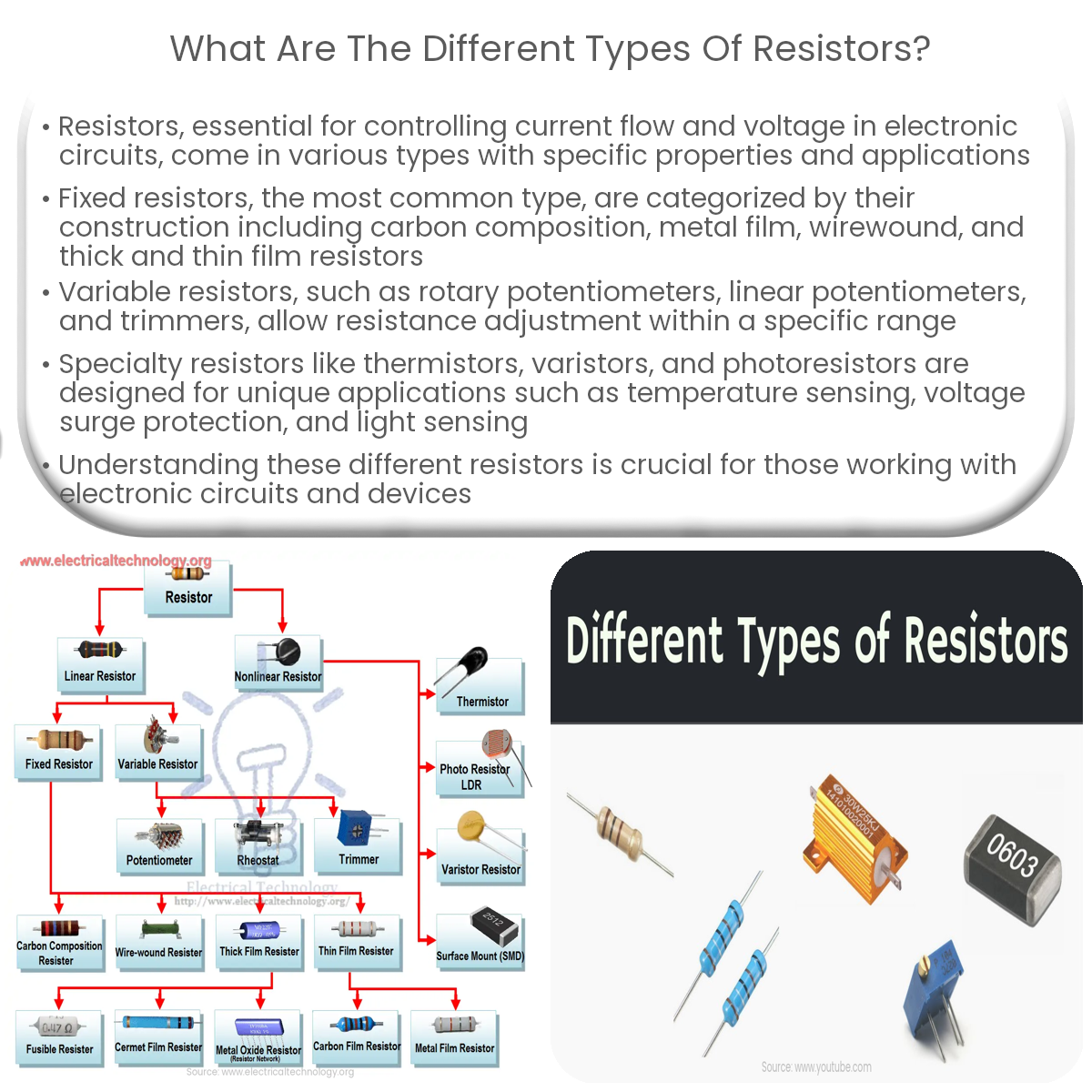
Resistors are classified into fixed, variable, and specialized types, such as carbon film, metal film, wirewound, thermistors, LDRs, and varistors.
Overview of Resistor Types
Resistors are essential electronic components that control the flow of electric current in circuits. There are several types of resistors, each with unique characteristics and applications. This article will discuss the different types of resistors and their uses.
Fixed Resistors
Fixed resistors have a constant resistance value and are the most common type of resistor. They are further classified based on their construction:
- Carbon Film Resistors: These are made by depositing a thin layer of carbon on an insulating substrate. They are affordable and commonly used in low-power applications.
- Metal Film Resistors: Similar to carbon film resistors, metal film resistors have a thin metallic layer deposited on an insulating substrate. They offer better temperature stability and lower noise compared to carbon film resistors.
- Wirewound Resistors: These resistors consist of a conductive wire wound around an insulating core. They are known for their high power handling capabilities and precision.
- Thin Film Resistors: Produced using thin-film deposition techniques, these resistors offer high precision, stability, and low noise. They are used in precision applications, such as instrumentation and high-frequency circuits.
Variable Resistors
Variable resistors, also known as potentiometers or rheostats, have an adjustable resistance value. They are used for tuning, calibration, and control purposes. Potentiometers have three terminals, while rheostats have two terminals. The resistance can be adjusted by moving a wiper along a resistive track.
Specialized Resistors
Some resistors are designed for specific applications and exhibit unique properties:
- Thermistors: Thermistors change their resistance with temperature variations. They are used for temperature sensing, control, and compensation. There are two types of thermistors: Negative Temperature Coefficient (NTC) and Positive Temperature Coefficient (PTC).
- Light-dependent Resistors (LDRs): Also called photoresistors, LDRs change their resistance based on light intensity. They are used in light-sensing applications, such as ambient light detection and light-controlled switches.
- Varistors: Varistors exhibit a non-linear resistance-voltage relationship and are used to protect circuits against voltage surges and spikes. Metal Oxide Varistors (MOVs) are a common type of varistor.
Choosing the Right Resistor
Selecting the appropriate resistor for a specific application depends on several factors, including:
- Resistance value and tolerance
- Power rating
- Temperature coefficient
- Noise characteristics
- Physical size and form factor
In conclusion, there are numerous types of resistors with unique characteristics and applications. Understanding the different resistor types and their properties is crucial for designing and implementing effective electronic circuits.