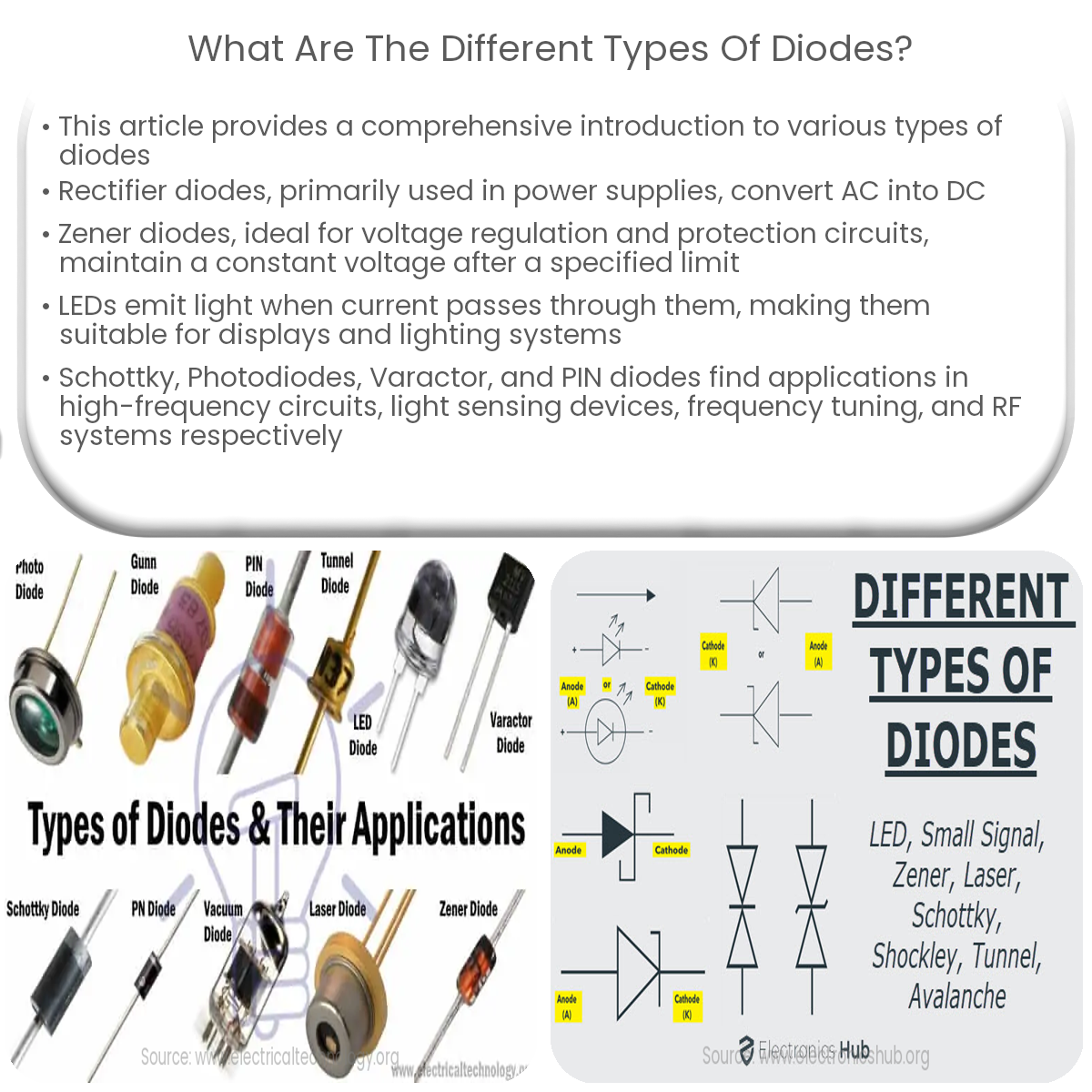
Different types of diodes include rectifier, Zener, LED, Schottky, photodiode, varactor, and PIN diodes, each with unique characteristics and uses.
Introduction to Diodes
A diode is a two-terminal electronic component that conducts current in one direction and blocks it in the opposite direction. There are various types of diodes, each with unique characteristics and applications. This article will introduce you to some of the most common types of diodes.
1. Rectifier Diodes
Rectifier diodes are the most basic type of diode, commonly used for converting alternating current (AC) into direct current (DC) in power supply applications. They have a high current and voltage rating, making them suitable for use in power supplies and high-voltage circuits.
2. Zener Diodes
Zener diodes are designed to operate in reverse bias, where they maintain a constant voltage across their terminals when the applied voltage exceeds a specific value called the Zener voltage. This unique property makes Zener diodes ideal for voltage regulation and protection circuits.
3. Light Emitting Diodes (LEDs)
LEDs are semiconductor diodes that emit light when current flows through them. They are widely used in various applications such as indicators, displays, and lighting systems. LEDs are energy-efficient, long-lasting, and available in various colors and sizes.
4. Schottky Diodes
Schottky diodes, also known as hot carrier diodes, have a low forward voltage drop and fast switching times. They are commonly used in high-frequency applications, such as radio frequency (RF) circuits and switching power supplies, due to their low power dissipation and high efficiency.
5. Photodiodes
Photodiodes are light-sensitive diodes that generate a current when exposed to light. They are used in various applications such as solar cells, optical communication systems, and light sensing devices.
6. Varactor Diodes
Varactor diodes, or varicap diodes, are semiconductor devices that have a variable capacitance depending on the applied reverse-bias voltage. They are used in frequency-tuning applications such as voltage-controlled oscillators and phase-locked loops in communication systems.
7. PIN Diodes
PIN diodes are designed with an intrinsic layer sandwiched between the P-type and N-type regions. They have unique characteristics, such as low capacitance and high-power handling capabilities, which make them suitable for use in RF and microwave applications, including switches and attenuators.
Conclusion
Understanding the different types of diodes and their applications is essential for selecting the right diode for a specific circuit or design. From rectifier diodes to LEDs, each type of diode serves a unique purpose in electronic devices and systems.