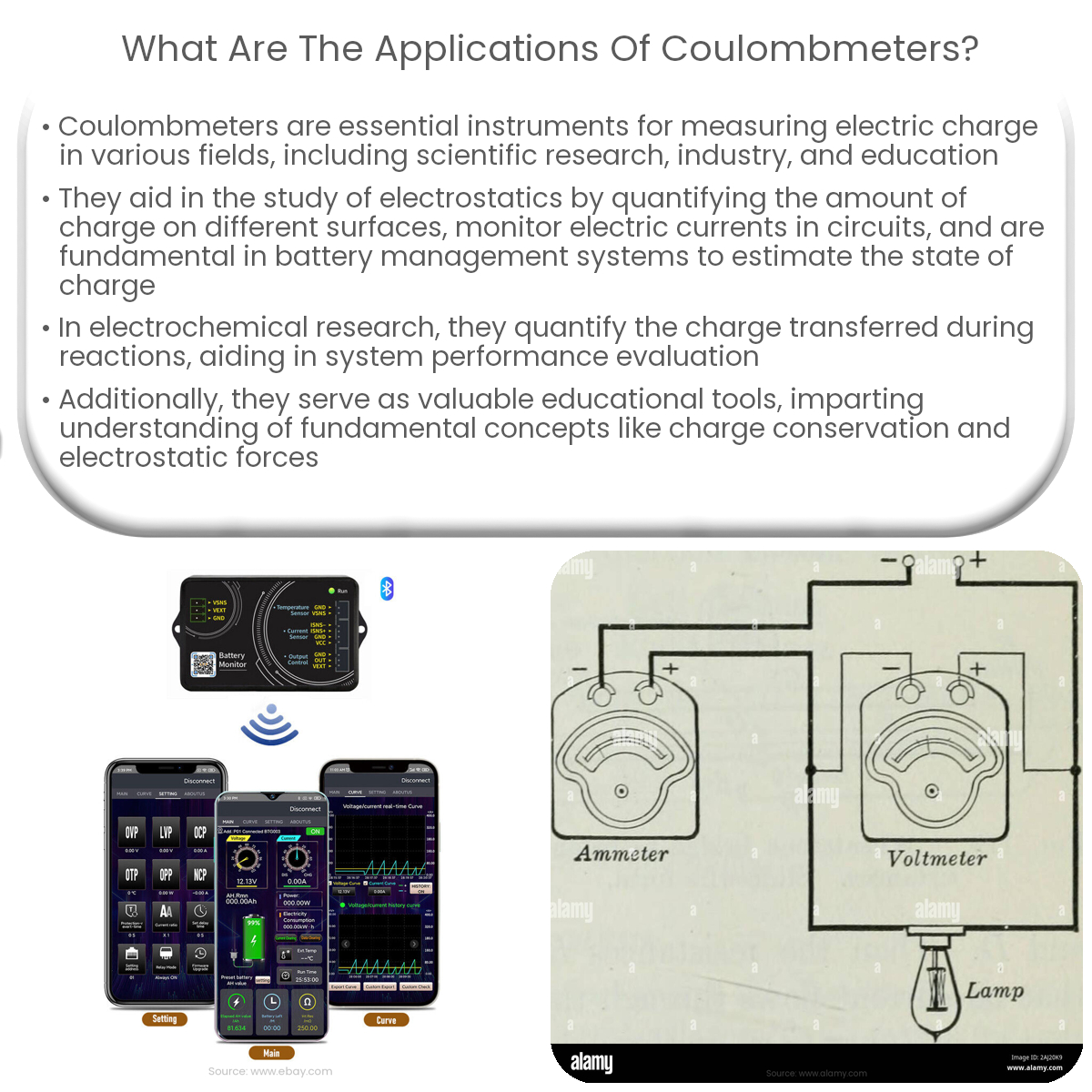
Coulombmeters are used in electrostatics, electric current monitoring, battery management, electrochemical experiments, particle detectors, and education.
Applications of Coulombmeters
Coulombmeters are instruments designed to measure the electric charge in various applications, such as scientific research, industry, and education. These devices are crucial for understanding and controlling the flow of charge in different scenarios. Here, we discuss the primary applications of Coulombmeters.
1. Electrostatics and Charge Measurement
In the study of electrostatics, Coulombmeters are used to measure the amount of electric charge accumulated on various surfaces, such as conducting spheres or insulating materials. This information helps researchers to understand the behavior of charged objects and the forces between them.
2. Electric Current Monitoring
Coulombmeters can be utilized to monitor electric currents in circuits by integrating the current over time, thus providing an accurate measurement of the charge transferred. This data can be valuable for diagnosing and troubleshooting electrical systems.
3. Battery Management Systems
Battery management systems (BMS) often employ Coulombmeters to estimate the state of charge (SoC) of batteries in electric vehicles, energy storage systems, and other applications. Accurate SoC estimation enables better control of charging and discharging processes, which contributes to increased battery life and efficiency.
4. Electrochemical Experiments
In electrochemical research, such as in the study of batteries, fuel cells, or corrosion processes, Coulombmeters play a vital role in quantifying the amount of charge transferred during electrochemical reactions. This information aids in understanding reaction mechanisms and evaluating the performance of electrochemical systems.
5. Particle Detectors
Coulombmeters are also employed in particle detectors to measure the charge generated by ionizing radiation. The charge produced by these interactions can be used to determine the type, energy, and intensity of the incident radiation, which is essential for applications such as nuclear research and medical imaging.
6. Educational Purposes
Coulombmeters serve as valuable teaching tools in physics and engineering courses, helping students understand fundamental concepts such as charge conservation, electrostatic forces, and electric currents. By using these devices in lab experiments, students can gain hands-on experience and a deeper comprehension of the subject matter.
In summary, Coulombmeters are versatile instruments that find applications across various fields, from fundamental research to practical applications in industry and education. Their ability to measure electric charge with precision makes them indispensable tools for understanding and controlling electric phenomena.