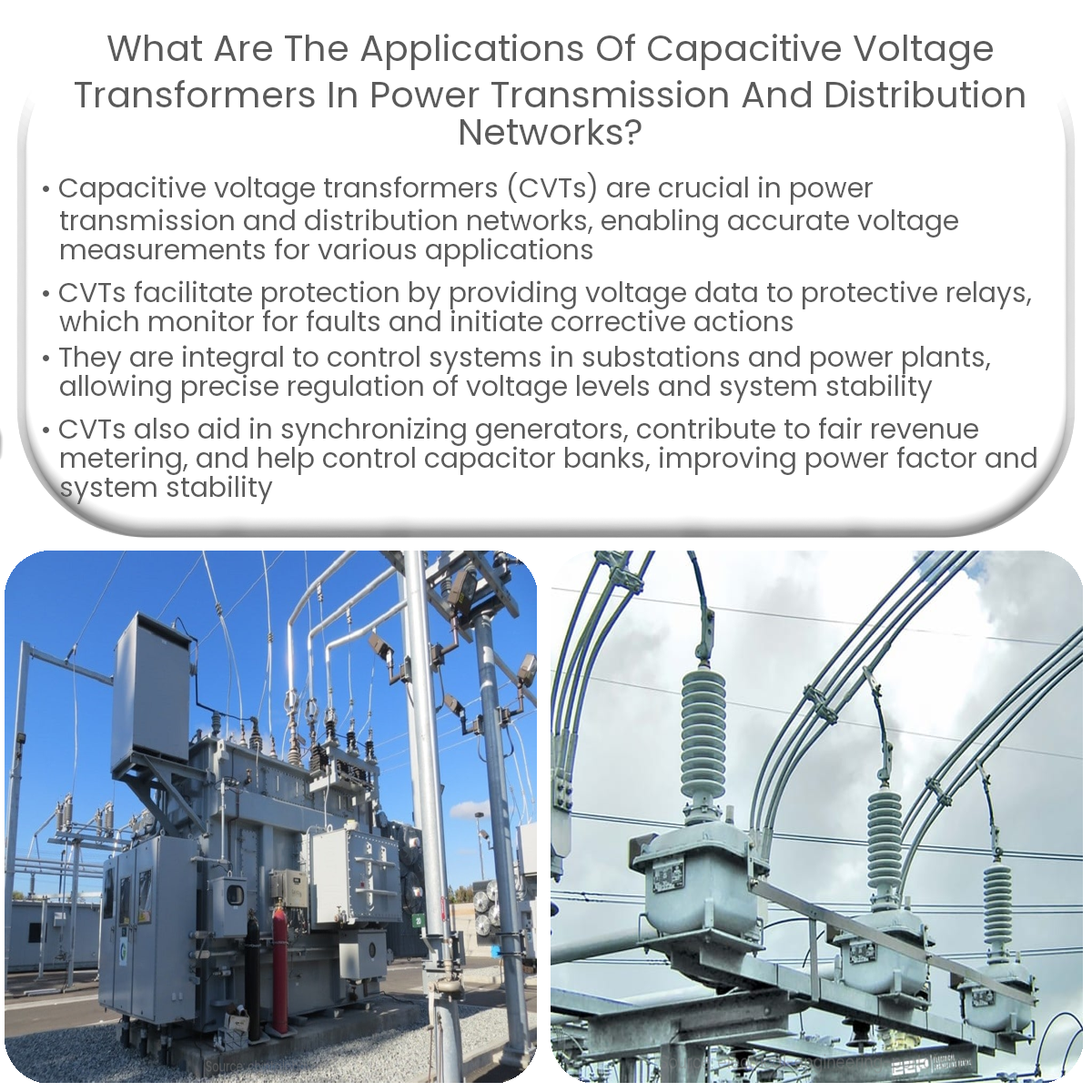
CVTs are used in power networks for voltage measurement, protection, control, synchronization, revenue metering, and capacitor bank control.
Applications of Capacitive Voltage Transformers in Power Transmission and Distribution Networks
Capacitive voltage transformers (CVTs) are essential components in power transmission and distribution networks, providing accurate voltage measurements for various purposes. This article highlights the key applications of CVTs in power transmission and distribution networks, emphasizing their critical role in maintaining system stability and efficiency.
Voltage Measurement
One of the primary functions of a CVT is to provide accurate voltage measurements for monitoring purposes. By accurately measuring high voltages, CVTs help operators assess the performance and efficiency of transmission and distribution networks. This information is vital for making informed decisions on system operation and maintenance.
Protection
CVTs play a crucial role in the protection of power transmission and distribution networks. The voltage output from a CVT serves as an input to protective relays, which continuously monitor the power system for faults or abnormal conditions. If a fault is detected, the protective relay sends a signal to circuit breakers or other protective devices, initiating corrective actions to isolate the affected area and minimize the impact on the overall system.
Control and Regulation
CVTs supply essential voltage information for control systems in substations and power plants. By providing accurate voltage measurements, CVTs enable the precise regulation of voltage levels, reactive power, and system stability. This is particularly important in power systems with a high penetration of renewable energy sources, where fluctuations in generation can lead to voltage instability.
Synchronization
CVTs can be used to provide voltage signals for synchronizing generators and other power system equipment. Synchronization is necessary for ensuring the proper coordination of power generation and distribution, maintaining system stability and minimizing the risk of faults or disturbances.
Revenue Metering
CVTs are often used in revenue metering applications, where accurate voltage measurements are required for billing purposes. By providing precise voltage information, CVTs help utility companies ensure fair billing for electricity consumers and facilitate the monitoring of energy consumption trends.
Capacitor Bank Control
In power transmission and distribution networks, capacitor banks are used to improve power factor and system stability. CVTs provide the necessary voltage information for the control and regulation of capacitor banks, ensuring optimal operation and minimizing losses in the network.
In conclusion, capacitive voltage transformers play a vital role in power transmission and distribution networks, contributing to system stability, efficiency, and safety. Their accurate voltage measurement capabilities are essential for a wide range of applications, including protection, control, synchronization, revenue metering, and capacitor bank control.