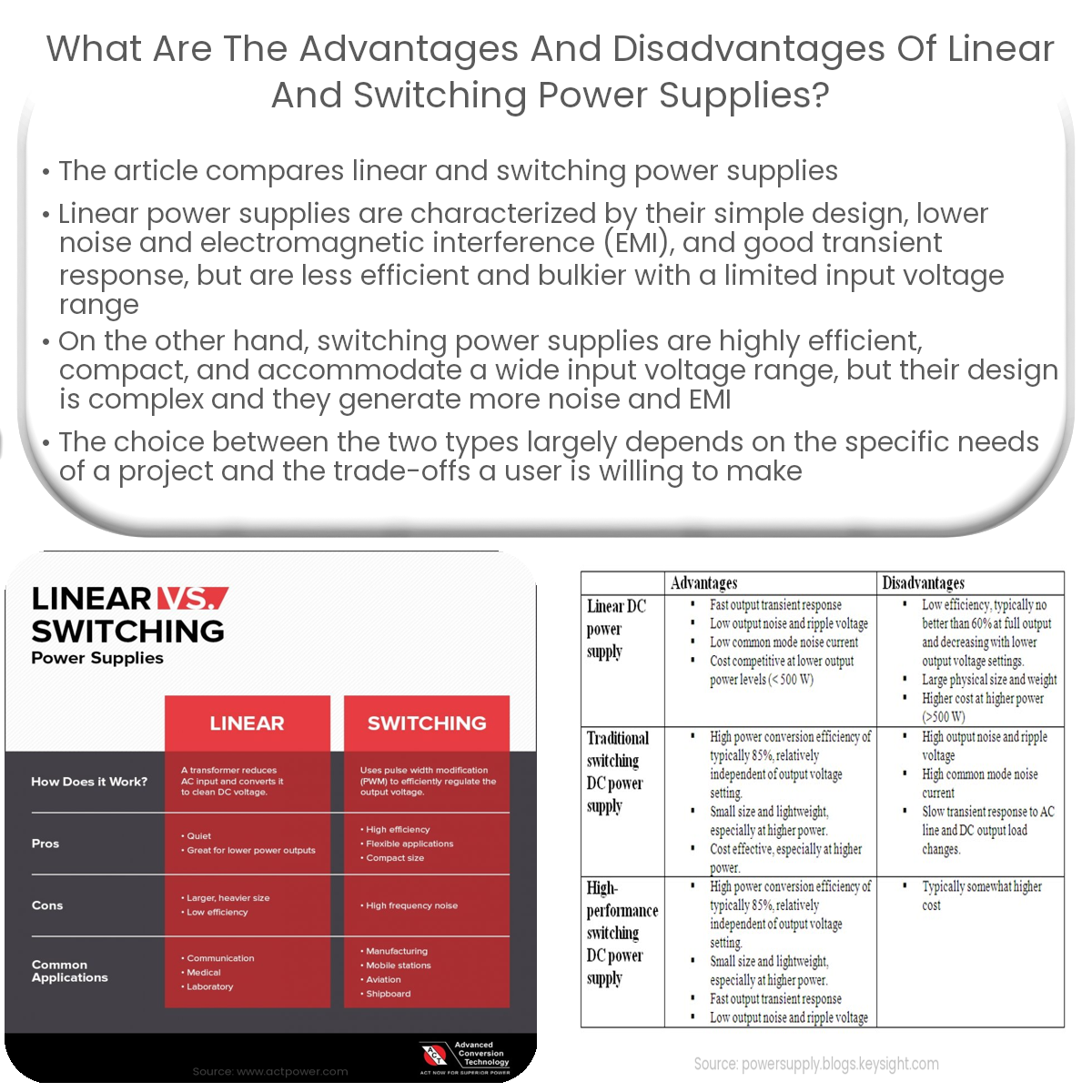
Linear power supplies have simple design, low noise, but lower efficiency, while switching power supplies offer high efficiency, compact size, but more noise and EMI.
Linear vs. Switching Power Supplies: Advantages and Disadvantages
Power supplies are essential components in electronic circuits, providing stable voltage levels for various devices. Linear and switching power supplies are the two most common types, each with its own set of advantages and disadvantages. This article will explore these pros and cons to help you make an informed decision when choosing a power supply for your project.
Linear Power Supplies
Advantages
- Simple design: Linear power supplies have a straightforward design, making them easier to understand and build.
- Low noise: They generate less noise and electromagnetic interference (EMI) compared to switching power supplies, making them suitable for sensitive applications.
- Good transient response: Linear power supplies provide a quick response to load changes, ensuring stable voltage output.
Disadvantages
- Lower efficiency: Linear power supplies dissipate excess energy as heat, resulting in lower efficiency (typically 40-60%).
- Size and weight: They require larger transformers and heat sinks, leading to a bulkier and heavier design.
- Limited input voltage range: Linear power supplies have a narrower input voltage range, making them less versatile for global applications.
Switching Power Supplies
Advantages
- High efficiency: Switching power supplies can achieve efficiencies between 85% and 95%, minimizing energy dissipation as heat.
- Compact size and lightweight: The high-frequency operation allows the use of smaller components, resulting in a more compact and lighter design.
- Wide input voltage range: Switching power supplies can handle a broad range of input voltages, making them suitable for global applications.
Disadvantages
- Complex design: The high-frequency switching and multiple stages make the design and layout of switching power supplies more complex.
- Noise and EMI: The rapid on-off switching generates high-frequency noise and EMI, which may require additional filtering and shielding.
- Higher cost: Due to their complexity and additional components, switching power supplies tend to be more expensive than linear power supplies.
Conclusion
Both linear and switching power supplies have their respective advantages and disadvantages. Linear power supplies offer simplicity, low noise, and good transient response but suffer from lower efficiency, larger size, and limited input voltage range. Switching power supplies provide high efficiency, compact size, and a wide input voltage range but have a more complex design and generate more noise and EMI. Your choice will depend on the specific requirements of your project and the trade-offs you are willing to make.