
Explore the intriguing world of voltage clamp circuits, their principle, components, and broad applications in electronics and neuroscience.
Introduction to Voltage Clamp Circuits
The concept of voltage clamping is integral to the field of electronics and neuroscience. This article aims to provide a detailed and intuitive understanding of voltage clamp circuits, their workings, and their applications. Before we delve into the specifics, it is essential to grasp the fundamental concept.
Understanding Voltage Clamping
A voltage clamp is an electronic method designed to ‘clamp’ or fix a certain voltage level that is to be maintained across a device. This is achieved by an external electronic circuit known as a voltage-clamp circuit. The core idea is to prevent the voltage across the device from going beyond a predetermined level, despite changes in the input voltage.
Working Principle
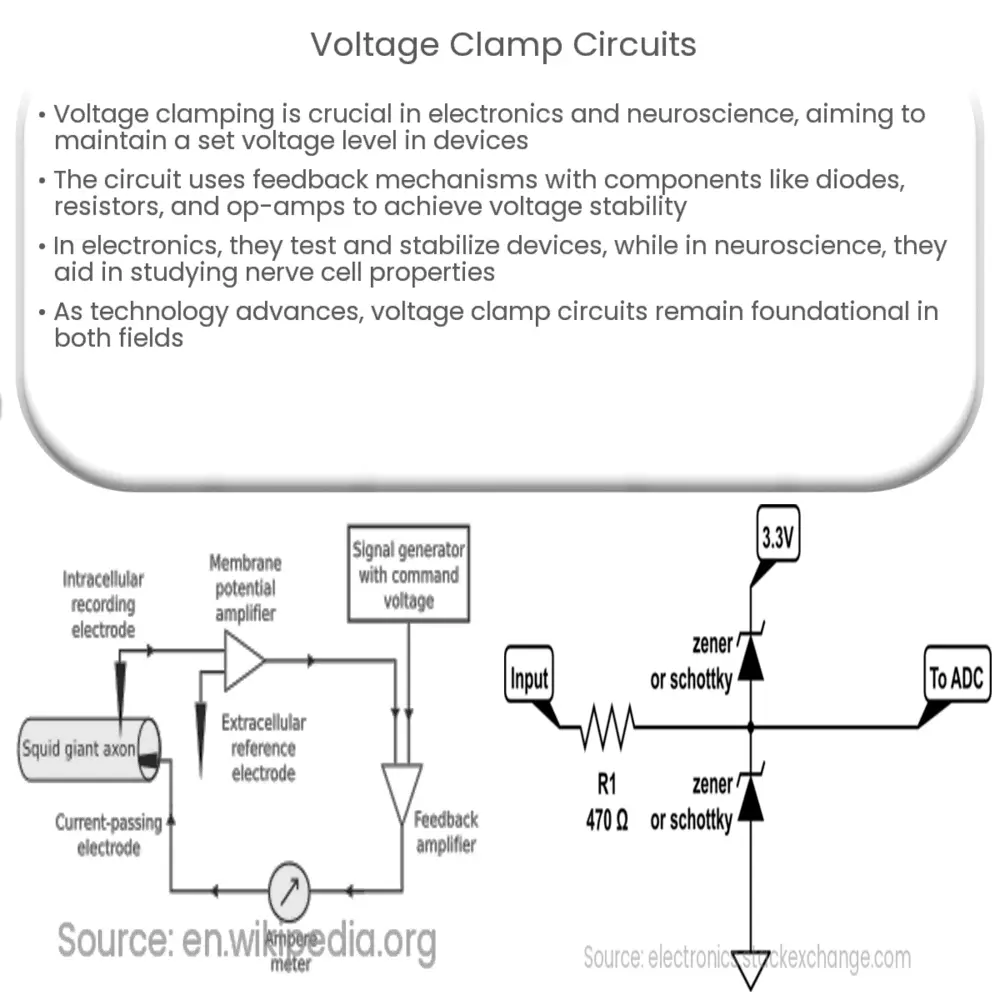
The functionality of a voltage clamp circuit depends on its composition. Generally, it involves a feedback mechanism that enables the circuit to maintain the desired voltage level. This system dynamically regulates the current through the device to offset any potential changes in the input voltage, thereby maintaining a constant voltage across it. The control of the voltage is achieved through the use of electronic components such as diodes, resistors, and operational amplifiers.
-
Diodes: Diodes are semiconducting devices that allow current to flow in only one direction. They are fundamental to voltage clamping circuits as they regulate the direction of current flow.
-
Resistors: Resistors limit the amount of current flowing through a circuit. They are used in voltage clamp circuits to control the level of current, which indirectly assists in controlling the voltage.
-
Operational Amplifiers: Also known as ‘op-amps,’ these devices amplify the input voltage difference. In a voltage clamp circuit, they provide the necessary gain to maintain the desired voltage level across the device.
Voltage Clamp Applications
Voltage clamp circuits have broad applications, from small-scale electronics to biological research. They are essential in testing and characterizing electronic devices and integrated circuits. They also play a pivotal role in neuroscience, where voltage clamping is employed to study the electrochemical properties of nerve cells. The detailed role of voltage clamping in these contexts will be explored in the next part of this article.
Applications in Electronic Devices
Voltage clamp circuits are widely used in testing electronic devices such as diodes and transistors. By clamping the voltage at a certain level, the characteristic curves of these devices can be studied under controlled conditions. Similarly, in integrated circuits, voltage clamping is essential for stabilizing the supply voltage, ensuring the circuit’s correct functioning regardless of variations in input voltage.
Role in Neuroscience
In the field of neuroscience, voltage clamp techniques play a crucial role in studying the electrochemical properties of nerve cells, or neurons. The membrane potential (voltage across the cell membrane) of a neuron is a critical factor in nerve signal transmission. By using a voltage clamp to control the membrane potential, scientists can study the response of ion channels (proteins that allow ions to pass through the neuron’s membrane) under different conditions. This has greatly facilitated our understanding of the nervous system and related disorders.
Modern Developments
With the advent of modern technology, voltage clamp circuits have evolved to accommodate more complex applications. One such example is the ‘patch clamp,’ a refined technique that allows the study of individual or few ion channels in cells. This technique has been instrumental in the field of electrophysiology, earning its inventors the Nobel Prize in Physiology or Medicine in 1991.
Conclusion
In conclusion, voltage clamp circuits serve as a cornerstone in both electronics and neuroscience. Their ability to control voltage allows for precise experimentation and stability in electronic devices and integrated circuits. At the same time, their role in biological research has deepened our understanding of nerve signal transmission, leading to significant advancements in neuroscience. As technology continues to evolve, it is certain that voltage clamp circuits will continue to play a vital role in these fields, showcasing the beauty and utility of this simple, yet powerful electronic method.