
Explore the intriguing world of varactor diodes, their working principle, unique applications, advantages, and limitations in our detailed guide.
Introduction to Varactor Diodes
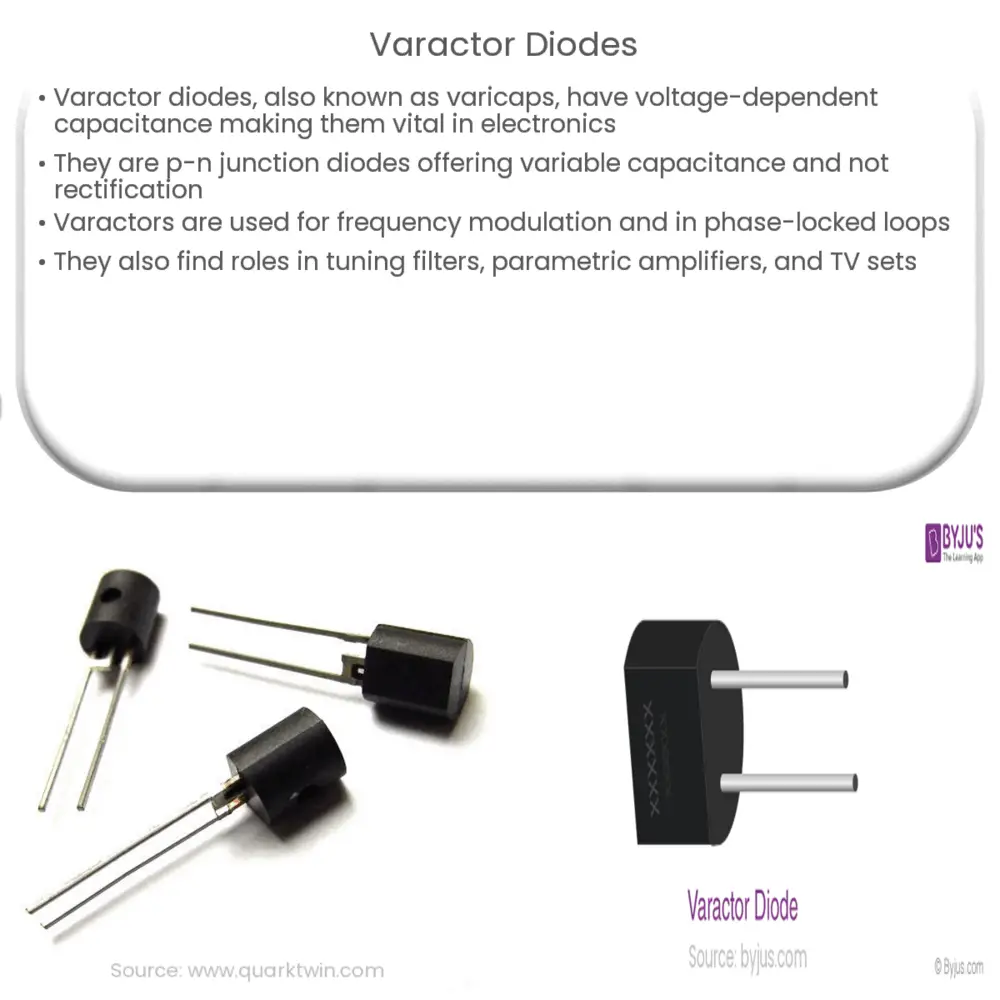
Varactor diodes, also known as varicaps or tuning diodes, hold a unique position in the electronics industry. Their distinct characteristic of voltage-dependent capacitance makes them a critical component in various applications.
What is a Varactor Diode?
The term ‘varactor’ is a blend of variable and reactor, implying its ability to react based on variable inputs. Specifically, a varactor diode is a p-n junction diode that changes its capacitance value based on the applied reverse bias voltage. Unlike traditional diodes, they are not used for their rectifying properties, but for the variable capacitance they offer.
Working Principle of Varactor Diodes
Varactor diodes operate on the principle of a variable depletion region. When a reverse bias is applied to a varactor, the width of the depletion region or the space between the p-type and n-type semiconductors in the diode, varies.
The capacitance of a varactor is inversely proportional to the width of this depletion region. Hence, when the reverse bias voltage increases, the depletion region widens, resulting in decreased capacitance and vice versa.
Symbol and Construction
Just like any other diode, a varactor diode consists of two layers of semiconductors. However, the symbol of a varactor diode differentiates it from other types of diodes. It’s represented by the diode symbol with an added capacitor in parallel. This capacitor symbol signifies its key feature: variable capacitance.
Applications of Varactor Diodes
Varactor diodes find a wide array of applications in electronics and communication systems due to their unique capabilities.
- Frequency Modulation: Varactor diodes are commonly used in frequency modulation for radio signals. By varying the reverse bias voltage, the frequency of the radio signal can be easily adjusted.
- Phase Locked Loops (PLL): They are often employed in phase-locked loops to control the frequency of oscillators.
In the upcoming section, we will explore the benefits and drawbacks of varactor diodes and delve deeper into their applications.
Additional Applications of Varactor Diodes
Along with their fundamental uses in frequency modulation and phase-locked loops, varactor diodes are employed in a wider range of applications.
- Tuning Filters: They are an integral component in tuning filters. By adjusting the reverse bias voltage, you can manipulate the resonant frequency of the filter.
- Parametric Amplifiers: In parametric amplifiers, varactor diodes are utilized for their variable reactance property.
- Television Sets: They play an important role in electronic tuning systems in modern television sets.
Advantages and Disadvantages of Varactor Diodes
Like all electronic components, varactor diodes come with their own set of benefits and limitations.
- Advantages: The primary advantage of a varactor diode lies in its ability to provide variable capacitance. This characteristic makes it extremely useful in frequency tuning circuits. Moreover, due to their small size, they are ideal for use in high-frequency applications.
- Disadvantages: Despite their advantages, varactor diodes have some limitations. The main drawback is their non-linear capacitance-voltage relationship, which can lead to distortion in some applications. Furthermore, their performance is significantly affected by temperature changes.
Conclusion
In conclusion, varactor diodes serve as an essential component in numerous electronic applications due to their unique variable capacitance feature. From FM radios to advanced communication systems, these diodes play a pivotal role in frequency modulation and tuning. However, like any other electronic device, they come with their share of pros and cons. As technology continues to advance, we can anticipate further enhancements in varactor diodes that could potentially minimize their limitations and augment their advantages, thereby broadening their application spectrum in the electronics industry.



