
Explore the fascinating world of Ultrasonic Touchscreen Technology, its working principle, applications, benefits, and future development.
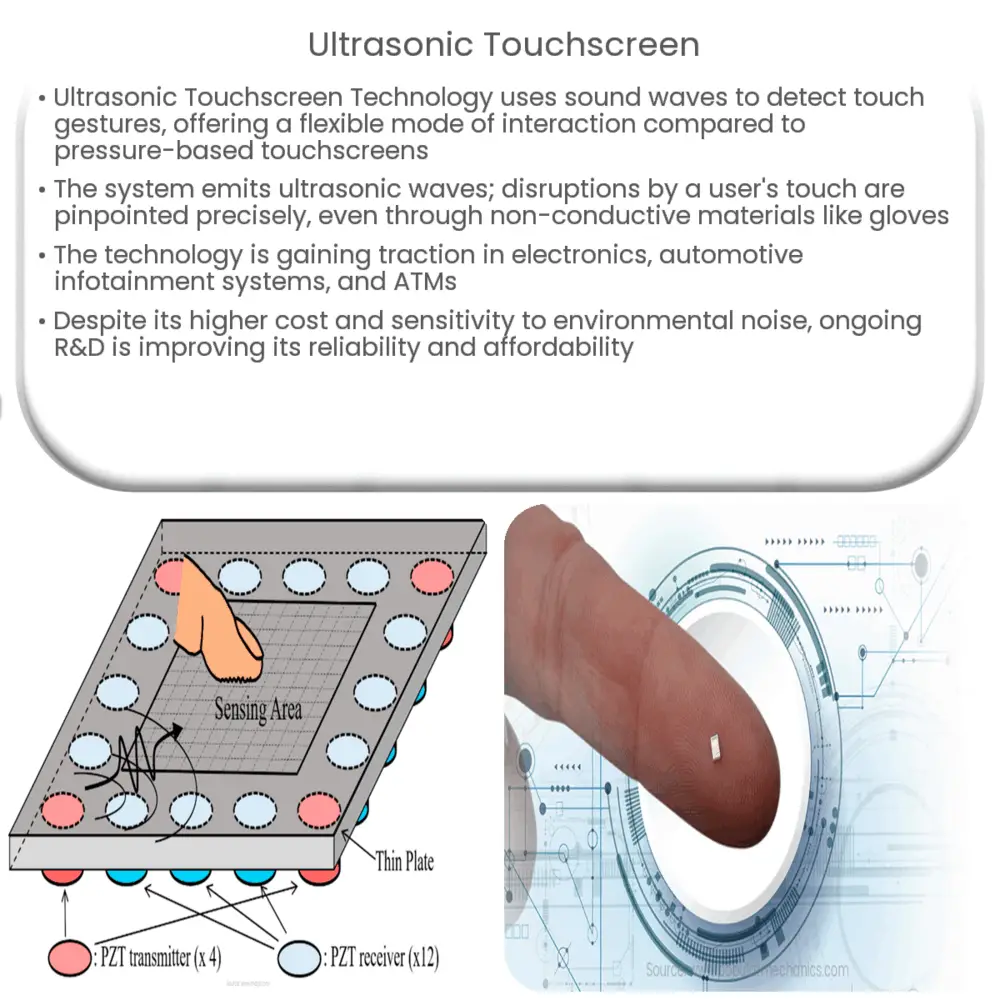
Understanding Ultrasonic Touchscreen Technology
In the realm of technological advancements, one innovation that has taken center stage is the ‘Ultrasonic Touchscreen.’ This fascinating technology is rapidly transforming the way we interact with our digital devices, offering a unique and highly responsive user experience.
What is Ultrasonic Touchscreen Technology?
Ultrasonic Touchscreen Technology is an advanced form of human-computer interaction that uses ultrasonic waves to detect and interpret touch gestures. Unlike conventional touchscreens that rely on pressure or electrical conductivity, ultrasonic touchscreens leverage the science of sound waves to register touch inputs, offering a more flexible and versatile mode of interaction.
How Does It Work?
At the heart of Ultrasonic Touchscreen Technology is a system that emits ultrasonic sound waves across the screen’s surface. When a user’s finger or stylus disrupts these waves, the system registers the interaction. This technology is capable of precisely pinpointing the exact location of the touch, allowing for high-resolution touch detection. Additionally, since it uses sound waves, ultrasonic touchscreens can effectively work even with gloves or other non-conductive materials—something that’s not possible with traditional capacitive touchscreens.
The Underlying Science
The science behind Ultrasonic Touchscreen Technology is rooted in the properties of sound waves. The emitted ultrasonic waves move in a specific pattern across the screen. When an object, such as a finger, interrupts this pattern, the waves are disrupted.
- Wave Emission: Ultrasonic transducers located on the edges of the screen emit high-frequency sound waves.
- Wave Disruption: When an object touches the screen, it interrupts the sound waves.
- Detection: The transducers detect this disruption and send a signal to the processing unit.
This process allows for the identification of the exact touch location, providing a highly accurate response. Furthermore, the use of sound waves means that the screen does not require a specific level of pressure or a conductive input, unlike traditional touchscreen technologies.
Applications of Ultrasonic Touchscreen Technology
Ultrasonic touchscreen technology is finding broad applications in numerous sectors. In consumer electronics, it’s used in smartphones, tablets, and other digital devices to enhance user interaction. The automotive industry is using it in car infotainment systems to provide more accurate touch controls. Additionally, it’s making its way into public information kiosks, ATMs, and gaming consoles, where high precision and robustness are essential.
Benefits of Ultrasonic Touchscreen Technology
Ultrasonic Touchscreen Technology comes with several significant advantages. One of the most notable is its high level of precision and sensitivity, which translates to superior touch resolution compared to standard touchscreens. This technology also works through a wide range of materials, allowing for more diverse application possibilities.
- High Accuracy: The ultrasonic waves can detect touch with extreme precision, making the technology suitable for applications that require high-resolution input.
- Material Independence: The technology can work with a wide array of materials, including gloves, styluses, or even a regular pen, making it versatile and flexible.
- Durability: Since there’s no need for a direct physical contact that might wear down the screen surface over time, ultrasonic touchscreens can be more durable than their traditional counterparts.
Challenges and Future Development
Despite its many benefits, Ultrasonic Touchscreen Technology also faces some challenges. It can be sensitive to environmental noise, which may cause interference with the ultrasonic waves. Additionally, the technology is currently more expensive to produce than traditional touchscreen technology, limiting its widespread adoption.
However, ongoing research and development promise to overcome these challenges. For instance, sophisticated algorithms are being developed to filter out background noise, improving the technology’s reliability and performance. As production processes become more efficient, the cost is expected to drop, making ultrasonic touchscreens more accessible.
Conclusion
In conclusion, Ultrasonic Touchscreen Technology is a groundbreaking innovation that’s poised to redefine our interaction with digital devices. It offers a versatile and highly precise touch interface that transcends the limitations of traditional touchscreen technology. While there are challenges to its widespread adoption, the potential of this technology is immense. As we continue to advance and refine this technology, we can expect to see ultrasonic touchscreens becoming an integral part of our digital lives, offering an unparalleled user experience.



