
Explore the world of Tunnel Diodes: their construction, operation, applications, advantages, and drawbacks in high-frequency electronics.
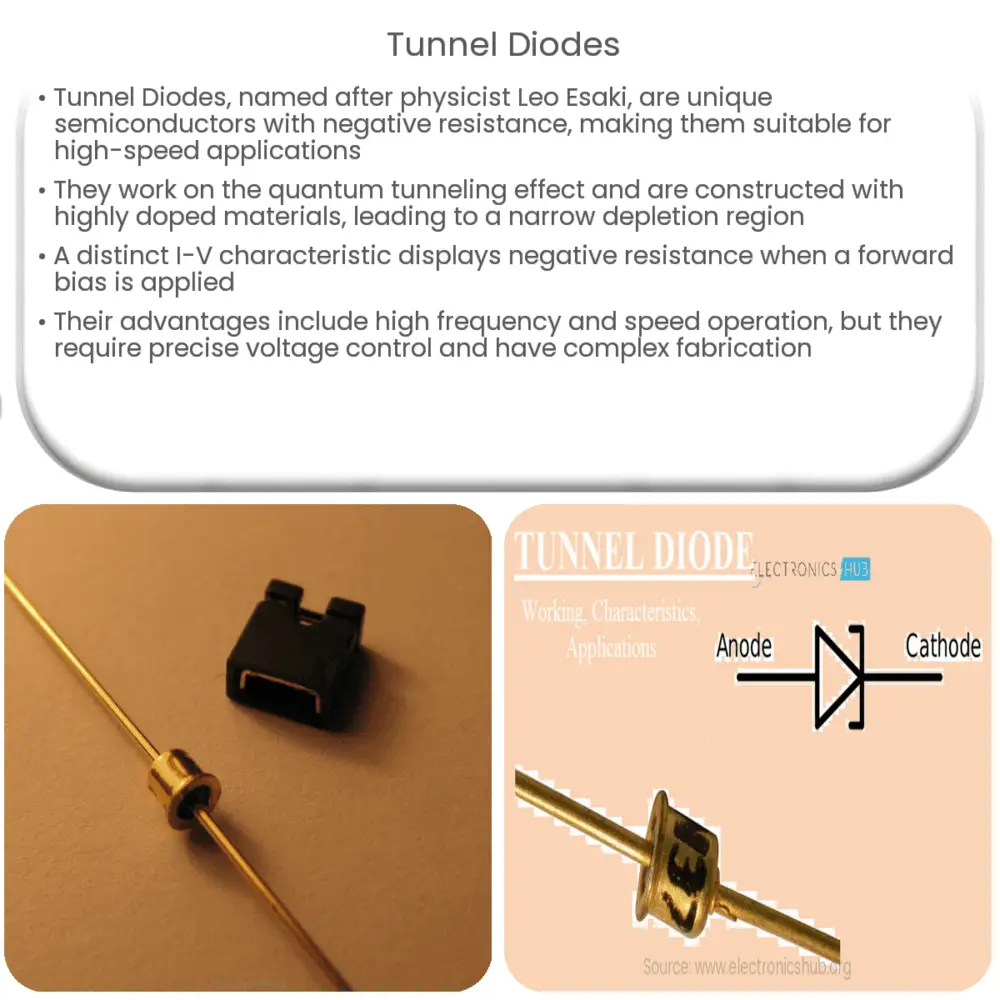
Introduction to Tunnel Diodes
Tunnel Diodes, also known as Esaki Diodes, named after the Japanese physicist Leo Esaki, are a type of semiconductor diode with negative resistance. This distinct attribute makes them unique and particularly beneficial in certain applications, including those demanding high speed and miniature dimensions.
Primarily, a Tunnel Diode capitalizes on the quantum mechanical effect, known as tunneling, hence the name. It is substantially different from a conventional diode in terms of its construction and functionality.
Construction of Tunnel Diodes
Tunnel Diodes are constructed with highly doped semiconductor materials. These materials typically constitute an N-type semiconductor and a P-type semiconductor. Doping levels are maintained at an exceptionally high degree to establish a narrow depletion region.
- N-type Semiconductor: This is a type of semiconductor that has been doped with impurity atoms that provide excess free electrons, the majority carriers.
- P-type Semiconductor: Conversely, a P-type semiconductor is doped with impurities providing additional holes, which are the majority carriers here.
The extremely high doping level ensures the narrowing of the depletion layer, facilitating the unique tunneling effect.
Working Principle of Tunnel Diodes
Understanding the working of a Tunnel Diode requires a grasp of its I-V characteristics. This characteristic curve is peculiar in that it displays a region of negative resistance.
Upon applying a small forward bias voltage to the Tunnel Diode, the conduction band electrons from the N-type semiconductor gain sufficient energy to cross the very thin depletion layer and tunnel into the valence band of the P-type semiconductor. This phenomenon is referred to as tunneling, and it leads to an abrupt increase in the diode current.
However, as the forward bias voltage continues to increase, the number of electrons able to tunnel through depletes, causing a decrease in the diode current and resulting in the phenomenon of negative resistance.
Applications of Tunnel Diodes
Tunnel Diodes are extensively used in several areas owing to their high-speed operation and the ability to function at microwave frequencies. A few key applications include:
- Oscillators: Due to their negative resistance region, Tunnel Diodes can generate oscillations. They are frequently used in local oscillators for FM radios, pre-amplifiers, and very fast switching circuits.
- High-Speed Switching and Clamping: Tunnel Diodes have the capability to switch in less than a nanosecond, making them ideal for high-speed computing systems.
To understand further applications and details about Tunnel Diodes, keep reading in the following section.
More Applications of Tunnel Diodes
- Logic Memory Storage: Tunnel diodes can also be used in logic memory storage circuits due to their high speed and fast response time.
- Microwave Amplifier: Tunnel diodes are found in various microwave amplification applications. The high frequency capabilities make them apt for microwave amplifier circuits.
- Frequency Multipliers: They are used in frequency multiplier circuits. The circuit operates in the negative resistance region of the diode, providing an output frequency that is a multiple of the input frequency.
Advantages and Disadvantages of Tunnel Diodes
Like all electronic components, tunnel diodes have their strengths and weaknesses.
Advantages
- They can operate at extremely high frequencies, reaching into the microwave range.
- High speed operation, with switching times of less than a nanosecond.
- Low power operation, due to their low voltage requirements.
Disadvantages
- Operating in the negative resistance region requires precise control over the voltage, which can be challenging.
- The fabrication of tunnel diodes is complex due to the high doping requirements.
- Due to their low output voltage, they are not suitable for high voltage applications.
Conclusion
Tunnel Diodes, with their unique principle of operation, distinct I-V characteristics, and impressive performance at high frequencies, have carved out their own niche in the field of electronics. While they come with their own set of challenges such as precise control of voltage and complex manufacturing processes, their high-speed operation and microwave frequency capabilities make them invaluable in specific applications, particularly in oscillators, high-speed computing systems, and microwave amplifier circuits.
Continued research and innovation in this area may yield newer, more efficient ways to use these diodes and possibly mitigate some of their limitations. As our need for high-speed, high-frequency devices grows, so too will the importance of understanding and utilizing components like the Tunnel Diode.