
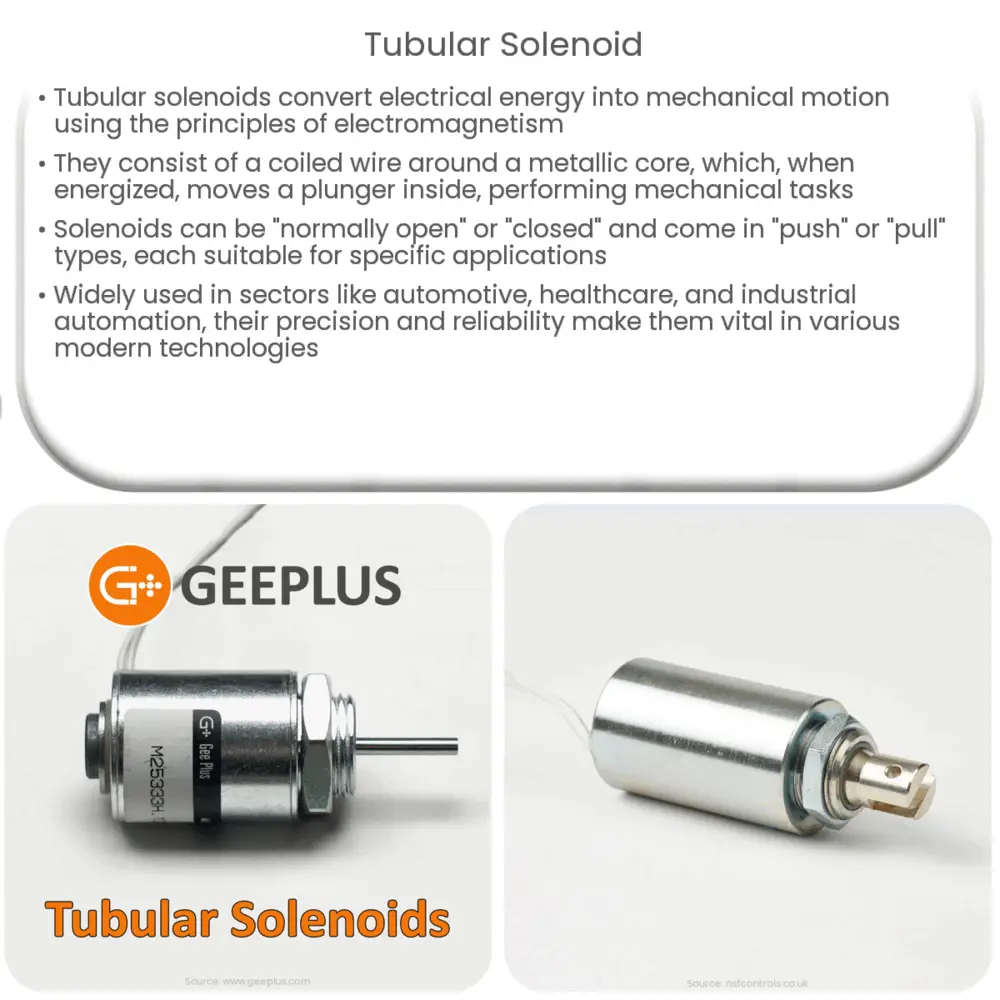
A tubular solenoid is an electro-mechanical device converting electrical energy into mechanical motion, widely used across various industries.
Introduction to Tubular Solenoids
Tubular solenoids are a type of electro-mechanical device that convert electrical energy into mechanical motion. They are integral components in many electrical systems, used extensively in various industries such as automotive, healthcare, telecommunications, and automation. The fundamental principle behind their operation is the magnetic field created by an electric current.
A tubular solenoid consists of a coil of wire, often wound around a metallic core, which is usually in the shape of a tube – hence the name ‘tubular’. When an electrical current is passed through the coil, a magnetic field is generated within the core. This magnetic field then acts upon a movable plunger within the tube, causing it to move.
Working Principle of Tubular Solenoids
The operation of a tubular solenoid relies on the principles of electromagnetism. When an electric current is passed through a wire, it produces a magnetic field around the wire. By coiling the wire, the magnetic field inside the coil is intensified.
In a tubular solenoid, the coil of wire is typically wound around a ferromagnetic core. This enhances the magnetic field generated when current is applied. Inside this coil-core assembly is a movable plunger, usually made of a magnetic material.
Upon energizing the coil, the magnetic field generated pulls or pushes the plunger, depending on the design. This linear motion of the plunger can be harnessed to perform various mechanical tasks such as pushing, pulling, or holding an object. This mechanism is utilized in many applications, ranging from simple doorbells to complex industrial machinery.
The strength of the magnetic field, and thus the force exerted on the plunger, is proportional to the amount of current flowing through the coil. This allows for precise control of the solenoid’s movement, making it ideal for applications that require high precision and reliability.
The solenoid can be designed to be either ‘normally open’ or ‘normally closed’. In a normally open solenoid, the plunger is retracted when the coil is energized, allowing fluid or air to pass through the solenoid. Conversely, in a normally closed solenoid, the plunger is extended when the coil is energized, blocking the passage. The choice between these two types depends on the specific application requirements.
Types of Tubular Solenoids
Tubular solenoids come in two main types: push and pull. A push solenoid operates by pushing the plunger out of the coil when energized, while a pull solenoid works by pulling the plunger into the coil when power is applied.
Pull solenoids are generally more common, as they tend to have a longer stroke length (the distance the plunger can move) compared to push solenoids. They are often found in applications like door locks, where the solenoid needs to pull a latch into place.
Push solenoids, on the other hand, are typically used in applications where a component needs to be moved away from the solenoid. For example, in a pinball machine, a push solenoid might be used to propel the ball into play.
Applications of Tubular Solenoids
Tubular solenoids are widely used across a variety of sectors due to their reliability, durability, and versatility. In the automotive industry, they are used in power door locks, automatic transmissions, and starter motors. In the healthcare sector, they play a vital role in medical devices such as ventilators and patient beds.
In the realm of industrial automation, tubular solenoids are used in assembly lines, robotic systems, and sorting machines. They also find applications in home appliances like washing machines, dishwashers, and refrigerators, where they control water flow and other mechanical operations.
Moreover, tubular solenoids are a critical component in many safety systems. For instance, they are used in fire suppression systems, where they control the release of fire-extinguishing substances, and in anti-lock braking systems (ABS) in vehicles, where they modulate brake fluid pressure.
In sum, tubular solenoids are an indispensable part of many modern technologies. Their ability to convert electrical energy into precise mechanical motion makes them a valuable component in a vast array of devices and systems. They are a testament to the power and versatility of electromagnetism, demonstrating how a simple principle can have far-reaching applications.



