
Triglycine Sulfate (TGS) is a promising ferroelectric material with applications in infrared detectors, temperature measurement, acoustic sensors, and non-volatile memory devices.
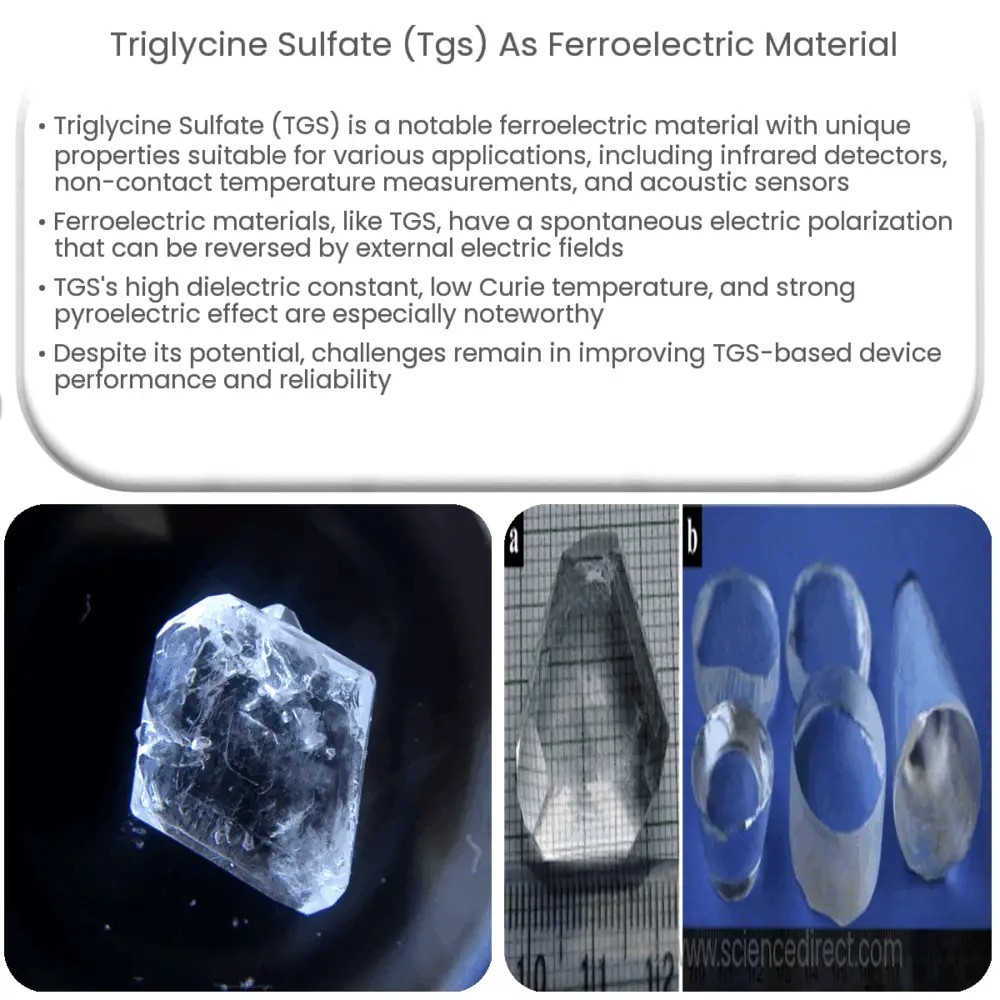
Triglycine Sulfate (TGS) as a Ferroelectric Material: Part 1
In recent years, the study of ferroelectric materials has garnered significant interest due to their unique properties and potential applications in a wide range of industries, such as sensors, actuators, and non-volatile memory devices. One such material that has attracted considerable attention is Triglycine Sulfate (TGS). In this two-part article, we will explore the properties and applications of TGS as a ferroelectric material.
Understanding Ferroelectric Materials
Ferroelectric materials are a class of dielectric materials that possess a spontaneous electric polarization, which can be reversed by the application of an external electric field. The phenomenon of ferroelectricity was first discovered in 1920, but it was not until the 1940s that the first practical applications of these materials were developed.
Typically, ferroelectric materials exhibit a temperature-dependent phase transition from a high-temperature, non-polar phase to a low-temperature, polar phase. This transition is characterized by a change in the crystal structure, resulting in the appearance of a spontaneous polarization. The temperature at which this transition occurs is called the Curie temperature.
Triglycine Sulfate (TGS) as a Ferroelectric Material
Triglycine Sulfate (TGS) is an organic compound with the chemical formula (NH2CH2COOH)3H2SO4. Discovered in the 1960s, it is one of the first organic ferroelectric materials to be studied extensively. TGS possesses several properties that make it an attractive choice as a ferroelectric material, including a high dielectric constant, a relatively low Curie temperature, and a strong pyroelectric effect.
The high dielectric constant of TGS, which can be as high as 200 at room temperature, makes it a suitable candidate for applications that require a high level of sensitivity, such as infrared detectors and capacitive sensors. The low Curie temperature of TGS (around 49°C) is advantageous for applications that require a stable performance over a wide temperature range, as the material can maintain its ferroelectric properties even at relatively high temperatures.
One of the most significant properties of TGS is its strong pyroelectric effect, which refers to the generation of an electric charge in response to a change in temperature. This effect is particularly pronounced in TGS, making it a popular choice for the fabrication of pyroelectric detectors, which are widely used in thermal imaging and non-contact temperature measurement applications.
Applications of TGS in Various Industries
Due to its unique combination of properties, TGS has found applications in a variety of industries. Some of the most common uses for TGS include:
- Infrared detectors: The strong pyroelectric effect of TGS makes it an ideal material for the fabrication of infrared detectors, which are used in a wide range of applications, such as thermal imaging, night vision, and remote temperature sensing.
- Non-contact temperature measurement: TGS-based pyroelectric sensors can be utilized for non-contact temperature measurement in various industries, including manufacturing, food processing, and medical diagnostics, where accurate and rapid temperature monitoring is crucial.
- Acoustic sensors: The high dielectric constant and piezoelectric properties of TGS make it suitable for use in acoustic sensors and transducers, which are employed in underwater sonar systems, ultrasonic imaging, and non-destructive testing applications.
- Non-volatile memory devices: The ability to switch the polarization of TGS with an electric field has led to its use in the development of non-volatile ferroelectric memory devices, offering advantages such as low power consumption, high-speed operation, and long data retention times.
[continued in Part 2]
Advancements and Challenges in TGS-Based Devices
While TGS has shown promise in various applications, continued research and development efforts are required to improve the performance and reliability of TGS-based devices. Some of the recent advancements in this area include:
- Improved growth techniques: Advanced techniques for growing high-quality TGS crystals, such as the Bridgman and Czochralski methods, have led to improved material properties and enhanced device performance.
- Nanostructured TGS: The development of nanostructured TGS materials, including thin films and nanoparticles, has opened up new possibilities for miniaturization and integration of TGS-based devices with existing semiconductor technologies.
- Composite materials: The combination of TGS with other materials, such as polymers and ceramics, has been explored to develop composite materials with tailored properties for specific applications, such as flexible sensors and actuators.
Despite these advancements, several challenges remain to be addressed in the development of TGS-based devices, such as the need for improved temperature stability, enhanced sensitivity, and better control over material properties. Addressing these challenges will require further research into the fundamental properties of TGS and the development of novel processing techniques and device architectures.
Conclusion
Triglycine Sulfate (TGS) is a versatile ferroelectric material that has been widely studied for its unique combination of properties, including a high dielectric constant, low Curie temperature, and strong pyroelectric effect. These properties have enabled the use of TGS in various applications, such as infrared detectors, non-contact temperature measurement, acoustic sensors, and non-volatile memory devices. While significant progress has been made in the development of TGS-based devices, further research and innovation are needed to overcome the remaining challenges and unlock the full potential of this fascinating material.