
A transistor shunt rectifier is an efficient component that converts AC to DC, offering improved voltage regulation and reduced output ripple in various electronic devices.
Transistor Shunt Rectifier
Introduction
The transistor shunt rectifier is an essential component in modern electronic devices, offering an efficient way to convert alternating current (AC) into direct current (DC). Rectification is a critical process for the proper functioning of many electronic devices, from power supplies and battery chargers to radio receivers and more. In this article, we will explore the basic principles of transistor shunt rectifiers, their advantages, and some common applications.
Basic Principles
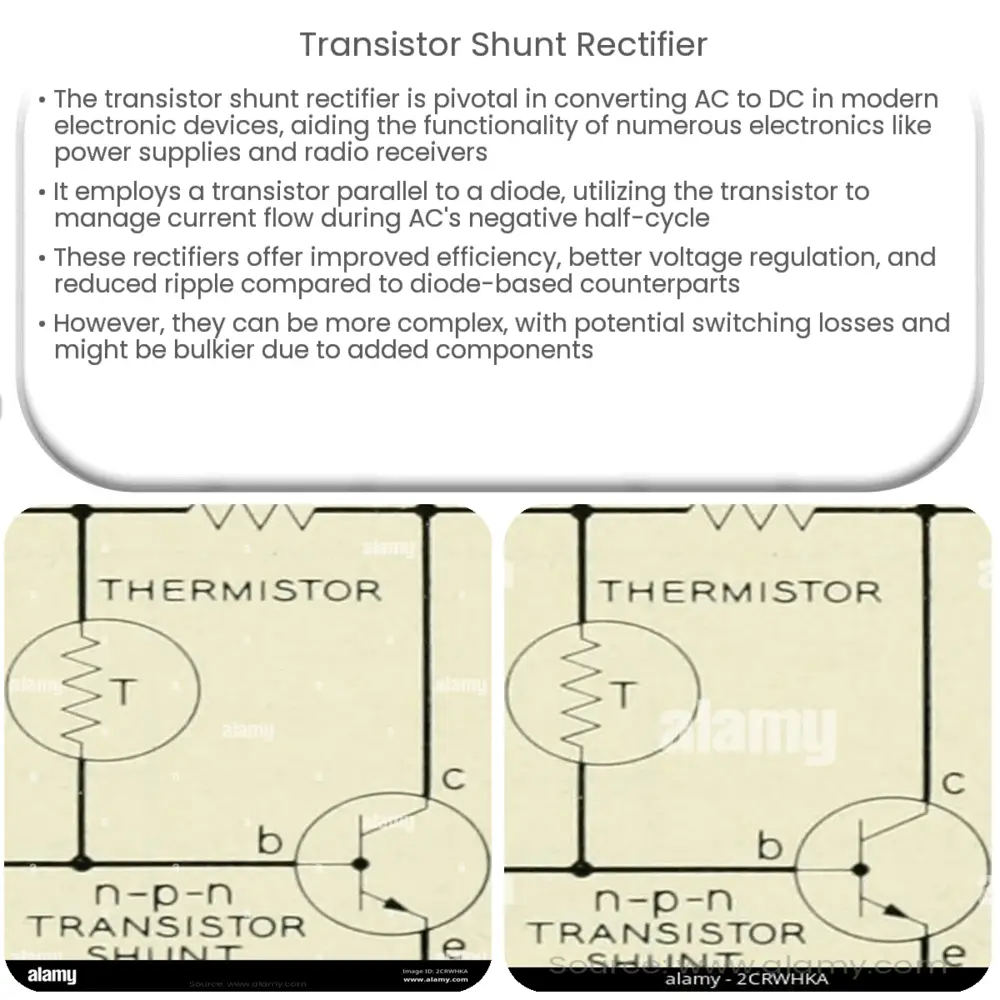
A transistor shunt rectifier is a type of rectifier that employs a transistor in parallel with a diode, forming a shunt configuration. The transistor functions as a voltage-controlled switch, while the diode helps in the rectification process. When the input AC voltage is positive, the diode conducts and allows the current to flow through the load, thereby charging the capacitor. Simultaneously, the transistor is turned off, blocking the flow of current through it. During the negative half-cycle of the input AC voltage, the diode is in reverse bias and blocks the current flow. The transistor, on the other hand, is turned on, shunting the current away from the load and preventing the capacitor from discharging.
The transistor shunt rectifier operates based on the simple principle of using a transistor to control the current flow during the negative half-cycle of the input AC voltage. This ensures that the output voltage remains constant, and only the positive half-cycle of the input AC voltage is allowed to pass through the load.
Advantages
Transistor shunt rectifiers offer several advantages over traditional diode-based rectifiers, such as:
- Improved Efficiency: Transistor shunt rectifiers have a lower voltage drop across the conducting element (transistor) than diode-based rectifiers, which results in reduced power losses and improved overall efficiency.
- Better Regulation: The transistor in the shunt rectifier configuration provides better voltage regulation than a diode-only rectifier, ensuring a stable output voltage even when the input voltage or load conditions change.
- Reduced Ripple: The use of a transistor in parallel with the diode helps to reduce the output voltage ripple, which is a common issue in diode-based rectifiers. This leads to a smoother DC output voltage, which is critical for many sensitive electronic devices.
Common Applications
Transistor shunt rectifiers are used in various electronic devices and applications, including:
- Power supplies for sensitive electronic equipment
- Battery chargers and DC-DC converters
- Voltage regulation in radio receivers and communication systems
- Signal processing and filtering circuits
Design Considerations
When designing a transistor shunt rectifier, several factors must be taken into account to ensure optimal performance and reliability. These factors include:
- Transistor Selection: The choice of the transistor is crucial for the performance of the rectifier. The transistor must have a suitable voltage rating and current handling capability for the specific application. In addition, it should have a low on-resistance to minimize power losses and a fast switching speed to reduce switching losses.
- Diode Selection: The diode used in the rectifier must also be carefully selected, considering its forward voltage drop, reverse recovery time, and current handling capability. Fast recovery diodes or Schottky diodes are often preferred due to their low voltage drop and fast switching speed.
- Capacitor Selection: The output capacitor helps to smooth the output voltage and reduce ripple. The capacitor should have a sufficient capacitance value to maintain a stable output voltage, as well as a high voltage rating to withstand voltage spikes during the rectification process.
- Thermal Management: Proper heat dissipation is essential for the reliable operation of the rectifier. Both the transistor and the diode may generate heat during operation, which must be effectively dissipated to prevent overheating and potential failure. This can be achieved through the use of heat sinks or other thermal management techniques.
Limitations and Challenges
While transistor shunt rectifiers offer several advantages over traditional diode-based rectifiers, they also have some limitations and challenges:
- Complexity: The transistor shunt rectifier requires additional components and control circuitry compared to a simple diode-based rectifier, which can increase the complexity and cost of the design.
- Switching Losses: The transistor in the shunt rectifier configuration generates switching losses during its on-off transitions. These losses can be minimized by selecting a transistor with fast switching speed and low on-resistance, but they can still impact the overall efficiency of the rectifier.
- Size and Weight: The additional components and control circuitry required for a transistor shunt rectifier may result in a larger and heavier design compared to a diode-based rectifier, which can be a disadvantage in space-constrained applications.
Conclusion
Transistor shunt rectifiers provide an efficient and reliable means of converting AC to DC in a wide range of electronic devices and applications. With their improved efficiency, better voltage regulation, and reduced ripple, they offer significant advantages over traditional diode-based rectifiers. By carefully considering the design factors and addressing the limitations and challenges, a well-designed transistor shunt rectifier can greatly enhance the performance and reliability of electronic devices and systems.



