
A transistor series rectifier is an electronic circuit that converts AC to DC using a transistor as a switch for efficient voltage regulation.
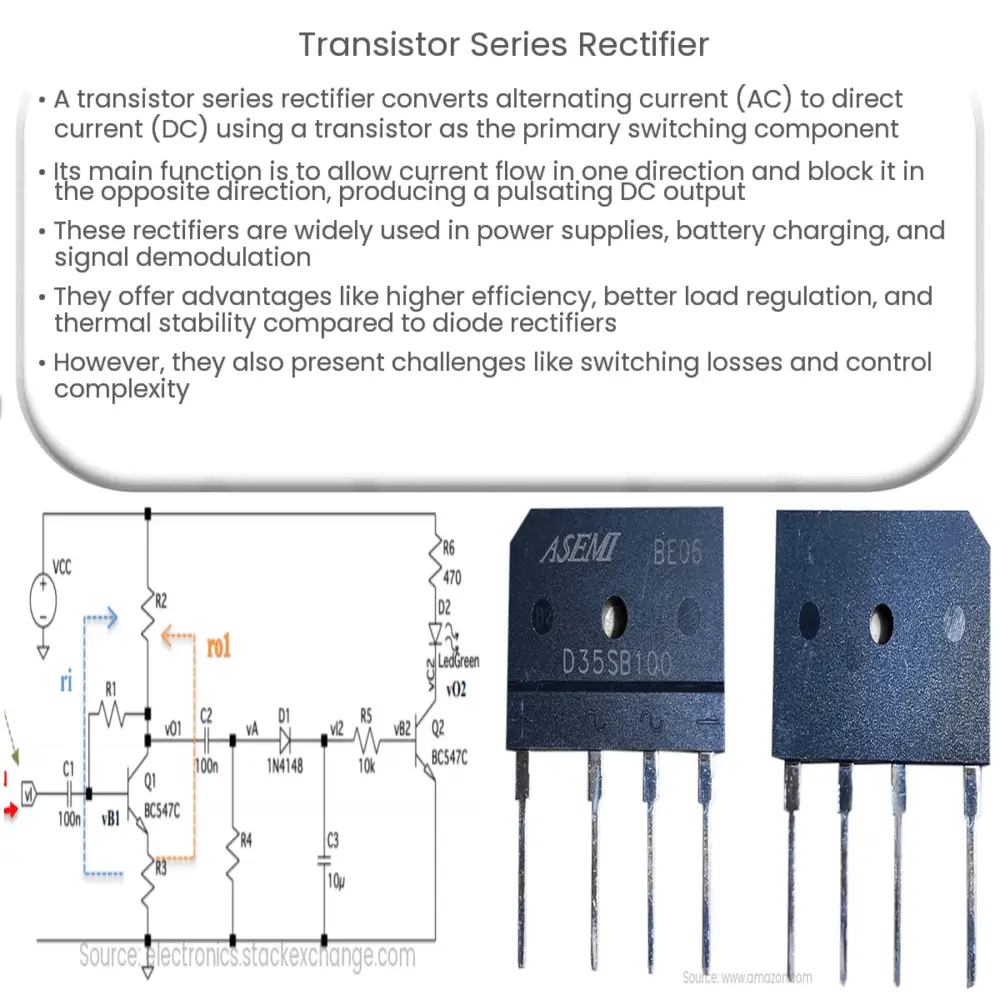
Transistor Series Rectifier: An Introduction
A transistor series rectifier is a type of electronic circuit that converts alternating current (AC) to direct current (DC). The transistor is the primary component in this circuit, and it functions as a switch that controls the flow of current. This article will provide an overview of the transistor series rectifier, including its working principle, applications, and advantages.
Working Principle
The primary function of a transistor series rectifier is to allow current flow in one direction, while blocking it in the opposite direction. This is achieved using a transistor, which is a semiconductor device that can amplify or switch electronic signals and electrical power. In a transistor series rectifier, the transistor is connected in series with the load, and it is switched on and off according to the input AC signal.
During the positive half-cycle of the input AC signal, the transistor is turned on, allowing current to flow through the load. Conversely, during the negative half-cycle, the transistor is turned off, preventing current flow through the load. This process results in a pulsating DC output voltage, which can be smoothed using a filter circuit, such as a capacitor or an inductor, to obtain a steady DC voltage.
Applications
Transistor series rectifiers have a wide range of applications, including:
- Power Supplies: They are commonly used in power supplies to convert AC voltage from the mains to DC voltage required by electronic devices and circuits.
- Battery Charging: In battery charging circuits, transistor series rectifiers help convert AC voltage to the appropriate DC voltage needed to charge batteries.
- Signal Demodulation: In communication systems, transistor series rectifiers can be used to demodulate amplitude-modulated signals, separating the information content from the carrier signal.
Advantages
Transistor series rectifiers offer several advantages over other rectification methods, such as diode rectifiers. Some of these benefits include:
- Efficiency: Transistor series rectifiers can provide higher efficiency, as they have lower voltage drops across the transistor compared to diode rectifiers.
- Load Regulation: Due to the active nature of the transistor, the rectifier is capable of maintaining better load regulation, which results in a more stable output voltage.
- Thermal Stability: Transistors are more thermally stable than diodes, which can help improve the overall performance and reliability of the rectifier circuit.
In conclusion, transistor series rectifiers are an essential component in many electronic applications, providing efficient conversion of AC to DC voltage. Their unique properties make them well-suited for use in power supplies, battery charging, and signal demodulation, among other applications.
Types of Transistor Series Rectifiers
There are two primary types of transistor series rectifiers, based on the transistor technology used:
- Bipolar Junction Transistor (BJT) Rectifiers: BJTs are made up of three layers of semiconductor material, and their operation is based on the movement of both electrons and holes. BJT rectifiers are commonly used in low to medium power applications, such as small power supplies and battery chargers.
- Field-Effect Transistor (FET) Rectifiers: FETs are voltage-controlled devices, and their operation is based on the movement of either electrons or holes. FET rectifiers are suitable for medium to high power applications, such as larger power supplies, inverters, and motor drives. They offer lower conduction losses and higher efficiency compared to BJT rectifiers.
Design Considerations
When designing a transistor series rectifier, several factors need to be taken into account, including:
- Input Voltage Range: The rectifier must be designed to handle the expected range of input AC voltages.
- Output Voltage and Current Requirements: The circuit must be capable of providing the desired DC output voltage and current to meet the requirements of the load.
- Thermal Management: Proper heat dissipation is crucial to ensure the reliability and longevity of the rectifier. This may involve the use of heatsinks or other thermal management techniques.
- Filtering: As mentioned earlier, the output of a transistor series rectifier is a pulsating DC voltage. The use of appropriate filtering techniques, such as capacitors or inductors, is necessary to obtain a smooth and steady DC voltage.
- Protection: Designers should consider adding protection features, such as overvoltage, overcurrent, and short-circuit protection, to enhance the safety and reliability of the rectifier.
Challenges and Limitations
While transistor series rectifiers offer many advantages, they also have some challenges and limitations:
- Switching Losses: Transistor rectifiers experience switching losses due to the continuous turning on and off of the transistor. These losses can lead to reduced efficiency, especially at higher frequencies.
- Control Complexity: Compared to passive diode rectifiers, transistor rectifiers require more complex control circuits to properly switch the transistor on and off, which can increase the overall circuit complexity and cost.
- Sensitivity to Temperature: Although transistors are more thermally stable than diodes, they can still be sensitive to temperature variations, which may affect their performance.
In summary, transistor series rectifiers are a versatile and efficient solution for converting AC to DC voltage in various applications. Designers must carefully consider the specific requirements and constraints of their application, including input voltage range, output voltage and current requirements, thermal management, filtering, and protection features. By addressing these factors, a reliable and efficient transistor series rectifier can be developed to meet the needs of various electronic systems.



