
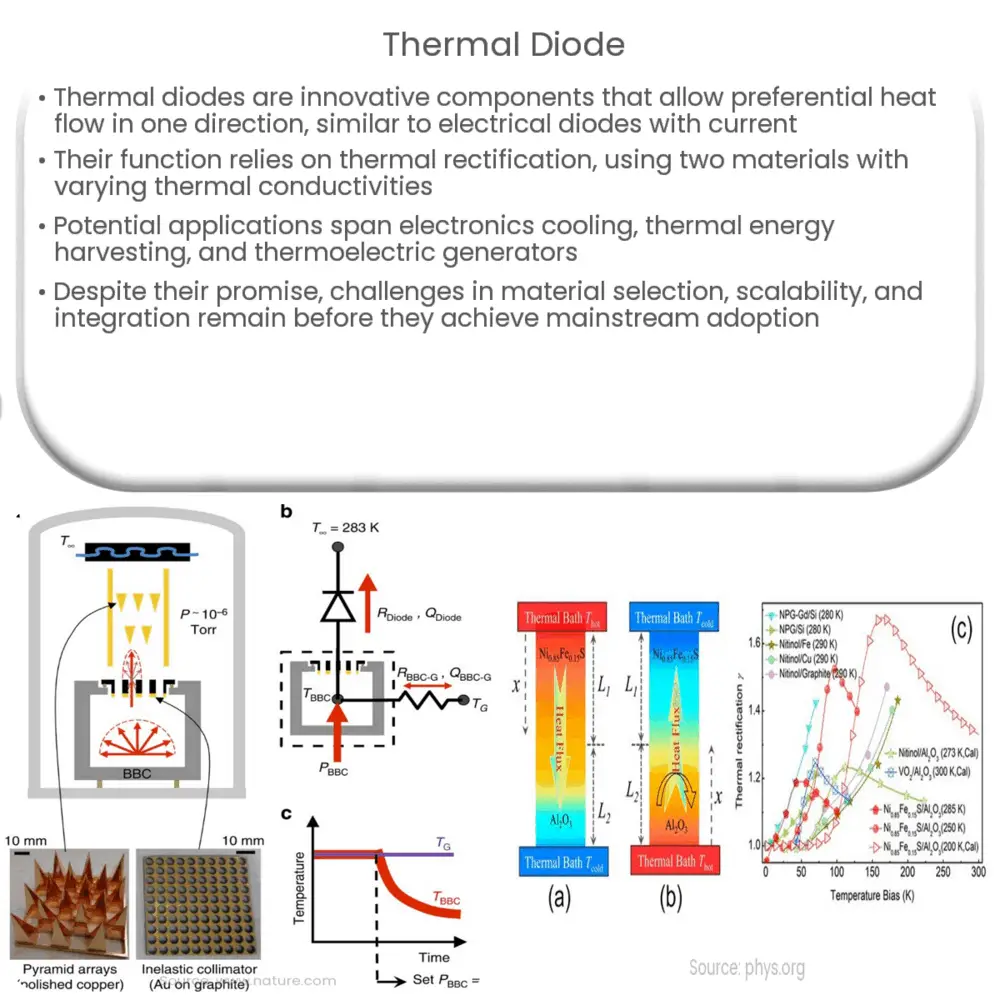
A thermal diode is a device that directs heat flow in one direction, improving heat management in electronics, energy harvesting, and thermoelectric applications.
Thermal Diode: The Future of Heat Management
Introduction
In today’s world, technological advancements in electronic devices have led to a rapid increase in the demand for efficient thermal management solutions. The thermal diode is an innovative component that holds great potential for revolutionizing heat management in various applications. This article delves into the fundamentals of thermal diodes, their working principles, and the potential applications that can benefit from this cutting-edge technology.
What is a Thermal Diode?
A thermal diode, also known as a thermal rectifier, is a device that allows heat to flow preferentially in one direction while suppressing it in the opposite direction. It operates in a manner analogous to an electrical diode, which permits current flow in one direction but blocks it in the reverse direction. The thermal diode’s ability to control heat flow directionally makes it an ideal candidate for various heat management applications, particularly in the field of electronics and energy harvesting.
Working Principle of a Thermal Diode
The thermal diode’s functionality is based on the concept of thermal rectification, which involves the asymmetric transport of heat. The diode comprises two materials with distinct thermal conductivities connected at a junction. When a temperature gradient is applied across the junction, one of the materials allows heat to flow through it more easily than the other, resulting in a preferential heat flow in a specific direction.
Different mechanisms can be employed to achieve thermal rectification in a diode, such as the utilization of phase change materials, shape-memory alloys, or materials with temperature-dependent thermal conductivities. The choice of materials and mechanisms is crucial in determining the performance and efficiency of a thermal diode.
Potential Applications of Thermal Diodes
Thermal diodes have a wide range of potential applications across various industries. Some of these applications include:
- Electronics Cooling: As electronic devices continue to shrink in size and increase in power, effective heat management becomes a critical factor for performance and reliability. Thermal diodes can be integrated into electronic devices to provide directional heat flow control, improving cooling efficiency and preventing damage due to overheating.
- Thermal Energy Harvesting: In situations where waste heat is generated, thermal diodes can be used to harvest and convert this heat into usable energy. By optimizing the direction of heat flow, these devices can help improve energy efficiency and reduce overall energy consumption.
- Thermoelectric Generators: Thermal diodes can be utilized in thermoelectric generators to enhance the efficiency of converting thermal energy into electrical energy. This improvement can be particularly beneficial in remote or off-grid applications, such as space exploration or remote sensing.
Advancements in Thermal Diode Technology
Research in the field of thermal diodes has been progressing rapidly, with scientists and engineers working on improving their efficiency and effectiveness. Recent advancements include the development of nanoscale thermal diodes, which leverage nanomaterials and nanostructures to enhance thermal rectification. These advancements have the potential to further miniaturize thermal diodes, making them suitable for integration into compact electronic devices and systems.
Challenges and Limitations
Despite their promising potential, thermal diodes still face several challenges that need to be addressed before they become a mainstream technology. Some of the primary challenges include:
- Material Selection: The choice of materials for a thermal diode is critical for its performance. Identifying the ideal combination of materials with the desired thermal properties and compatibility is a complex task that requires further research and development.
- Scalability: While laboratory-scale demonstrations of thermal diodes have shown promising results, scaling the technology for mass production and commercial applications remains a challenge. Manufacturing processes must be developed to ensure the consistent production of high-quality thermal diodes at an affordable cost.
- Integration: Integrating thermal diodes into existing systems and electronic devices requires careful consideration of design constraints and compatibility with other components. This may necessitate the development of new design methodologies and tools to facilitate the seamless integration of thermal diodes.
Conclusion
Thermal diodes have the potential to revolutionize heat management in various applications, from electronic cooling to energy harvesting. As research and development in this field continue to advance, it is expected that thermal diodes will overcome the current challenges and become an integral part of many emerging technologies. With further advancements, the integration of thermal diodes into electronic devices, systems, and energy-harvesting applications could significantly enhance performance, reliability, and efficiency, paving the way for a more sustainable future.