
Explore the fundamentals, types, and applications of termination loads in electronics and communications in our comprehensive guide.
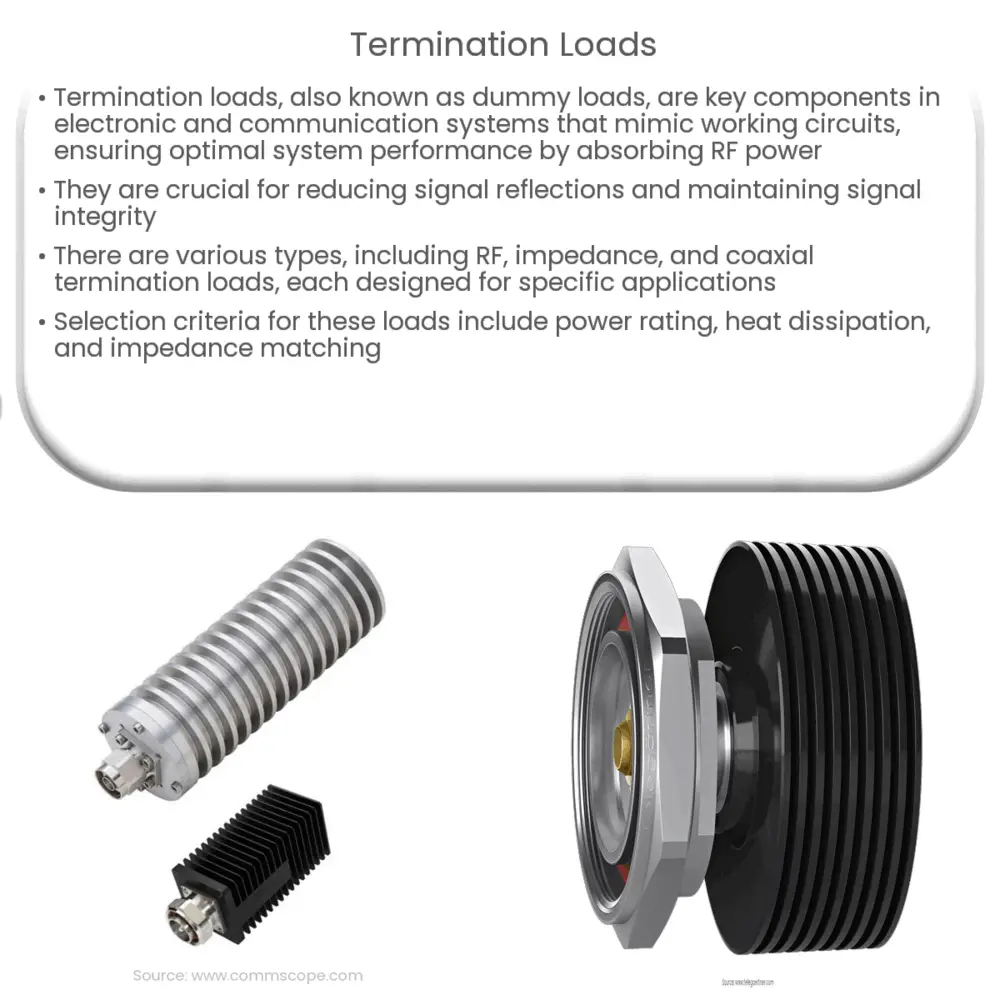
Understanding Termination Loads
Termination loads, often known as dummy loads, are fundamental components used in a broad range of electronic and communication systems. Their primary function is to mimic a working circuit to ensure proper system performance. These devices are essentially resistive components that absorb radio frequency (RF) power without reflecting it back into the system.
The Role of Termination Loads in Electronics
In an ideal scenario, all the power generated by a source should be consumed by the load. However, in practical situations, some power often remains unabsorbed due to load mismatch, leading to signal reflection. This is where termination loads come into play. They consume the unused power, thereby minimizing reflection and ensuring better signal integrity.
Types of Termination Loads
Applications of Termination Loads
Termination loads find wide-ranging applications across various industries. In the telecommunications sector, they are used to improve signal integrity in transmission lines. They are essential components of RF circuits and antennas, ensuring optimum performance by reducing signal reflection.
The Importance of Power Rating and Heat Dissipation
The power rating is a key parameter to consider when choosing a termination load. It signifies the maximum amount of power the termination load can handle before it overheats and potentially fails. Heat dissipation is another crucial factor as termination loads tend to generate heat while absorbing power. Therefore, they often incorporate heat sinking or cooling fins to dissipate the heat effectively and ensure consistent performance.
Termination Loads in Test and Measurement
In the domain of test and measurement, termination loads are invaluable tools. They are extensively used during the testing phase of electronic devices and communication systems. By replicating the operation of a working circuit, they allow engineers to conduct various tests in a controlled and safe environment. These might include power measurements, signal propagation investigations, or integrity checks of transmission lines, among other applications.
Termination Loads in Broadcasting and Telecommunication
In the field of broadcasting and telecommunications, termination loads are instrumental in maintaining the integrity of transmitted signals. For example, in the operation of a broadcasting station, transmission lines need to be accurately matched to their characteristic impedance. Termination loads are often employed at the end of these lines to avoid reflections that could disrupt signal transmission.
Termination Loads in Radar and Antenna Systems
Antenna and radar systems rely heavily on termination loads. These systems work with high-frequency signals, and any reflected power can cause significant problems. The role of termination loads in these systems is to absorb the residual power, preventing signal reflections and ensuring efficient operation.
Final Thoughts and Conclusion
In conclusion, termination loads play a crucial role in a wide array of electronic and communication systems. They ensure optimal performance by reducing signal reflections and absorbing residual power, thus improving signal integrity. Whether it’s in RF circuits, antenna systems, broadcasting, or test and measurement setups, the importance of termination loads can’t be overstated.
The selection of appropriate termination loads requires consideration of factors like power rating, heat dissipation, and impedance matching. Therefore, a sound understanding of these devices is essential for electronic engineers and anyone involved in the design and operation of electronic systems. As technology continues to advance, the significance of termination loads in ensuring efficient and reliable operation of these systems is likely to grow even further.



