
Explore the world of temperature detectors: their types, working principles, challenges, future prospects, and widespread applications.
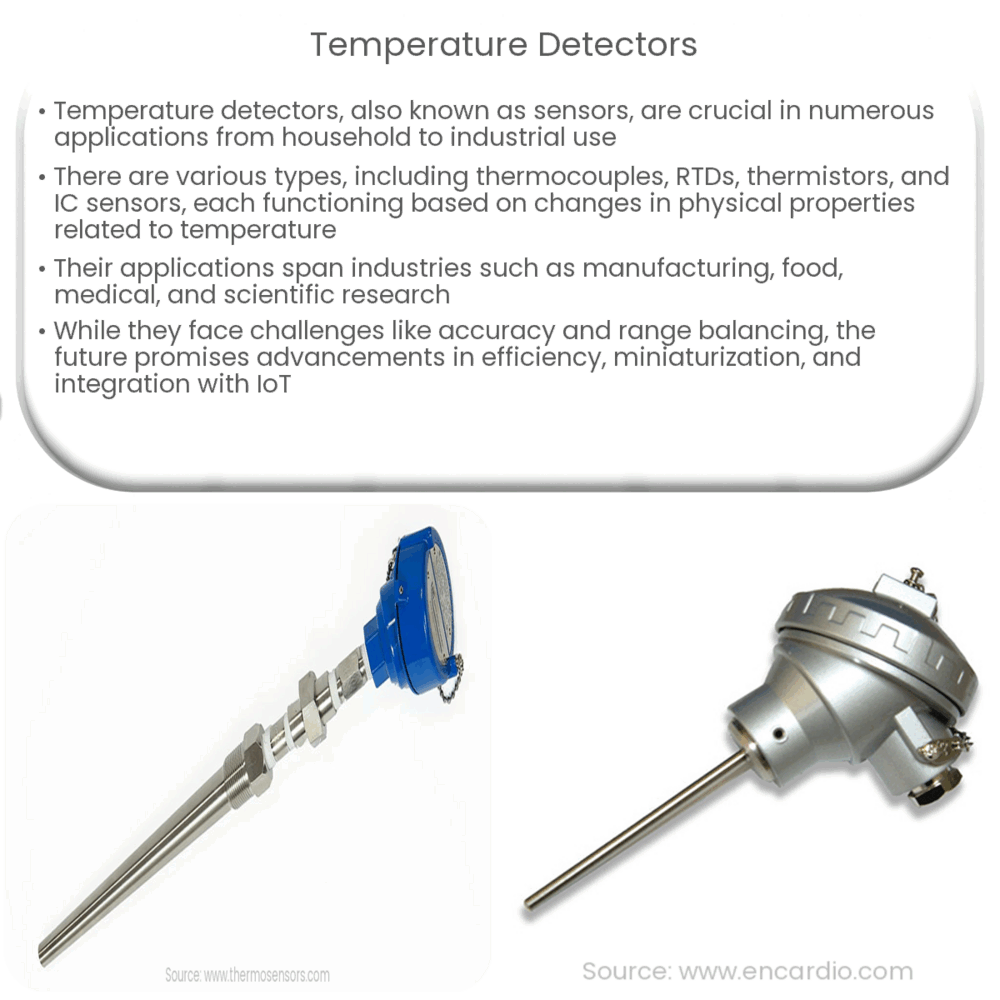
Understanding Temperature Detectors
Temperature detectors, or temperature sensors, play an integral role in a myriad of applications ranging from household devices to industrial machinery and advanced scientific research. These devices monitor changes in environmental conditions and convert the data into an interpretable form. By understanding the basics of temperature detectors, we can better appreciate their impact on our day-to-day lives.
Types of Temperature Detectors
There are several types of temperature detectors, each with its own unique capabilities and areas of use. We’ll explore some of the most common types below:
- Thermocouples: Thermocouples are among the most common types of temperature sensors. They are formed by joining two dissimilar metals. When heated, this junction produces a voltage which can be interpreted as temperature.
- Resistance Temperature Detectors (RTDs): RTDs operate on the principle that electrical resistance changes with temperature. Usually made of pure platinum, these sensors are highly accurate and stable over a wide temperature range.
- Thermistors: Thermistors function similarly to RTDs, but instead of platinum, they’re composed of a ceramic or polymer. Thermistors are very sensitive to temperature changes, which makes them ideal for precision measurements in a limited temperature range.
- Integrated Circuit (IC) Sensors: IC sensors are solid-state temperature sensors that are often used in digital applications. They provide direct temperature readings in a digital output.
Working Principles of Temperature Detectors
While the design and material of temperature detectors vary significantly, they typically operate under similar fundamental principles. Whether it is a thermocouple, an RTD, or a thermistor, these devices rely on changes in physical properties – such as voltage, resistance, or current – with respect to temperature. These changes are then translated into temperature readings through a calibration process.
For instance, thermocouples utilize the Seebeck effect1, where a voltage is generated at the junction of two different metals when subjected to a temperature gradient. This voltage can then be correlated to a specific temperature.
Applications of Temperature Detectors
The applications of temperature detectors are as diverse as their types. They are used extensively in various industries and fields including, but not limited to, manufacturing, food and beverage industry, medical sector, automotive, and HVAC systems. They are also pivotal in scientific research, playing key roles in laboratories and space exploration missions.
Take, for instance, the use of temperature detectors in household appliances such as ovens, refrigerators, and thermostats. These devices help regulate temperature, ensuring optimal operation and safety.
Challenges and Considerations in Using Temperature Detectors
While temperature detectors are extremely useful, they’re not without their challenges. The accuracy and reliability of a temperature detector can be influenced by several factors such as environmental conditions, installation quality, and calibration process. Hence, it is crucial to choose the right type of sensor for a given application and ensure its proper installation and maintenance.
Additionally, accuracy and range are two critical parameters that must be balanced according to the needs of a specific application. For example, while thermistors can provide high accuracy, they have a relatively limited temperature range. On the other hand, thermocouples have a wider range but might not be as precise as other types.
The Future of Temperature Detectors
Looking ahead, the future of temperature detectors is promising. With the evolution of technology, there is a strong push towards the development of more efficient, accurate, and robust sensors. This includes advancements in materials science, leading to the creation of sensors with improved sensitivity and stability. Miniaturization is another exciting trend, with the development of micro and nano-scale temperature sensors.
Moreover, the rise of the Internet of Things (IoT) has introduced a new frontier for temperature detectors. With IoT, sensors can be embedded in various devices and systems, enabling real-time temperature monitoring and control from remote locations.
Conclusion
In conclusion, temperature detectors serve as the backbone of various systems, contributing to their proper function and enhancing their performance. From the basic thermocouple to the advanced IC sensors, these tools help ensure our safety, improve our comfort, and support scientific advancements. As technology continues to evolve, we can expect to see even more sophisticated and versatile temperature detectors in the years to come.
Whether you’re a scientist conducting an experiment, a chef baking a cake, or a driver relying on your vehicle’s coolant system, remember that a temperature detector is working diligently behind the scenes to make these tasks possible. The importance of these devices, often overlooked, is immeasurable and their potential for the future is undeniably vast.



