
Temperature-compensated ohmmeters offer accurate resistance measurements by adjusting for temperature fluctuations, ensuring reliable results in various applications.
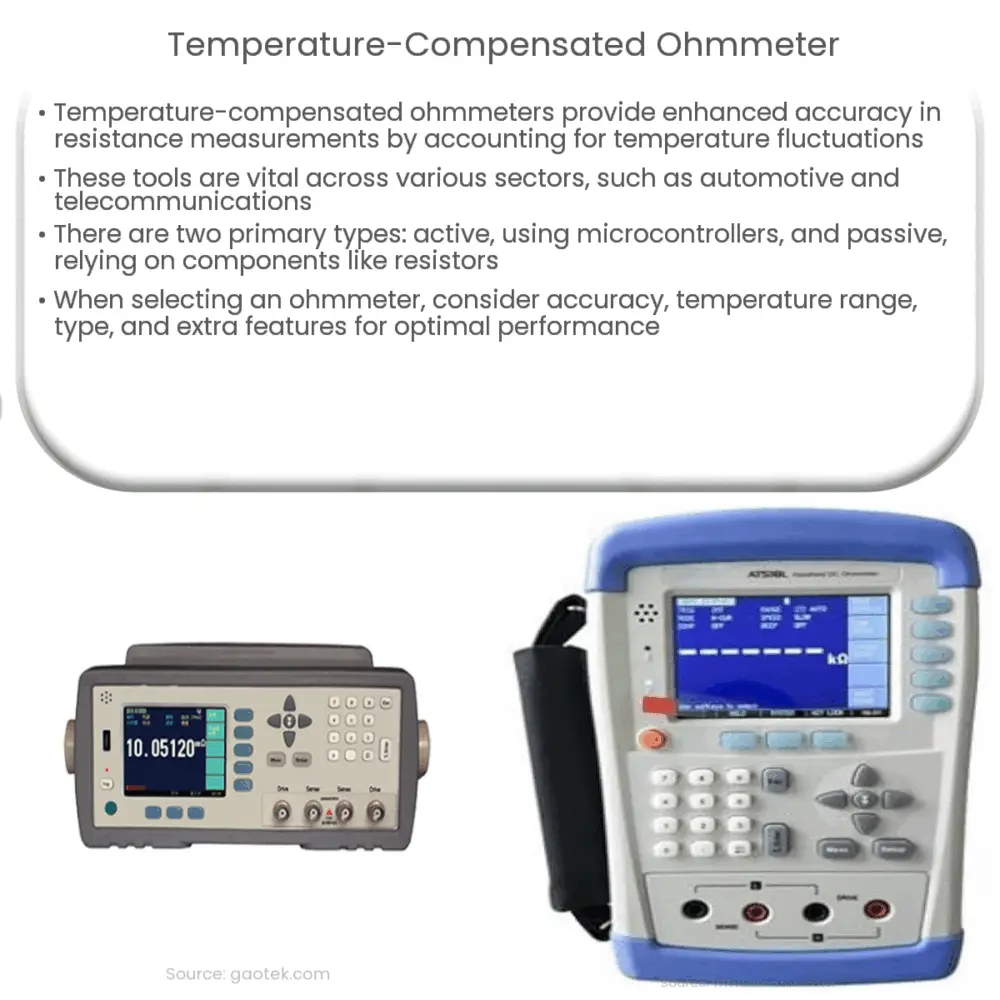
Temperature-Compensated Ohmmeter: An Essential Tool for Accurate Resistance Measurements
In the world of electronics, accurate resistance measurements are crucial for the proper functioning and maintenance of electronic devices and systems. One of the tools commonly used for measuring resistance is the ohmmeter. In this article, we will explore the temperature-compensated ohmmeter and how it offers a more accurate solution for resistance measurements by accounting for temperature fluctuations.
Understanding the Basics of an Ohmmeter
An ohmmeter is a specialized instrument designed to measure the electrical resistance of a component or circuit. It works by passing a known current through the component or circuit and measuring the voltage drop across it. The resistance can then be calculated using Ohm’s Law, which states that the resistance is equal to the voltage divided by the current (R = V/I).
Why Temperature Compensation Matters
Temperature plays a significant role in the resistance of materials. As temperature changes, so does the resistance of a component or conductor. Many materials, such as metals and semiconductors, experience an increase in resistance as temperature rises. This can lead to inaccurate resistance measurements if the temperature is not taken into account.
A temperature-compensated ohmmeter addresses this issue by incorporating a temperature sensor and compensation circuit into its design. The sensor measures the temperature of the component or conductor being tested, while the compensation circuit adjusts the resistance reading accordingly. This ensures that the ohmmeter provides an accurate resistance measurement that takes temperature fluctuations into account.
Types of Temperature-Compensated Ohmmeters
There are two main types of temperature-compensated ohmmeters: active and passive. Both types utilize a temperature sensor and compensation circuit, but they differ in how the compensation is applied.
Active Temperature-Compensated Ohmmeter
An active temperature-compensated ohmmeter incorporates an active component, such as a microcontroller or a digital signal processor, to process the temperature data and calculate the necessary compensation. The active component adjusts the current source or voltage reference within the ohmmeter to account for the temperature change, providing a more accurate resistance measurement.
Passive Temperature-Compensated Ohmmeter
A passive temperature-compensated ohmmeter relies on passive components, such as resistors and thermistors, to provide the necessary compensation. The passive components are carefully selected and arranged within the ohmmeter’s circuitry so that their temperature-dependent behavior cancels out the temperature-induced changes in the resistance of the component or conductor being tested. This results in a more accurate resistance measurement that accounts for temperature fluctuations.
Applications of Temperature-Compensated Ohmmeters
Temperature-compensated ohmmeters are essential in various industries and applications where accurate resistance measurements are crucial. Some of these applications include:
- Automotive: Monitoring and diagnosing sensors and electronic components in vehicles
- Telecommunications: Testing and maintenance of communication networks and devices
- Power Systems: Assessing the condition of transformers, breakers, and other electrical equipment
- Electronics Manufacturing: Quality control and troubleshooting of electronic components and assemblies
Advantages of Temperature-Compensated Ohmmeters
Using a temperature-compensated ohmmeter offers several advantages over a traditional ohmmeter:
- Improved Accuracy: By accounting for temperature fluctuations, temperature-compensated ohmmeters provide more accurate resistance measurements, leading to better decision-making and problem-solving in various applications.
- Greater Reliability: Temperature-compensated ohmmeters offer more consistent and reliable measurements, reducing the chances of errors and false readings caused by temperature variations.
- Increased Versatility: These ohmmeters can be used in a wider range of environments and applications, as they can account for temperature changes that may affect the accuracy of a standard ohmmeter.
Selecting the Right Temperature-Compensated Ohmmeter
When choosing a temperature-compensated ohmmeter, it’s essential to consider the following factors:
- Accuracy: Select an ohmmeter that offers the desired level of accuracy for your specific application. The accuracy of an ohmmeter is usually specified in percentage or parts per million (ppm).
- Temperature Range: Ensure that the ohmmeter can operate within the temperature range of your application. This will ensure that it provides accurate resistance measurements under all expected conditions.
- Type: Choose between an active or passive temperature-compensated ohmmeter based on your application’s requirements and your preference for the underlying compensation method.
- Additional Features: Consider any additional features that may be beneficial for your application, such as data logging, a built-in thermometer, or a user-friendly interface.
Conclusion
Temperature-compensated ohmmeters are essential tools for accurate resistance measurements, especially in applications where temperature fluctuations can significantly impact measurement accuracy. By incorporating a temperature sensor and compensation circuit, these ohmmeters provide improved accuracy, reliability, and versatility compared to traditional ohmmeters.
When selecting a temperature-compensated ohmmeter, it is crucial to consider factors such as accuracy, temperature range, type, and additional features to ensure the best fit for your specific application. By choosing the right temperature-compensated ohmmeter, you can ensure accurate and reliable resistance measurements, leading to better decision-making and problem-solving in various industries and applications.



