
What is absorption, and how does it occur in electromagnetic waves?
Absorption occurs when electromagnetic waves transfer energy to a material through electronic, vibrational, or rotational transitions.
Absorption occurs when electromagnetic waves transfer energy to a material through electronic, vibrational, or rotational transitions.
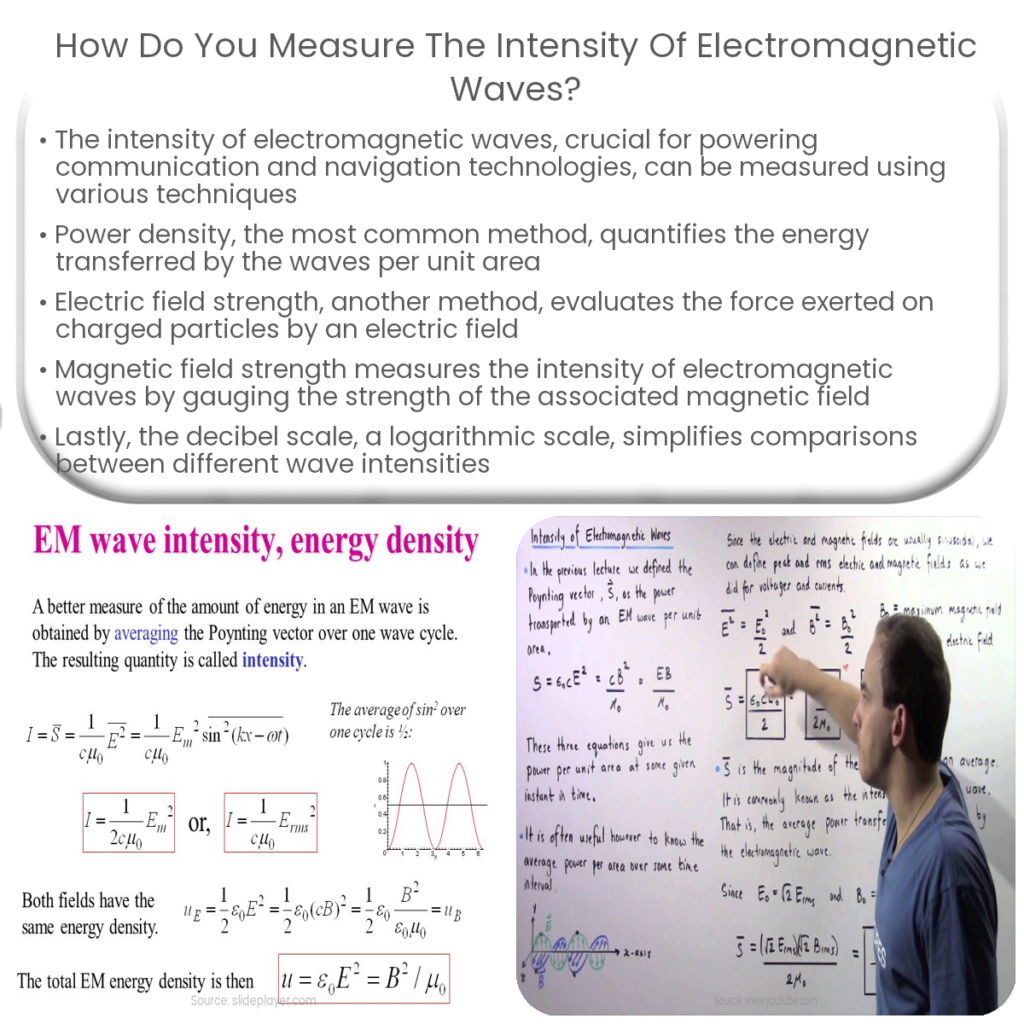
To measure electromagnetic wave intensity, methods include calculating power density, electric field strength, magnetic field strength, or using decibels.
The inverse square law states that the intensity of a physical quantity, such as electromagnetic waves, is inversely proportional to the square of the distance from the source.
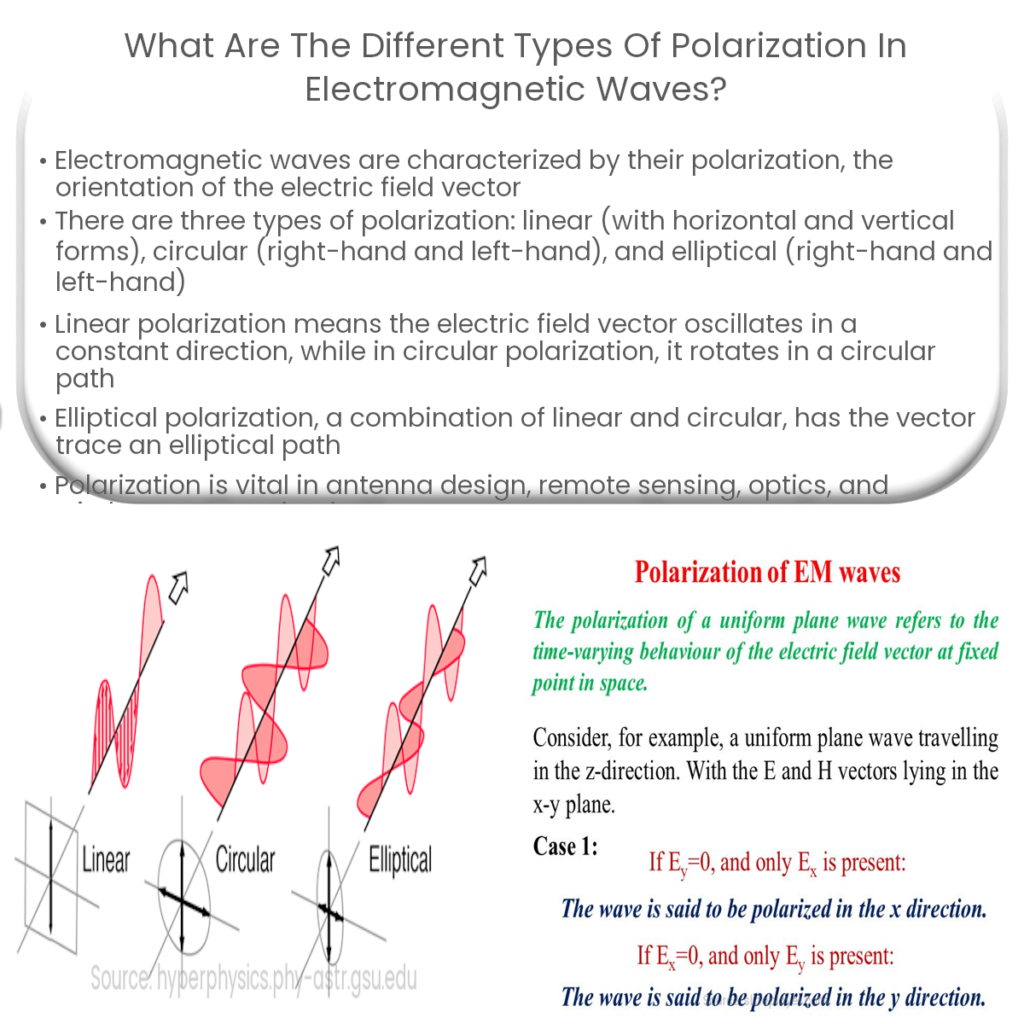
There are three types of polarization in electromagnetic waves: linear, circular, and elliptical polarization.
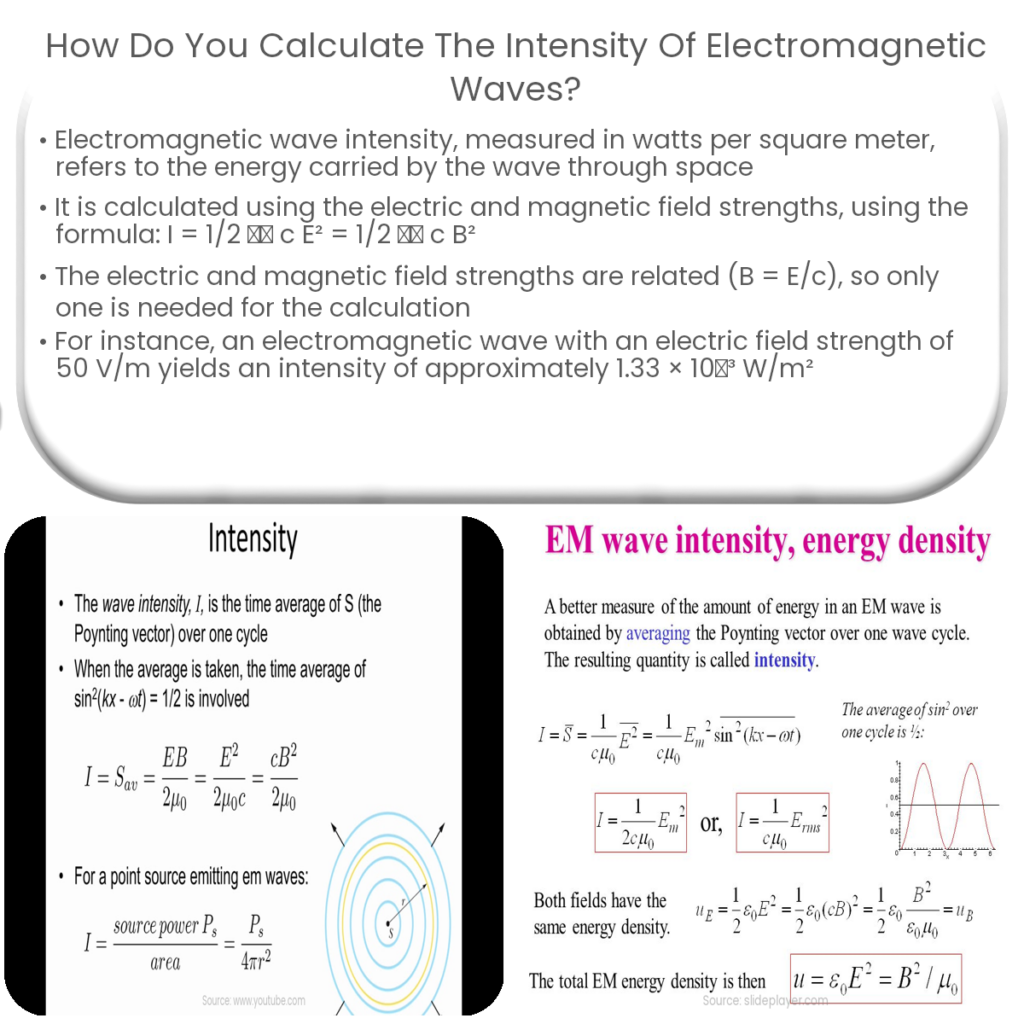
To calculate the intensity of electromagnetic waves, use the formula I = 1/2 μ₀ c E² or I = 1/2 ε₀ c B², with E or B field strength given.
Total internal reflection occurs when a wave, like light, travels from a higher to a lower refractive index medium, and the angle exceeds the critical angle.
Polarization refers to the orientation of an electromagnetic wave’s electric field and affects reflection, transmission, scattering, and interactions with matter.
The index of refraction is a measure of how much a medium slows light compared to a vacuum, affecting its speed and direction when passing through different media.
Snell’s Law describes the refraction of electromagnetic waves at the boundary between two media with different refractive indices.
The principle of superposition states that the resulting wave from two or more interacting waves is the sum of their individual amplitudes.

The primary purpose of this project is to help the public to learn some exciting and important information about electricity and magnetism.
Our Website follows all legal requirements to protect your privacy. Visit our Privacy Policy page.
The Cookies Statement is part of our Privacy Policy.
The information contained on this website is for general information purposes only. This website does not use any proprietary data. Visit our Editorial note.
It’s simple:
1) You may use almost everything for non-commercial and educational use.
2) You may not distribute or commercially exploit the content, especially on another website.
