
A switched-capacitor rectifier is an efficient circuit that converts AC to DC by charging and discharging capacitors with controlled switching.
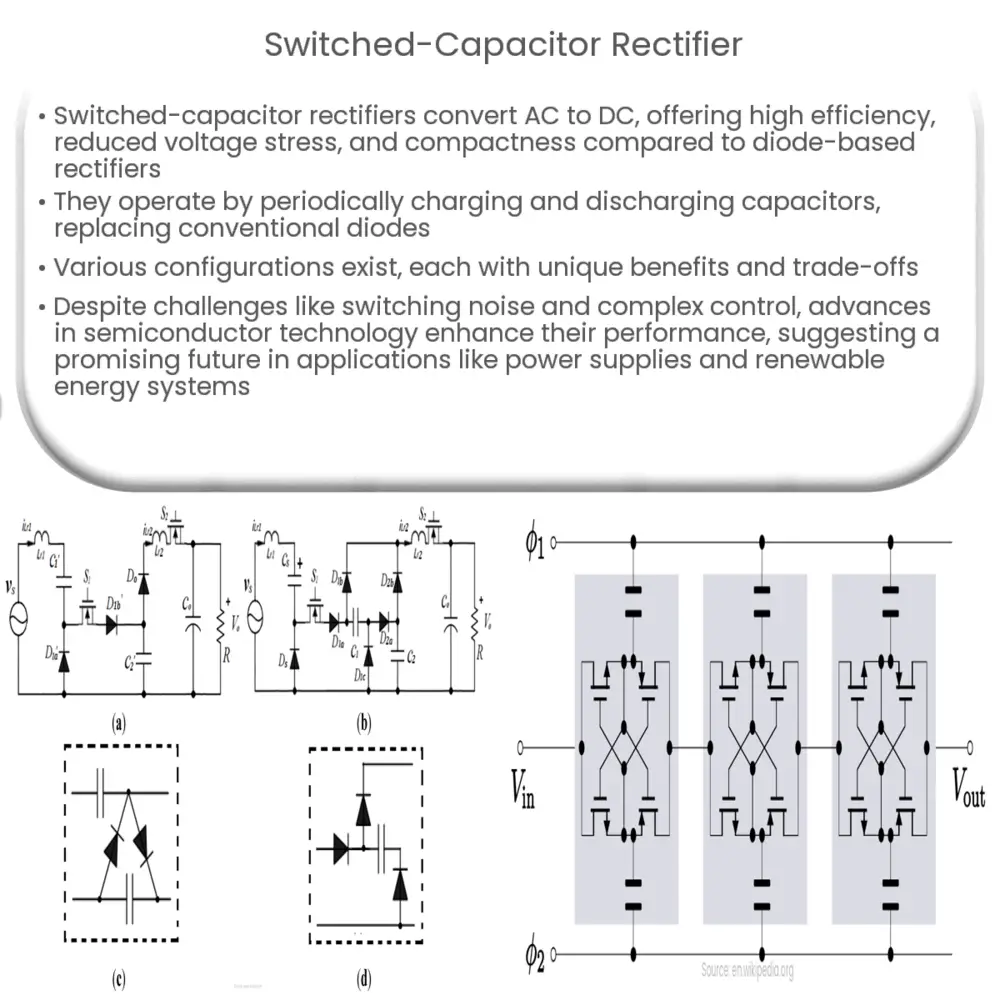
Switched-Capacitor Rectifier: An Overview
Introduction
A switched-capacitor rectifier is a type of electrical circuit used for converting alternating current (AC) to direct current (DC). Rectifiers play an essential role in various applications, such as power supplies for electronic devices, battery chargers, and renewable energy systems. While traditional diode-based rectifiers have been widely utilized in these applications, switched-capacitor rectifiers have emerged as a promising alternative, offering advantages such as high efficiency, reduced voltage stress, and compact size.
Operation Principle
The switched-capacitor rectifier operates by periodically charging and discharging capacitors in a controlled manner to achieve rectification. The fundamental concept behind this technique is to replace the conventional diodes with a combination of capacitors and switches, effectively eliminating diode voltage drops and thus improving efficiency. The process can be divided into two main phases: the charging phase, where capacitors are charged from the AC input, and the discharging phase, where the stored energy is transferred to the output as DC.
Switched-Capacitor Rectifier Configurations
There are several popular configurations for switched-capacitor rectifiers, each offering unique advantages and trade-offs. Some of the most common types include:
- Flying-Capacitor Rectifier: This topology employs a series of capacitors connected in a ladder-like structure with appropriate switches to achieve rectification. It offers excellent voltage regulation and reduced voltage stress on components but requires a larger number of capacitors and switches, which may increase the overall size and complexity of the circuit.
- Charge-Pump Rectifier: This configuration uses a combination of capacitors and switches to create a charge-pump effect, which is then used to convert the AC input into DC. It provides high efficiency and good voltage regulation, but its performance is highly dependent on the quality of the switches and their timing.
- Resonant Switched-Capacitor Rectifier: In this design, the capacitors and switches are combined with an inductor to form a resonant tank circuit. This approach helps minimize switching losses and achieve zero-voltage or zero-current switching, leading to high efficiency and reduced stress on the components. However, the presence of the inductor increases the overall size and complexity of the circuit.
Advantages and Applications
Switched-capacitor rectifiers offer several advantages over traditional diode-based rectifiers, such as:
- Higher efficiency, as they eliminate the voltage drop across diodes.
- Reduced voltage stress on components, leading to improved reliability and lifespan.
- Compact size, as they can be built using integrated circuit technology.
These benefits make switched-capacitor rectifiers suitable for a wide range of applications, including:
- Power supplies for electronic devices, where high efficiency and compact size are crucial.
- Battery chargers, where precise voltage regulation and high efficiency are desired.
- Renewable energy systems, such as solar and wind power converters, where maximizing energy conversion efficiency is vital.
Challenges and Limitations
Despite their advantages, switched-capacitor rectifiers also face several challenges and limitations, including:
- Switching noise: The switching action of capacitors and switches can generate electromagnetic interference (EMI) and noise, which may affect the performance of sensitive electronic components in close proximity.
- Switching losses: Although switched-capacitor rectifiers can achieve higher efficiency than diode-based rectifiers, switching losses still exist due to the non-ideal behavior of switches and capacitors. These losses can be minimized using advanced control techniques and high-performance components.
- Complex control: The proper operation of switched-capacitor rectifiers requires precise control of the timing and sequencing of switches, which can be challenging to implement and may necessitate the use of dedicated control ICs or microcontrollers.
- Component selection: The performance of switched-capacitor rectifiers is highly dependent on the quality of the capacitors and switches used in the design. Selecting appropriate components that can handle the required voltage and current levels while maintaining low losses is crucial for achieving optimal performance.
Recent Advances and Future Outlook
Recent advances in semiconductor technology and power electronics have enabled significant improvements in switched-capacitor rectifier performance. Some noteworthy developments include:
- Wide-bandgap semiconductors: The adoption of wide-bandgap semiconductor materials, such as silicon carbide (SiC) and gallium nitride (GaN), has led to the development of high-performance switches with lower conduction and switching losses, further enhancing the efficiency of switched-capacitor rectifiers.
- Advanced control techniques: The development of advanced control algorithms, such as predictive and adaptive control, has allowed for better management of switching losses and EMI, leading to improved overall performance and reliability.
- Integration and miniaturization: The increasing trend towards integrating switched-capacitor rectifiers into power supply ICs or power management units has resulted in more compact and efficient solutions, opening up new application possibilities, especially in portable and wearable electronics.
As research and development efforts continue, switched-capacitor rectifiers are expected to become increasingly prevalent in various applications due to their numerous advantages. Future research directions may include the exploration of novel topologies, the development of high-density integrated solutions, and the optimization of control techniques to further enhance performance and reliability.
Conclusion
Switched-capacitor rectifiers have emerged as a promising alternative to traditional diode-based rectifiers, offering significant advantages in terms of efficiency, voltage stress reduction, and compact size. With ongoing advancements in semiconductor technology and power electronics, these rectifiers are expected to find widespread use in a variety of applications, including power supplies for electronic devices, battery chargers, and renewable energy systems. However, addressing the challenges associated with switching noise, switching losses, and control complexity will be crucial to fully realize the potential of this innovative rectification technique.



