
Explore the mechanics, advantages, limitations, and future prospects of Surface Acoustic Wave (SAW) touch sensor technology.
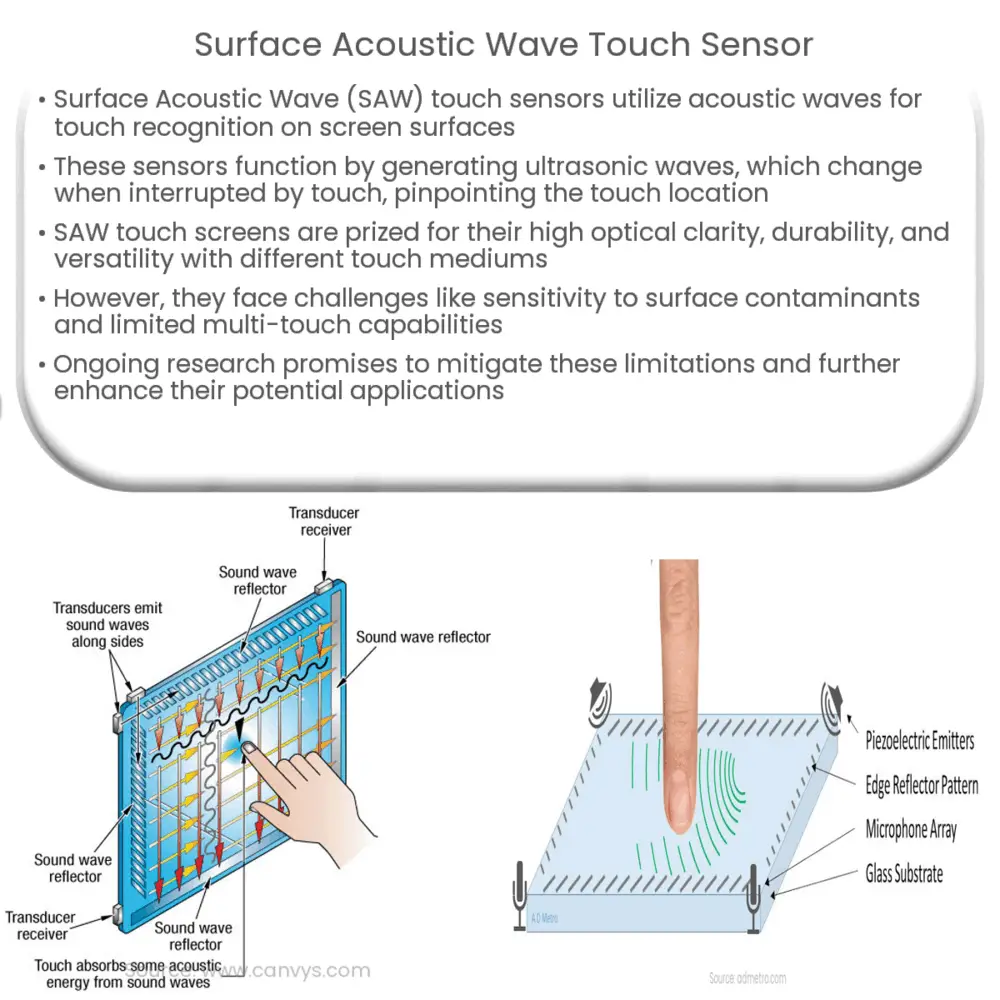
Introduction to Surface Acoustic Wave Touch Sensor
Surface Acoustic Wave (SAW) touch sensors are a type of touch technology that leverages the transmission of acoustic waves across the surface of a screen to recognize touch inputs. They have carved out a niche in the realm of interactive touch technologies due to their distinct advantages and operational characteristics.
The Mechanics of SAW Touch Sensors
SAW touch sensors operate by generating ultrasonic waves that pass over the touch screen panel. These waves are created by piezoelectric transducers and reflectors located at the edges of the screen. The transducers emit and receive the waves, while the reflectors guide them across the surface of the screen.
- 1When a finger or a stylus comes into contact with the screen, a portion of the wave is absorbed. This event changes the waves returning to the transducers, and the touch point is detected.
- 2The precise position of the touch is calculated based on the time it took for the wave to be absorbed and the change in the amplitude of the wave.
Advantages of SAW Touch Technology
SAW touch sensors have several key advantages that make them suitable for a variety of applications. Their high clarity and durability make them a common choice for industrial settings, public kiosks, ATMs, and more.
- 1High Optical Quality: SAW touch screens are renowned for their excellent light transmission, offering a clear, sharp image. This is because the screen surface is glass, and the acoustic waves do not affect the visual output.
- 2Durability: The touch sensor components are sealed behind the screen, which provides a high level of durability and protection from external elements.
- 3Stylus Versatility: SAW touchscreens can work with a finger touch, a gloved hand, or a soft-tipped stylus, making them versatile for various uses.
Despite these advantages, SAW touch sensors also have their limitations, which make them unsuitable for certain applications. These limitations and the future of SAW touch sensor technology will be discussed in the next section.
Limitations and Challenges of SAW Touch Technology
While SAW touch sensors offer numerous benefits, they also present some challenges that limit their applicability in certain contexts.
- 1Sensitivity to Surface Contaminants: Dust, dirt, or other foreign substances on the surface of the screen can interfere with the transmission of acoustic waves, resulting in false touch detections or decreased responsiveness.
- 2Not Suited for Multi-Touch: Due to their operating principle, SAW touchscreens have difficulty recognizing and processing multiple simultaneous touch points. This limits their usefulness in applications requiring multi-touch capability.
- 3Vulnerability to Scratches: Although SAW touchscreens are generally durable, any substantial scratch on the surface can result in a permanent dead spot on the touchscreen where touch inputs will no longer be recognized.
Future of SAW Touch Sensor Technology
Despite these limitations, the future of SAW touch sensor technology looks promising. With ongoing research and advancements, many of these issues are being addressed. For instance, the development of more robust surface coatings can help mitigate the problem of surface contaminants and scratches. Furthermore, the evolution of SAW technology is moving towards enabling multi-touch capabilities, expanding its potential applications.
Conclusion
In conclusion, Surface Acoustic Wave touch sensors provide a unique combination of high optical clarity, durability, and stylus versatility, making them ideal for a range of industrial and public use cases. However, like all technologies, they are not without their challenges. Understanding these strengths and limitations is crucial for selecting the right touch technology for a given application. As research and development in this field continues, we can anticipate further improvements that will expand the capabilities and applications of SAW touch sensor technology.



