
Strontium titanate (STO) is a promising ferroelectric material with applications in non-volatile memory, sensors, actuators, and energy harvesting devices.
Strontium Titanate (STO) as Ferroelectric Material
Strontium titanate (STO) is a perovskite oxide with the chemical formula SrTiO3, which has garnered significant interest in the materials science and engineering community for its unique properties and versatile applications. One of the most remarkable characteristics of STO is its potential as a ferroelectric material. Ferroelectric materials possess spontaneous electric polarization that can be reversed by the application of an external electric field. This property makes them highly desirable for a wide range of applications, including non-volatile memory devices, sensors, and actuators.
Structure and Properties of Strontium Titanate
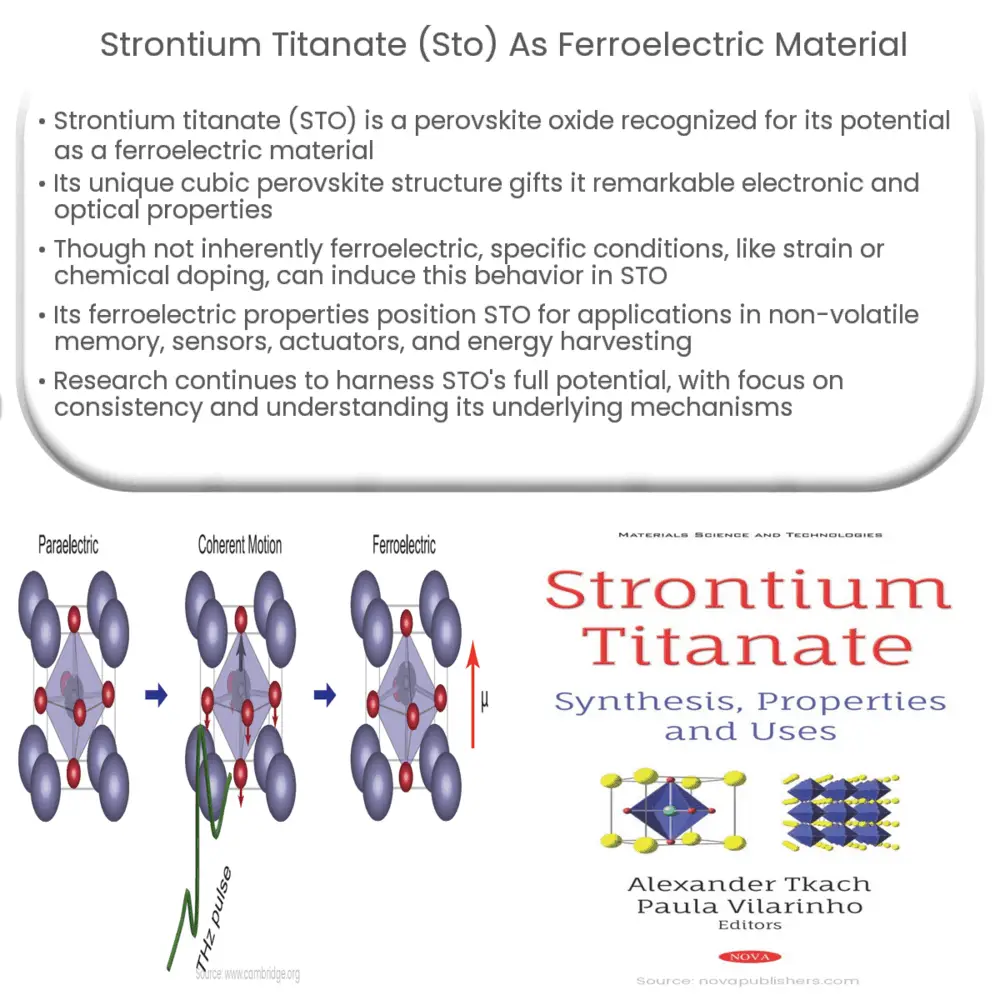
STO has a cubic perovskite structure with each unit cell composed of a strontium (Sr) atom at the center, surrounded by a titanium (Ti) atom and three oxygen (O) atoms. The Ti atom sits at the center of an octahedron formed by the oxygen atoms, while the Sr atom occupies the corners of the cube. This unique structure imparts STO with a range of remarkable properties, including high dielectric constant, low dielectric loss, and a large electrostrictive coefficient. These characteristics have made STO a popular choice for various electronic and optical applications.
Ferroelectricity in Strontium Titanate
Despite STO’s cubic structure, which is not typically associated with ferroelectricity, recent research has demonstrated that STO can exhibit ferroelectric behavior under specific conditions. The origin of ferroelectricity in STO lies in the displacement of the Ti atom from its central position within the oxygen octahedron. This displacement leads to a polar structure, which in turn results in the appearance of a net electrical dipole moment, a defining characteristic of ferroelectric materials.
Several factors can induce ferroelectricity in STO, such as strain, chemical doping, and the presence of defects or impurities. For example, applying epitaxial strain through the growth of STO thin films on lattice-mismatched substrates can lead to a tetragonal distortion of the cubic perovskite structure, enabling ferroelectricity. Similarly, chemical doping with elements like niobium (Nb) or lanthanum (La) can introduce off-center displacements of the Ti atom, resulting in a polar structure and ferroelectric behavior. The presence of oxygen vacancies and other defects can also contribute to the emergence of ferroelectricity in STO.
Applications of Ferroelectric STO
The ferroelectric properties of STO open up numerous possibilities for technological applications. One of the most promising areas is non-volatile memory devices, where the ability to switch and maintain polarization states without the need for constant power supply is highly desirable. STO-based ferroelectric memories can offer high-speed operation, low power consumption, and excellent endurance, making them suitable for a variety of computing and data storage applications.
Other potential applications of ferroelectric STO include sensors, actuators, and energy harvesting devices. The high dielectric constant and low dielectric loss of STO make it an attractive candidate for capacitive sensors, while its large electrostrictive coefficient enables the development of efficient actuators. Furthermore, the energy conversion properties of ferroelectric materials like STO can be harnessed for energy harvesting in self-powered devices and systems.
Challenges and Future Directions in Ferroelectric STO Research
Despite the significant progress made in understanding and harnessing the ferroelectric properties of STO, several challenges remain. One of the main challenges is achieving stable and reproducible ferroelectric behavior in STO-based devices. The presence of defects, impurities, and variations in strain or doping levels can result in significant variations in the ferroelectric properties, leading to inconsistent device performance. Researchers are actively exploring methods to optimize the growth and processing of STO films and nanostructures to minimize these variations and achieve reliable ferroelectric behavior.
Another challenge in the field is the need for a better understanding of the fundamental mechanisms underlying ferroelectricity in STO. While considerable progress has been made in elucidating the role of strain, doping, and defects in inducing ferroelectric behavior, the complex interplay between these factors and their influence on the material’s properties is not yet fully understood. Further advances in theoretical and experimental research are required to develop a comprehensive understanding of ferroelectricity in STO, which can then guide the design and optimization of STO-based devices.
Environmental and Societal Implications of Ferroelectric STO
The development of ferroelectric STO materials and devices has the potential to impact various aspects of society and the environment. The adoption of STO-based non-volatile memory devices could lead to significant reductions in energy consumption in data centers and computing systems, contributing to lower greenhouse gas emissions and a reduced environmental footprint. Moreover, the use of ferroelectric STO in energy harvesting devices can enable the development of self-powered systems, reducing the reliance on traditional power sources and promoting the adoption of renewable energy technologies.
On the societal front, the application of ferroelectric STO in sensors and actuators could lead to advances in various sectors, including healthcare, transportation, and consumer electronics. For instance, STO-based sensors could enable the development of more sensitive and accurate diagnostic tools in medicine, while STO actuators could be used in the fabrication of high-performance microelectromechanical systems (MEMS) for a wide range of applications.
Conclusion
In conclusion, strontium titanate (STO) is a promising ferroelectric material with a wide range of potential applications in electronic and optical devices. By exploiting its unique properties, researchers are developing innovative solutions for non-volatile memory, sensors, actuators, and energy harvesting devices. Continued progress in understanding the fundamental mechanisms of ferroelectricity in STO, as well as advances in materials synthesis and processing, are crucial for realizing the full potential of this versatile material in future technologies.