
Explore strontium bismuth tantalate (SBT) as a ferroelectric material, its synthesis methods, properties, applications, and challenges in electronics.
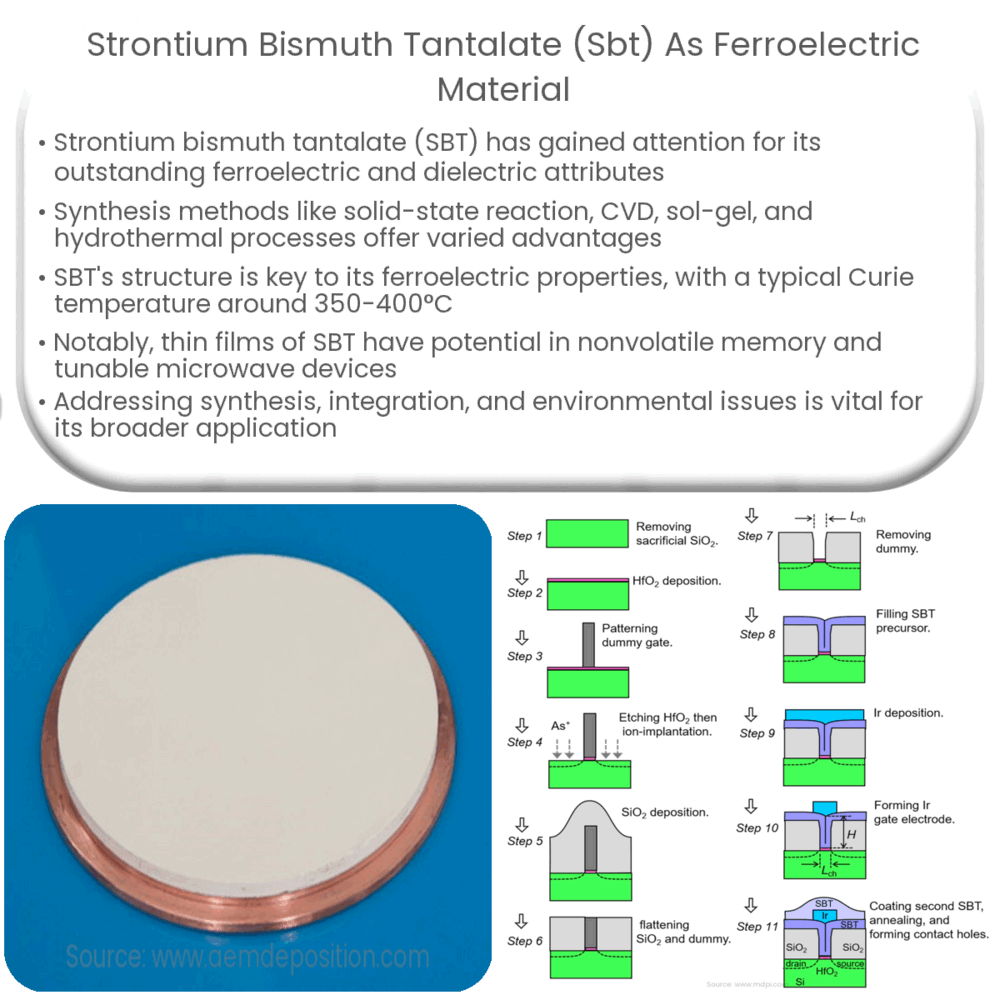
Strontium Bismuth Tantalate (SBT) as Ferroelectric Material
Introduction
Ferroelectric materials have been extensively studied for their unique properties and wide range of applications in areas such as nonvolatile memory devices, piezoelectric sensors, and actuators. One such material, strontium bismuth tantalate (SBT), has recently gained significant interest for its excellent ferroelectric and dielectric properties. This article aims to provide an overview of SBT as a ferroelectric material and delve into its synthesis methods, properties, and potential applications.
Synthesis Methods
There are several methods to synthesize strontium bismuth tantalate, including solid-state reaction, chemical vapor deposition (CVD), sol-gel, and hydrothermal synthesis. Each method has its advantages and limitations, depending on the desired properties and applications. For instance, solid-state reaction is a conventional method that offers high purity and stoichiometry control, but often requires high temperatures and extended reaction times. On the other hand, CVD is a versatile method that can produce thin films with high uniformity, while sol-gel and hydrothermal synthesis offer a more cost-effective and low-temperature approach.
Crystal Structure and Ferroelectric Properties
Strontium bismuth tantalate crystallizes in the orthorhombic perovskite structure, which consists of corner-sharing BO6 (B = Bi, Ta) octahedra and A-site (A = Sr) cations. The structure exhibits ferroelectricity due to the off-center displacement of the A-site cations, resulting in a spontaneous polarization. The ferroelectric properties of SBT are highly dependent on its composition, processing conditions, and temperature.
One of the key parameters that influences the ferroelectric properties of SBT is the so-called tolerance factor, which is determined by the ionic radii of the A-site cations and the BO6 octahedra. A tolerance factor close to 1 results in a more stable perovskite structure and improved ferroelectric properties. The ferroelectric transition temperature, or Curie temperature (Tc), is another crucial parameter that determines the operational temperature range for ferroelectric devices. For SBT, the Tc is typically around 350-400°C, making it suitable for high-temperature applications.
Dielectric Properties
Aside from its ferroelectric properties, SBT also exhibits remarkable dielectric properties, which are important for energy storage and filtering applications. The dielectric constant (εr) and loss tangent (tanδ) are two essential parameters that characterize the dielectric properties of a material. SBT typically exhibits a high dielectric constant, which is desirable for capacitive applications. Moreover, the dielectric loss of SBT is relatively low, indicating its potential for high-frequency applications where low energy dissipation is required.
Thin Films and Applications
Thin film technology has played a significant role in advancing the field of ferroelectric materials by providing enhanced control over material properties and enabling the integration of these materials into various devices. Thin films of SBT can be prepared using methods such as chemical vapor deposition, pulsed laser deposition, and sol-gel techniques. These thin films exhibit improved ferroelectric and dielectric properties compared to their bulk counterparts, making them suitable for a wide range of applications.
One promising application of SBT thin films is in nonvolatile ferroelectric random access memory (FeRAM) devices, which offer fast read/write speeds, low power consumption, and nonvolatile data storage. SBT’s high Curie temperature and excellent fatigue endurance make it an attractive candidate for FeRAM devices operating at high temperatures or under high-stress conditions.
Another potential application of SBT thin films is in tunable microwave devices such as phase shifters and filters. The high dielectric constant and low dielectric loss of SBT make it suitable for these applications, where the ability to control the dielectric properties with an applied electric field is crucial. Moreover, the compatibility of SBT thin films with existing semiconductor technology allows for the integration of these devices into modern communication systems.
Challenges and Future Perspectives
Despite the remarkable properties and potential applications of SBT as a ferroelectric material, there remain several challenges that need to be addressed to fully realize its potential. One of the primary challenges is controlling the stoichiometry and microstructure of SBT thin films, which directly impact their ferroelectric and dielectric properties. Developing novel synthesis and processing techniques that enable precise control over these parameters will be crucial in advancing the field.
Another challenge is the integration of SBT thin films with existing electronic devices and systems. Compatibility with standard semiconductor processing techniques and the development of reliable and stable device architectures are essential for the widespread adoption of SBT-based devices.
Furthermore, environmental concerns associated with the use of toxic elements such as bismuth and tantalum in SBT should not be overlooked. Future research should explore the development of environmentally friendly alternatives or methods for recycling and reusing these materials to minimize their environmental impact.
Conclusion
Strontium bismuth tantalate (SBT) has emerged as a promising ferroelectric material due to its excellent ferroelectric and dielectric properties. Its potential applications in nonvolatile memory devices, tunable microwave devices, and other electronic systems have garnered significant interest. However, addressing the challenges related to synthesis, processing, integration, and environmental concerns will be crucial in fully realizing the potential of SBT as a ferroelectric material. Continued research and innovation in this field will undoubtedly lead to the development of advanced SBT-based devices and applications that can revolutionize modern electronics.