
Run-length decoder decompresses data compressed using RLE, effectively restoring the original data without any loss of information.
Run-Length Decoder: A Data Compression Technique
Run-length encoding (RLE) is a simple lossless data compression technique that can be used to reduce the size of data files without any loss of information. This algorithm is particularly effective when dealing with data that contains long sequences of repeated elements, such as in image files, text documents, or binary data streams. In this article, we will discuss the concept of a run-length decoder, which is the process of decoding data that has been compressed using RLE.
Understanding Run-Length Encoding
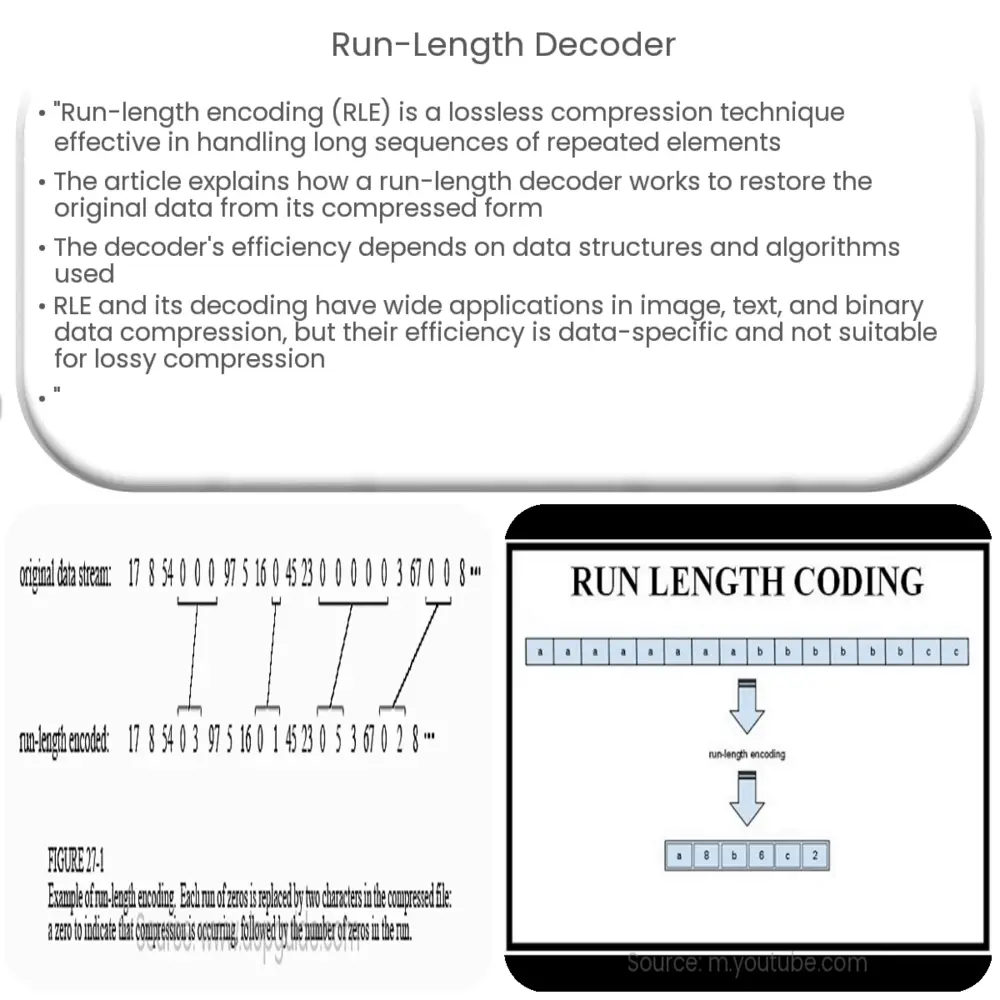
Before diving into the specifics of a run-length decoder, it is essential to understand the basics of run-length encoding. RLE works by identifying and replacing long sequences of repeated elements with a shorter representation consisting of the repeated element and the number of times it occurs in a sequence. For example, consider the following sequence of characters:
AAABBBBCCCC
RLE would compress this sequence as follows:
3A4B4C
As demonstrated above, the original sequence of 11 characters has been compressed to a shorter representation containing just 6 characters. The key to this compression technique is the presence of long sequences of repeated elements.
Run-Length Decoder: The Basics
A run-length decoder is responsible for decompressing data that has been previously compressed using RLE. The primary goal of the decoder is to restore the original data from its compressed form without any loss of information. The decoder processes the compressed data, identifies the run-length encoded sequences, and reconstructs the original data by expanding the compressed sequences according to the specified repetitions.
For instance, given the compressed data sequence ‘3A4B4C’, a run-length decoder would reconstruct the original data as follows:
AAABBBBCCCC
As seen in this example, the run-length decoder has successfully restored the original data from the compressed form without any loss of information.
Implementing a Run-Length Decoder
There are various ways to implement a run-length decoder, depending on the programming language and specific requirements of the application. However, the fundamental process remains the same across different implementations:
- Read the compressed data as input.
- Iterate through the compressed data, identifying the run-length encoded sequences.
- For each sequence, expand it according to the specified repetitions to reconstruct the original data.
- Continue processing the input until the entire compressed data has been decoded and the original data has been reconstructed.
It is important to note that the efficiency of a run-length decoder depends on the choice of data structures and algorithms used in the implementation, as well as the nature of the compressed data.
Run-Length Decoder: Applications and Limitations
Run-length decoders have a wide range of applications, particularly in domains where data often contains long sequences of repeated elements. Some common use cases for run-length decoding include:
- Image compression: RLE is often used in bitmap image formats (e.g., BMP and TIFF) to compress image data. Run-length decoders are essential in these applications for reconstructing the original image from its compressed form.
- Text compression: Text documents, especially those with repetitive formatting or whitespace, can benefit from RLE compression. Run-length decoders play a crucial role in reconstructing the original text from the compressed data.
- Binary data streams: Run-length decoding can also be applied to binary data streams, such as those encountered in communication systems, to restore the original data after transmission.
While run-length decoding offers several advantages, it also has some limitations:
- Data-specific efficiency: The efficiency of RLE depends on the nature of the data being compressed. If the data does not have long sequences of repeated elements, RLE may not provide significant compression or could even increase the size of the data.
- Not suitable for lossy compression: RLE is a lossless compression technique, which means it preserves all information in the original data. However, in some applications, lossy compression techniques, which sacrifice some information for higher compression ratios, may be more suitable.
- Complexity: Although RLE is relatively simple compared to other compression techniques, the decoding process can still be computationally intensive, especially for large data sets.
Conclusion
Run-length decoding is an essential component of the RLE data compression technique, enabling the restoration of original data from its compressed form. While RLE and run-length decoders offer several advantages, they are most effective when applied to data that contains long sequences of repeated elements. Understanding the basics of run-length decoding and its applications is crucial for choosing the right compression technique and optimizing the storage and transmission of data in various domains.



