
Explore the key features, functioning, advantages, and applications of RS-485 controllers in data communication systems.
Introduction to RS-485 Controllers
The RS-485 controller is a crucial component in the world of data communication, especially in situations that require long-distance and high-speed data transmission. Also known as the TIA/EIA-485, this standard finds extensive application in various industries, such as automation, telecommunications, and instrumentation.
Understanding RS-485
The RS-485 standard, developed by the Electronic Industries Alliance (EIA), defines the electrical characteristics of drivers and receivers for use in digital systems. It is a balanced data transmission system that is capable of handling both simplex and full-duplex communication over long distances, up to 4000 feet, while supporting data rates up to 10 Mbit/s.
Key Features of RS-485 Controllers
- Long Distance Data Transmission: With its capability to transmit data over long distances, RS-485 is ideal for applications such as remote sensing and control.
- Differential Signaling: RS-485 uses differential signaling, which enables it to function reliably in electrically noisy environments.
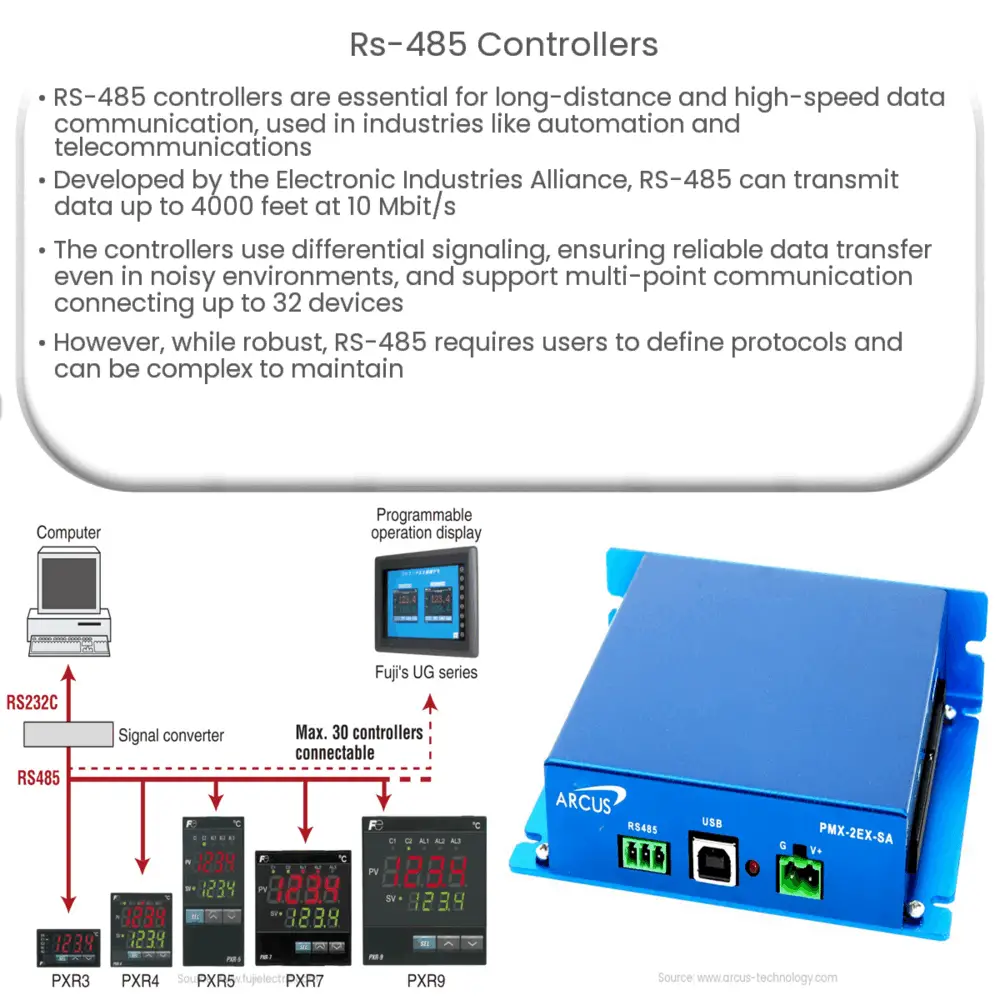
- Multi-point Communication: RS-485 controllers allow for multi-point communication, enabling connection of up to 32 devices on a single network.
How RS-485 Controllers Work
RS-485 controllers use differential signaling to transfer data. This means that data is transmitted over two complementary signal lines, referred to as ‘A’ and ‘B’. The data’s value is determined by the voltage difference between these two lines, rather than their individual voltages relative to ground. This technique increases the noise immunity and allows for longer cable lengths.
At the heart of an RS-485 system, the controller is responsible for controlling the driver that converts the digital signal into a differential one. It also controls the receiver that converts the differential signal back into a digital one. The controller handles the timing and protocol specifics for the data transmission.
RS-485 controllers are typically used in systems that require robust data transmission over long distances or in electrically noisy environments. They find extensive applications in various fields like building automation, industrial control systems, and remote sensor networks.
Applications of RS-485 Controllers
The versatile nature of RS-485 controllers means they are used across a broad range of industries and applications.
- Industrial Automation: In manufacturing and process control systems, RS-485 controllers are commonly used to connect devices like sensors, actuators, and PLCs over long distances.
- Building Automation: RS-485 is often employed in building automation systems, such as HVAC and security systems, allowing for reliable data communication.
- Telecommunications: Telecommunication systems, such as telephone networks and radio communication systems, also take advantage of the robustness of RS-485.
The Advantages and Limitations of RS-485 Controllers
RS-485 controllers are appreciated for their robustness and versatility, but they also have their limitations.
- Advantages: RS-485 controllers can handle long-distance data transmission and can function reliably in electrically noisy environments. They also support multi-point communication, allowing for the connection of many devices on a single network.
- Limitations: The RS-485 standard does not define a protocol, so it’s up to the user to ensure that the devices on the network can understand each other. Additionally, RS-485 networks can be more complex to install and maintain than simpler, short-range networks.
Conclusion
In conclusion, RS-485 controllers play an integral role in a variety of industries that require robust, long-distance, and high-speed data transmission. Their ability to function reliably in electrically noisy environments and support multi-point communication makes them a popular choice for many applications. However, their use does require careful consideration of the communication protocol, and they can be more complex to install and maintain than other options.
As technology continues to evolve, the RS-485 standard remains a proven and reliable choice for many, testament to its robustness and versatility. Whether in industrial automation, building systems, or telecommunications, RS-485 controllers continue to facilitate effective and efficient data communication.



