
Explore the fascinating world of radio telescopes, their working principle, global landmarks, challenges, future prospects, and their role in unraveling cosmic mysteries.
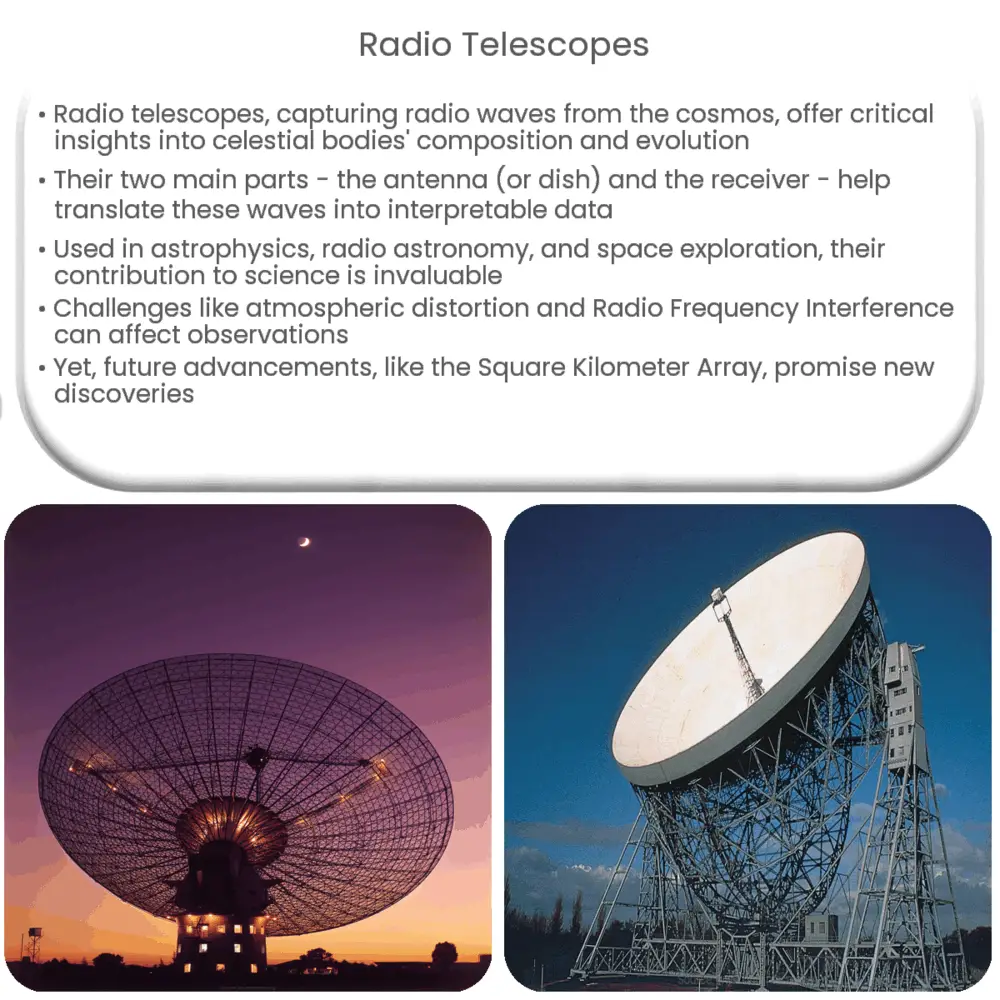
Understanding Radio Telescopes
Radio telescopes are an essential component in the study of celestial objects and phenomena. Unlike optical telescopes, which detect visible light, radio telescopes are designed to detect radio waves emanating from sources across the vast universe. In doing so, they provide invaluable insights into the composition, behavior, and evolution of celestial bodies.
How Radio Telescopes Work
Radio telescopes operate on the same basic principles as their optical counterparts. They collect incoming radio waves using a large dish or antenna, which then reflects the waves into a focus point. Here, a receiver converts these waves into an electrical signal that can be analyzed by computers.
The Structure of a Radio Telescope
A radio telescope consists primarily of two parts: the antenna, often referred to as the ‘dish’, and the receiver. The antenna’s size and shape play a crucial role in determining the telescope’s sensitivity and resolution. Larger dishes can collect more radio waves, and hence, can detect fainter sources. On the other hand, the receiver is responsible for translating the collected radio waves into a form that can be interpreted by scientists.
Applications of Radio Telescopes
- Astrophysics: Radio telescopes have been indispensable in the study of astrophysical phenomena, such as pulsars, cosmic microwave background radiation, and black holes. They can detect signals that optical telescopes cannot, thereby expanding our understanding of the universe.
- Radio Astronomy: Radio astronomy is a subfield of astronomy that uses radio telescopes to detect radio frequency radiation emitted by celestial bodies. With the help of radio telescopes, astronomers have made significant discoveries, such as quasars and cosmic microwave background radiation.
- Space Exploration: Radio telescopes are often used in space exploration missions for communication purposes. They can transmit and receive signals over long distances, making them ideal for interplanetary communications.
It’s evident that radio telescopes have a wide array of uses, and their contribution to science has been invaluable. In the next part, we’ll explore some notable radio telescopes around the world, the challenges associated with radio telescope observations, and the exciting future developments in this field.
Notable Radio Telescopes Around the World
Many radio telescopes around the globe have made significant contributions to our understanding of the universe. For example, the Arecibo Observatory in Puerto Rico, despite its unfortunate collapse in 2020, was instrumental in detecting the first binary pulsar. The Very Large Array (VLA) in New Mexico, USA, has made vital observations of black holes and cosmic jets. The Five-hundred-meter Aperture Spherical Telescope (FAST) in China is currently the largest filled-aperture radio telescope in the world.
Challenges Associated with Radio Telescope Observations
Radio telescope observations can be affected by several factors. Earth’s atmosphere can distort radio signals, and interference from human-made sources, such as radio, television, and mobile phones (known as Radio Frequency Interference or RFI), can also contaminate data. Furthermore, building and maintaining these large-scale structures present significant logistical and financial challenges.
The Future of Radio Telescopes
Despite these challenges, the future of radio astronomy is promising. Advances in technology are paving the way for more sensitive receivers and larger telescope arrays. One exciting development is the Square Kilometer Array (SKA), a project aiming to build the world’s largest radio telescope, with a total collecting area of approximately one square kilometer.
Conclusion
In conclusion, radio telescopes play a pivotal role in advancing our knowledge of the cosmos. From probing the mysteries of pulsars and black holes to enhancing interplanetary communication, these instruments are an integral part of the scientific endeavor to explore and understand our universe. Although radio telescope observations come with their unique set of challenges, the promise of future technological advancements holds untold potential for new discoveries. As we gaze into the universe with these tools of science, we continue our quest to unravel the mysteries of the cosmos, one radio wave at a time.



