
Explore the world of push-type solenoids, from their operating principles to various applications and their future prospects.
Understanding the Push-Type Solenoid
A push-type solenoid is a type of electromagnetic device that exerts a pushing force when activated. Its function is central to many electrical and mechanical systems, making it a critical component in a variety of applications. The solenoid’s underlying physics, structure, and usage are key to understanding its role and significance.
Physics Behind Solenoids
The fundamental principle behind a solenoid’s operation is electromagnetism. When an electric current is passed through a wire, it creates a magnetic field around the wire. A solenoid is essentially a coil of wire, and when current is passed through it, the resulting magnetic field exerts a force. This force can either push or pull, depending on the solenoid’s design, hence the terms ‘push-type’ and ‘pull-type’ solenoids.
Structure of a Push-Type Solenoid
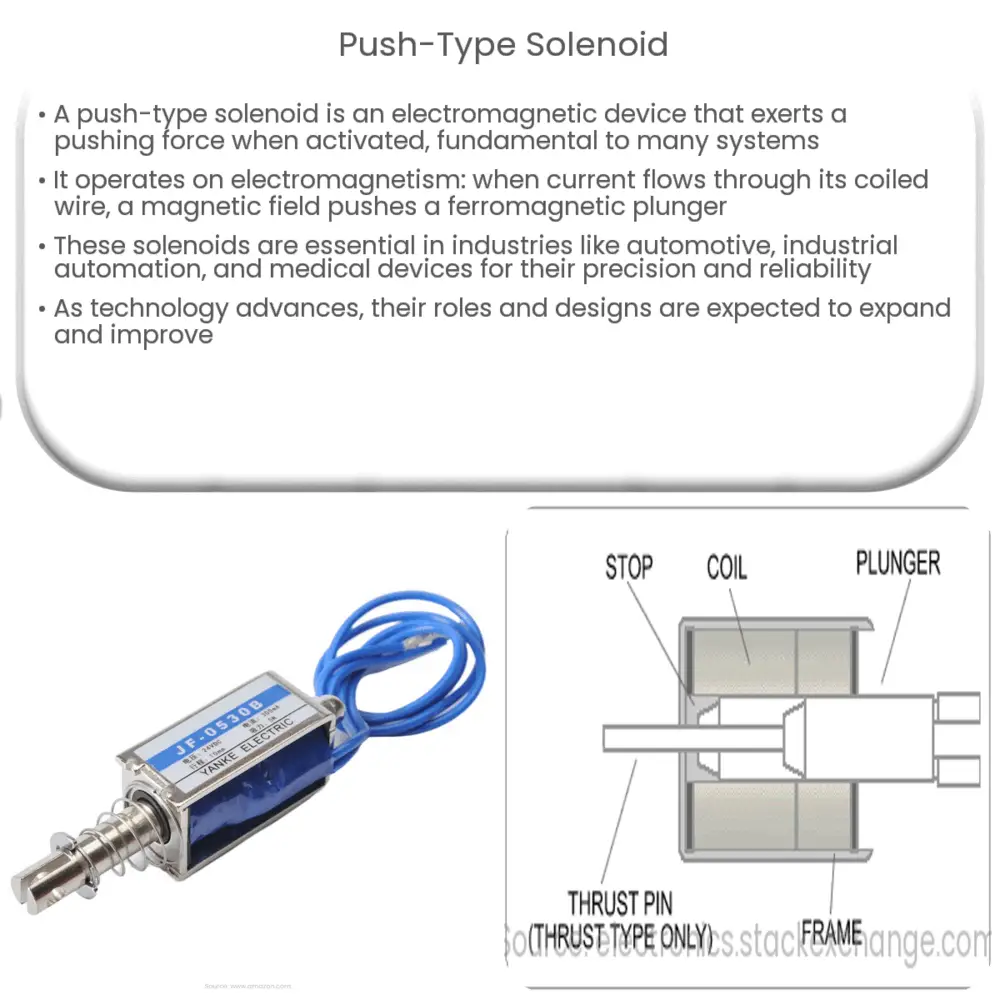
At its core, a push-type solenoid consists of three main components: the coil, the plunger, and the housing. The coil is a long wire wound around a cylindrical form. The plunger, usually made of a ferromagnetic material like iron or steel, is located within the coil. The housing or casing, which holds the coil and plunger, is also typically made of a ferromagnetic material.
- Coil: The solenoid’s coil is where the electromagnetism occurs. When current is applied, the coil generates a magnetic field, inducing a force on the plunger.
- Plunger: This movable component is directly impacted by the magnetic field generated by the coil. In push-type solenoids, the plunger is pushed away from the coil when the solenoid is activated.
- Housing: The housing holds the coil and plunger, providing a path for the magnetic flux and protecting the components from external elements.
Operation of a Push-Type Solenoid
The operation of a push-type solenoid starts when an electric current is applied to the coil. The current flowing through the coil generates a magnetic field, which in turn induces a force on the plunger. Since the plunger is made of a ferromagnetic material, it is strongly affected by the magnetic field. As a result, it is pushed in the direction away from the coil, hence the term ‘push-type’ solenoid. When the electric current is removed, the magnetic field dissipates, and a spring mechanism typically returns the plunger to its original position.
Applications of Push-Type Solenoids
Push-type solenoids are ubiquitous in various technological applications due to their precise control, quick response times, and reliable functionality. Their inherent ability to convert electrical energy into mechanical energy makes them indispensable in numerous industries.
- Automotive: In vehicles, push-type solenoids are often used in automatic door locks, starters, and fuel injection systems. The precise control of solenoids ensures the smooth and efficient operation of these systems.
- Industrial Automation: In manufacturing and automation industries, these solenoids are employed in various types of machines for tasks like sorting, positioning, or locking.
- Medical Devices: The precision of push-type solenoids is crucial in medical devices like drug delivery systems and surgical instruments.
Maintenance and Troubleshooting of Push-Type Solenoids
While push-type solenoids are typically robust and reliable, like all mechanical and electrical devices, they may occasionally require maintenance or troubleshooting. Some common issues include the solenoid not activating, the plunger not returning to its original position, or the device overheating. Often, these problems can be traced back to issues with the power supply, the control circuit, or the mechanical components of the solenoid.
Future of Push-Type Solenoids
As technology continues to evolve, the role of push-type solenoids is expected to expand even further. Emerging technologies such as electric vehicles, smart homes, and advanced manufacturing will likely rely on the precise control and reliability that these devices offer. As the demand for more energy-efficient and compact devices grows, the design and materials used in solenoids are likely to see significant advancements as well.
Conclusion
In conclusion, push-type solenoids are fundamental electromechanical devices that play a crucial role in numerous applications across a wide range of industries. Their operation, based on the principles of electromagnetism, provides a reliable and precise method of converting electrical energy into mechanical motion. As technology continues to evolve, the importance and application of these devices are expected to grow, making them a fascinating area of study and use.



