
Explore the evolution, applications, and pros & cons of Programmable Logic Devices (PLDs), from basic ROMs to advanced FPGAs.
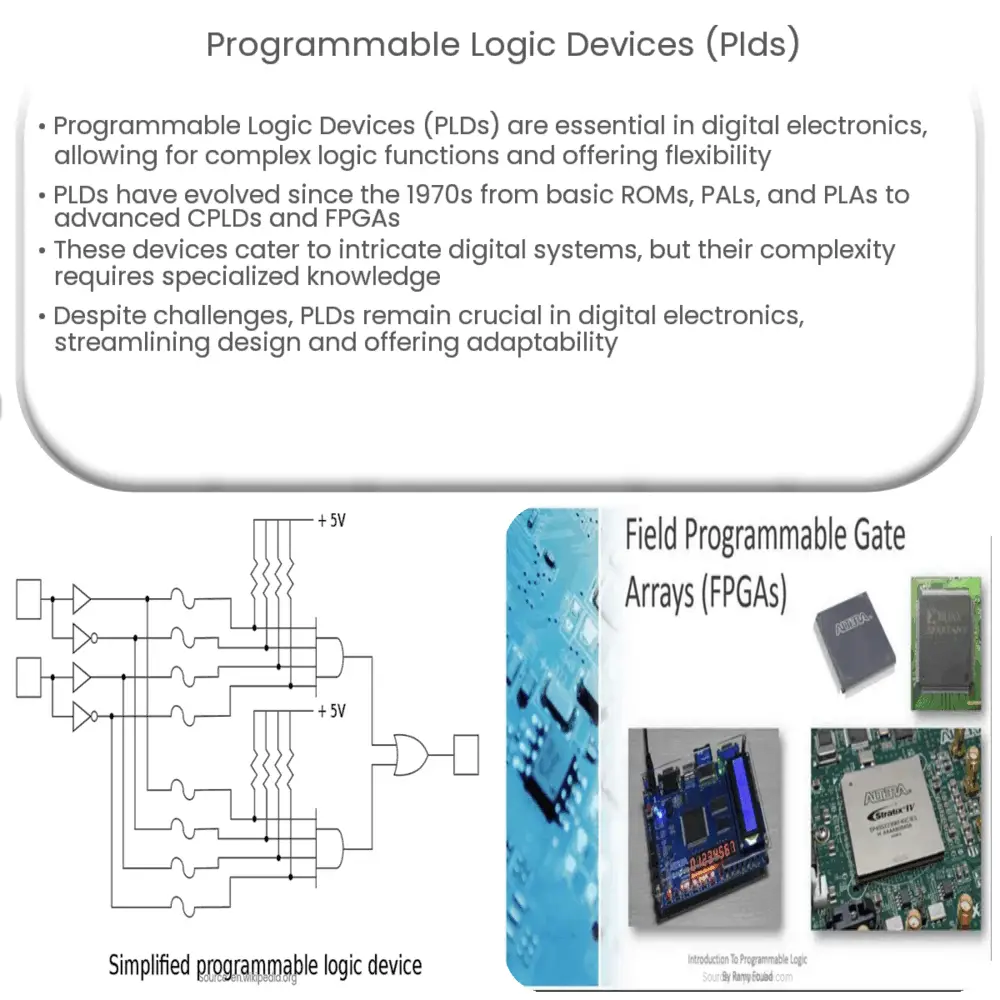
Understanding Programmable Logic Devices (PLDs)
Programmable Logic Devices (PLDs) are an essential component in the realm of digital electronics. These devices are integrated circuits with internal logic gates and flip-flops that can be programmed to execute complex logic functions. PLDs offer flexibility, as the same device can be used for numerous tasks, cutting down on development time and cost.
The Evolution of Programmable Logic Devices
The inception of Programmable Logic Devices dates back to the late 1970s, with the introduction of the Read-Only Memory (ROM), Programmable Array Logic (PAL), and Programmable Logic Array (PLA). These were rudimentary yet ground-breaking, offering the ability to perform basic logic operations. However, they were limited in terms of programmability and complexity.
- ROM: The simplest type of PLD, ROM has a fixed AND array connected to a programmable OR array.
- PAL: PALs have a programmable AND array and a fixed OR array, which gives them more flexibility compared to ROMs.
- PLA: PLAs have both a programmable AND array and a programmable OR array, offering the highest flexibility among early PLDs.
Complex Programmable Logic Devices (CPLDs) and Field-Programmable Gate Arrays (FPGAs)
With advancements in technology, PLDs have evolved into more sophisticated forms, namely Complex Programmable Logic Devices (CPLDs) and Field-Programmable Gate Arrays (FPGAs). CPLDs and FPGAs are capable of handling more complex functions and configurations, enabling them to cater to more advanced and intricate digital systems.
- CPLDs: These devices are characterized by their large number of logic gates and flip-flops. CPLDs are essentially multiple PLDs in one chip, connected by a programmable interconnect. This arrangement allows complex digital circuits to be implemented in a single chip.
- FPGAs: FPGAs are the most flexible type of PLDs, boasting a high gate-count, programmable interconnects, and configurable logic blocks. They are capable of implementing extremely complex digital systems, including processors and SoCs, making them popular in many sectors of the industry.
Despite their versatility, the complex nature of CPLDs and FPGAs also brings a steep learning curve, with design and programming requiring specialized knowledge and tools.
The Applications of Programmable Logic Devices
Programmable Logic Devices have a wide range of applications, spanning across various sectors. They are extensively used in digital systems, embedded systems, and signal processing. PLDs’ customizable nature allows them to be tailored to specific tasks, making them ideal for custom circuit design.
- Digital Systems: PLDs can be programmed to perform a variety of digital logic functions, such as binary addition, binary subtraction, or complex mathematical operations.
- Embedded Systems: In embedded systems, PLDs can be used to control hardware, interface with sensors, and perform data processing tasks.
- Signal Processing: PLDs, especially FPGAs, are utilized in signal processing for real-time operations due to their ability to execute parallel tasks.
Advantages and Disadvantages of Programmable Logic Devices
PLDs bring a host of advantages. They are highly flexible, allowing for easy design changes and modifications. PLDs are also cost-effective for small production runs, as they avoid the high initial costs associated with custom ASIC design. Moreover, they facilitate rapid prototyping, as the same device can be reprogrammed for different tasks.
- However, PLDs also have certain disadvantages. One of the main drawbacks is their relatively high unit cost for large-scale production compared to custom ASICs. Additionally, the performance of PLDs, in terms of speed and power consumption, may not match that of dedicated hardware for the same function.
Conclusion
In conclusion, Programmable Logic Devices play a pivotal role in digital electronics, offering a level of flexibility and versatility that is hard to match. The evolution from simple ROM, PAL, and PLA to advanced CPLDs and FPGAs represents a significant advancement in the industry. Despite their disadvantages, the benefits that PLDs bring to the table make them an indispensable tool for designers and engineers. As technology advances, we can expect PLDs to become even more powerful and accessible, further solidifying their position in the world of electronics.