
KDP is a versatile ferroelectric material with applications in electro-optics, piezoelectric devices, and nonlinear optics.
Potassium Dihydrogen Phosphate (KDP) as Ferroelectric Material
Introduction
Ferroelectric materials have gained significant attention in recent years due to their unique properties, such as spontaneous polarization, piezoelectricity, and electro-optic effects. These materials find applications in various fields, including sensors, actuators, transducers, capacitors, and memory devices. One such promising ferroelectric material is potassium dihydrogen phosphate (KDP), which has shown excellent performance in electro-optic and nonlinear optical applications.
Structure and Properties of KDP
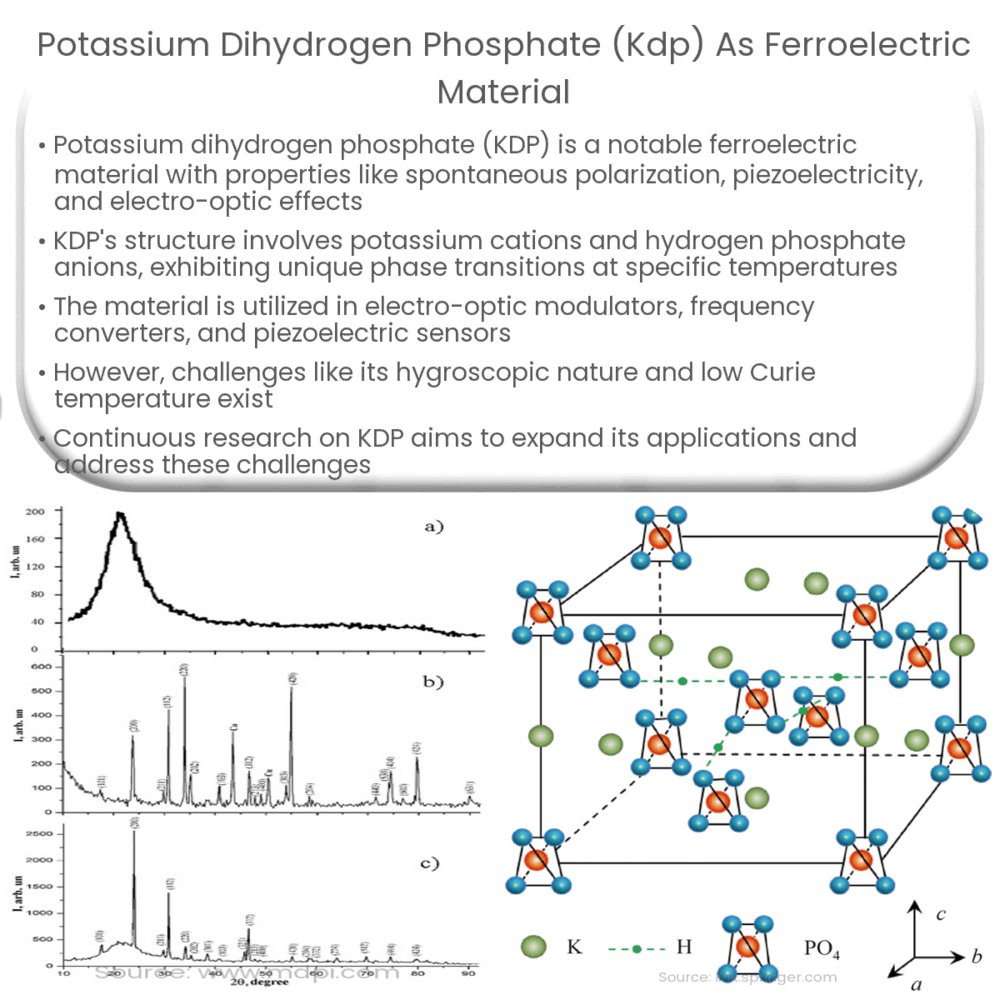
Potassium dihydrogen phosphate (KH2PO4), commonly referred to as KDP, is an inorganic compound that crystallizes in the tetragonal system. It consists of potassium cations (K+), hydrogen phosphate anions (H2PO4–), and hydrogen bonds connecting these ions. The KDP crystal structure exhibits centro-symmetric space groups at room temperature, which transform into non-centrosymmetric space groups upon cooling below the Curie temperature (Tc), around 122 K (-151°C).
As a ferroelectric material, KDP demonstrates spontaneous polarization, which is the result of the displacement of positive and negative ions within the crystal lattice. This spontaneous polarization can be reversed by applying an external electric field, making KDP a promising candidate for various applications, such as electro-optic modulators and frequency converters.
KDP also exhibits excellent piezoelectric properties, which involve the generation of an electric charge in response to mechanical stress. This property makes KDP suitable for applications in sensors and actuators. Furthermore, KDP has a high damage threshold and excellent chemical stability, making it an attractive material for high-power laser systems.
Applications of KDP
Due to its unique ferroelectric, piezoelectric, and electro-optic properties, KDP has found numerous applications in various fields. Some of the most common applications of KDP include:
- Electro-optic modulators: KDP crystals are widely used in electro-optic modulators, which are devices that can control the phase, amplitude, or polarization of an optical signal by applying an electric field. These modulators are essential components in optical communication systems and laser technology.
- Frequency converters: KDP is commonly used in nonlinear optical frequency conversion processes, such as second-harmonic generation (SHG) and optical parametric oscillation (OPO). These processes allow for the conversion of an input laser beam into a new wavelength or a set of wavelengths, enabling various applications in spectroscopy, imaging, and sensing.
- Piezoelectric sensors and actuators: KDP’s piezoelectric properties make it a suitable material for fabricating sensors and actuators that can detect or generate mechanical stress, respectively. These devices find applications in aerospace, automotive, and industrial sectors.
In conclusion, potassium dihydrogen phosphate (KDP) is a versatile ferroelectric material with a wide range of applications, thanks to its unique electro-optic, piezoelectric, and nonlinear optical properties. As research continues to uncover new properties and applications for KDP, it is expected to play an increasingly important role in the development of advanced materials and technologies.
Growth and Fabrication of KDP Crystals
The growth and fabrication of high-quality KDP crystals are essential for their successful implementation in various applications. KDP crystals are typically grown using the slow-cooling or slow-evaporation methods, both of which involve the controlled crystallization of KDP from an aqueous solution. The slow-cooling method consists of slowly decreasing the temperature of a saturated KDP solution, while the slow-evaporation method involves the gradual evaporation of the solvent. Both techniques can produce large, high-quality KDP crystals, but the growth process can take several weeks to months.
Once the KDP crystals are grown, they must be carefully cut, polished, and coated to optimize their electro-optic and piezoelectric properties for specific applications. Advanced fabrication techniques, such as ion-beam etching and chemical-mechanical polishing, can be employed to achieve high surface quality and precise control of crystal dimensions.
Challenges and Future Prospects
Despite the many advantages of KDP as a ferroelectric material, there are some challenges associated with its use. One of the primary challenges is the hygroscopic nature of KDP crystals, which can absorb moisture from the surrounding environment, leading to the degradation of their electro-optic and piezoelectric properties. To overcome this issue, researchers have investigated various methods for improving the stability of KDP crystals, including surface treatments, coatings, and the development of new crystal compositions with reduced hygroscopicity.
Another challenge is the relatively low Curie temperature of KDP, which limits its use in high-temperature applications. To address this issue, researchers are exploring alternative ferroelectric materials with higher Curie temperatures, as well as investigating methods for increasing the Curie temperature of KDP through compositional modifications and doping.
As research progresses, it is expected that these challenges will be addressed, and new applications for KDP will continue to emerge. For example, recent studies have explored the use of KDP in energy storage devices, such as supercapacitors and batteries, as well as in novel photonic and optoelectronic devices, including waveguides and photonic crystals. Furthermore, the integration of KDP with other materials, such as graphene and perovskites, offers exciting opportunities for developing advanced hybrid devices with enhanced functionality and performance.
Conclusion
Potassium dihydrogen phosphate (KDP) is a promising ferroelectric material with a wide range of applications in electro-optic, piezoelectric, and nonlinear optical devices. Its unique properties make it an attractive candidate for various applications, including electro-optic modulators, frequency converters, and piezoelectric sensors and actuators. As researchers continue to explore new properties, fabrication methods, and applications for KDP, it is expected to play a crucial role in the development of next-generation materials and technologies. With ongoing research and development, KDP is poised to make significant contributions to fields such as optics, electronics, and energy storage in the coming years.



