
Polymer humidity sensors offer high sensitivity, fast response times, and cost-effectiveness, enabling diverse applications in agriculture, pharmaceuticals, and environmental monitoring.
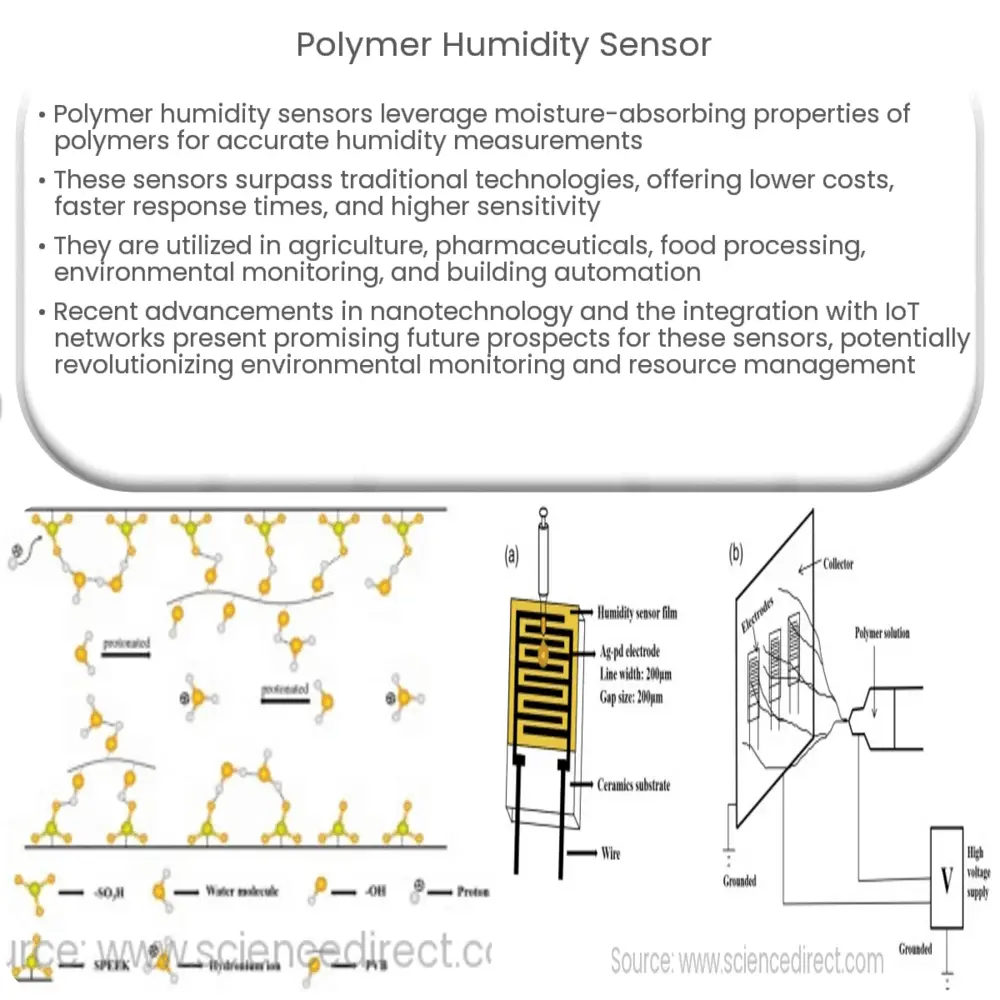
Polymer Humidity Sensors: The Future of Humidity Sensing Technology
Introduction
Humidity sensing is a crucial aspect of various industries, such as agriculture, pharmaceuticals, food processing, and environmental monitoring. Accurate and reliable humidity measurement plays a vital role in maintaining product quality and ensuring optimum operation conditions in these sectors. With the advent of polymer-based humidity sensors, there has been a significant improvement in the efficiency and accuracy of humidity measurement devices. This article will provide an overview of polymer humidity sensors, their working principles, and applications in different industries.
What are Polymer Humidity Sensors?
Polymer humidity sensors are a type of sensing device that utilizes the moisture-absorbing properties of specific polymers to measure relative humidity. These sensors are made up of organic materials with high sensitivity to changes in humidity levels. When exposed to varying humidity conditions, the electrical properties of the polymers alter, which can be measured and correlated to the humidity levels in the environment.
Compared to traditional humidity sensing technologies, such as capacitive or resistive sensors, polymer-based sensors offer various advantages like lower cost, faster response time, higher sensitivity, and better long-term stability. Additionally, these sensors can be easily fabricated and integrated into various devices, making them ideal for a wide range of applications.
Working Principle of Polymer Humidity Sensors
Polymer humidity sensors operate based on the changes in the electrical properties of the polymer material in response to the variations in humidity levels. Generally, there are two types of polymer humidity sensors: resistive and capacitive.
Resistive Polymer Humidity Sensors: In resistive sensors, the change in humidity leads to a change in the resistance of the polymer material. As the humidity level increases, the polymer absorbs moisture, resulting in an increase in the number of charge carriers (ions) within the material. Consequently, the resistance decreases. This change in resistance is measured and correlated to the humidity levels.
Capacitive Polymer Humidity Sensors: Capacitive sensors, on the other hand, work based on the change in the dielectric constant of the polymer material with varying humidity levels. The dielectric constant is a measure of the ability of a material to store electrical energy. As the humidity increases, the absorbed moisture alters the dielectric constant of the polymer, which in turn affects the capacitance of the sensor. The change in capacitance is measured and related to the humidity levels.
Applications of Polymer Humidity Sensors
Polymer humidity sensors find applications in a wide range of industries, including:
- Agriculture: Monitoring humidity levels is essential for maintaining the health of crops and preventing the growth of mold and pests. Polymer humidity sensors can be integrated into smart agricultural systems to provide real-time data on humidity levels, enabling farmers to make informed decisions regarding irrigation and crop management.
- Pharmaceuticals: The pharmaceutical industry requires strict humidity control to ensure the quality and efficacy of drugs. Polymer humidity sensors can be used in cleanrooms, storage facilities, and manufacturing processes to maintain the optimal humidity levels and prevent contamination.
- Food Processing: Humidity control is crucial in the food processing industry to prevent microbial growth and extend the shelf life of products. Polymer humidity sensors can be used in food storage facilities, processing plants, and packaging lines to monitor and control humidity levels effectively.
- Environmental Monitoring: Accurate humidity measurement is vital
for understanding and predicting weather patterns, climate change, and air quality. Polymer humidity sensors can be integrated into weather stations, air quality monitoring systems, and research equipment to provide reliable and accurate humidity data. - Home and Building Automation: Maintaining appropriate humidity levels in homes and commercial buildings is essential for ensuring comfort, energy efficiency, and preventing mold growth. Polymer humidity sensors can be used in HVAC systems, smart thermostats, and air quality monitoring devices to provide real-time data on indoor humidity levels and enable automated control of heating, ventilation, and air conditioning systems.
Advancements and Future Prospects
Recent developments in nanotechnology and materials science have led to significant improvements in the performance and capabilities of polymer humidity sensors. Novel materials, such as conductive polymers, hydrogels, and nanocomposites, are being explored to enhance the sensitivity, response time, and long-term stability of these sensors. Furthermore, advancements in flexible electronics and printed sensors enable the development of lightweight, low-cost, and wearable polymer humidity sensors for various applications.
One promising area of research is the integration of polymer humidity sensors with other environmental sensing technologies, such as temperature and air quality sensors, to develop multifunctional devices capable of providing comprehensive environmental data. This will enable the development of more advanced monitoring systems and smart city infrastructure, contributing to improved decision-making and resource management in various sectors.
Another exciting prospect is the incorporation of polymer humidity sensors into the Internet of Things (IoT) ecosystem. By connecting these sensors to IoT networks, real-time humidity data can be collected and analyzed from multiple sources, allowing for improved environmental monitoring, predictive maintenance, and more efficient resource utilization in various industries.
Conclusion
Polymer humidity sensors offer a promising alternative to traditional humidity sensing technologies due to their cost-effectiveness, high sensitivity, and rapid response times. As research continues to advance in the field of polymer science and sensor technology, it is expected that these sensors will find even more applications in diverse industries, contributing to improved efficiency and sustainability. By incorporating these sensors into IoT networks and integrating them with other environmental sensing technologies, a more comprehensive understanding of our environment can be achieved, paving the way for smarter and more sustainable solutions in the future.



