
Explore the fundamentals of phototransistors, their types, operation, applications, and their role in modern electronics.
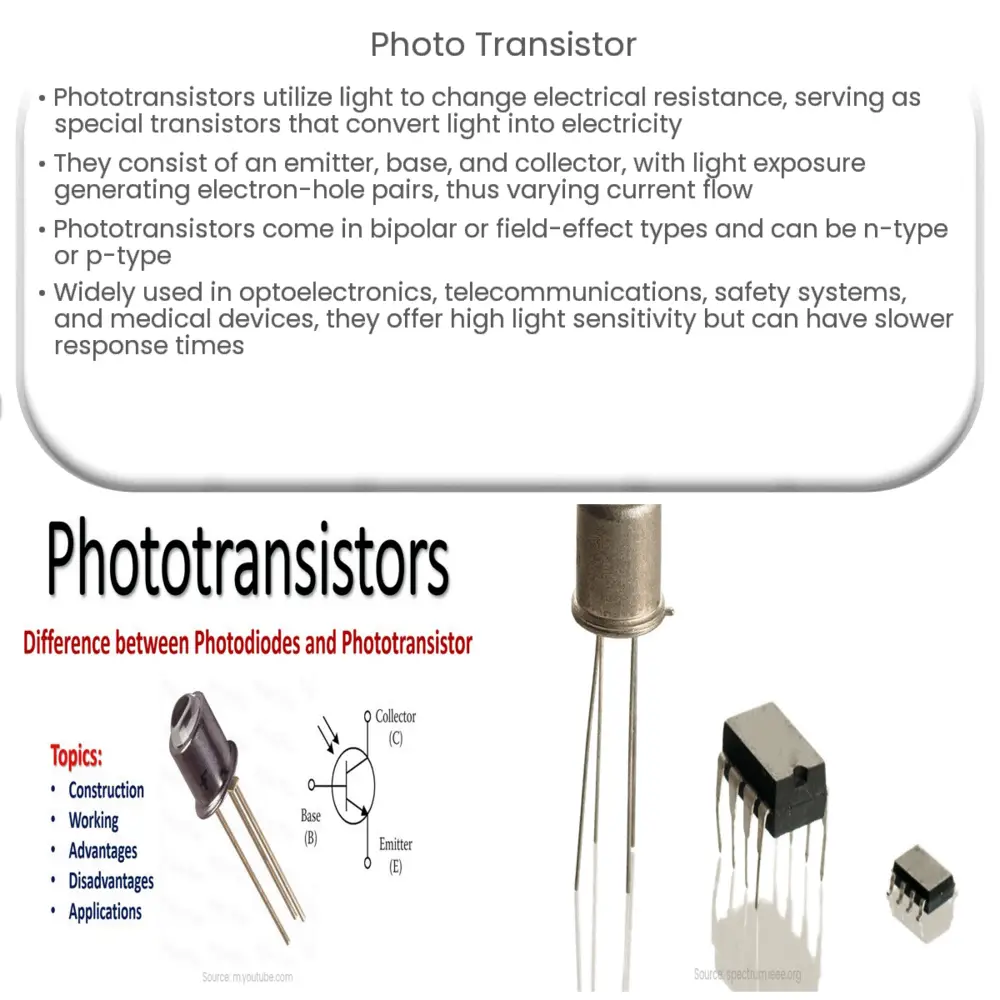
Introduction to Phototransistors
A phototransistor is a unique type of transistor that utilizes light to modify its electrical resistance. This property enables it to perform various functions in different electronics and devices. To understand this, let’s briefly revisit what a transistor is.
The Concept of a Transistor
A transistor is a key semiconductor device that amplifies or switches electronic signals and electrical power. It’s an integral part of virtually all modern electronic devices. The term “transistor” is a combination of “transfer” and “resistor,” which indicates its capability to resist changes in electrical signals and transfer them efficiently. Now, imagine a transistor that changes its behavior based on the amount of light it receives. This is essentially what a phototransistor does.
Understanding Phototransistors
Phototransistors are special types of transistors engineered to convert light into electricity. They function similarly to photodiodes, but they offer more sensitivity to light, making them ideal for use in various applications, including infrared remote controls, laser alignment systems, and ambient light sensing.
Components and Operation of a Phototransistor
A phototransistor typically consists of a bipolar semiconductor and a light-sensitive region. The main components are the emitter, base, and collector, with the base region being light-sensitive. When this region is exposed to light, it generates electron-hole pairs, which are then separated by the internal electric field of the transistor.
The number of charge carriers is directly proportional to the intensity of the incoming light. When the light intensity increases, the number of generated charge carriers also increases, leading to an increase in current flow from the collector to the emitter. This is how a phototransistor converts variations in light intensity into variations in current.
Types of Phototransistors
Phototransistors come in two primary types: bipolar phototransistors and field-effect phototransistors. The bipolar phototransistors operate based on the principle of electron-hole pair generation due to light, while the field-effect phototransistors operate by using light to control the gate voltage.
Additionally, phototransistors can be either n-type or p-type, based on the type of charge carriers that conduct electricity. In n-type phototransistors, electrons are the majority charge carriers, while in p-type phototransistors, holes are the majority charge carriers.
Applications of Phototransistors
Due to their unique light-sensitivity properties, phototransistors find extensive use in various industries and applications. Some of these include:
- Optoelectronics: Phototransistors are used in optocouplers, devices that transmit signals between different parts of an electronic device while keeping them electrically isolated.
- Telecommunications: In fiber optic communication systems, phototransistors act as receivers to convert light signals into electrical signals.
- Safety Systems: Phototransistors are integral to some safety systems, such as smoke detectors and intrusion alarm systems, where they help detect changes in light patterns.
- Medical Devices: They are used in various medical imaging devices to convert light signals into electrical signals for further processing.
Advantages and Disadvantages of Phototransistors
Phototransistors offer several advantages such as high sensitivity to light, good signal-to-noise ratio, and the ability to detect a wide range of light wavelengths. However, they also have some disadvantages, like slower response times compared to photodiodes and a higher susceptibility to damage from excessive light exposure.
Conclusion
In conclusion, phototransistors are remarkable components that have revolutionized many aspects of technology. By effectively converting light into electrical signals, they serve as the backbone of various devices and systems, from everyday gadgets like remote controls to more complex systems such as medical imaging devices and fiber optic communication systems. Despite some limitations, their high sensitivity to light and broad range of detection make them invaluable in an increasingly digital and interconnected world. As technology continues to advance, we can only expect the role and importance of phototransistors to grow even more.



