
Explore the world of Overhauser Magnetometers, their operation, applications, advantages, and future potential in this comprehensive guide.
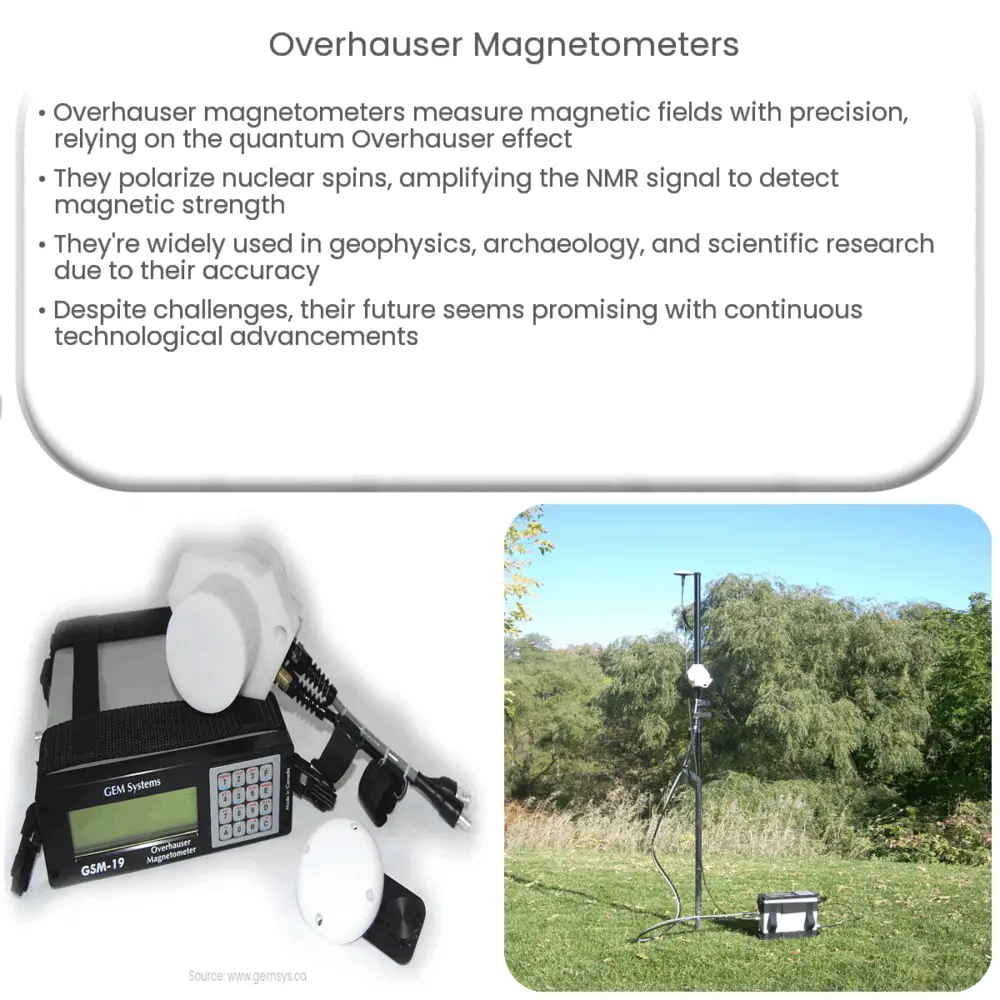
Introduction to Overhauser Magnetometers
Overhauser magnetometers are scientific instruments that measure magnetic fields with high precision. Named after physicist Albert Overhauser, who discovered the Overhauser effect in 1953, these devices rely on this quantum mechanical phenomenon to operate.
The Overhauser Effect
The Overhauser effect, at its core, involves polarizing the nuclear spins in a fluid using electron spin resonance (ESR). When a magnetic field is present, the interaction between the spins of free electrons and atomic nuclei in the fluid results in a phenomenon known as dynamic nuclear polarization (DNP).
This effect greatly enhances the nuclear magnetic resonance (NMR) signal, which is typically quite weak. The amplified signal is what Overhauser magnetometers detect and measure to determine the magnetic field’s strength.
Design and Operation of Overhauser Magnetometers
- Sensor Unit: The magnetometer’s core component is the sensor unit, which contains the fluid needed for the Overhauser effect. This fluid is often a solution of hydrogen atoms, as the proton’s spin is easy to polarize.
- Radiofrequency (RF) Source: The RF source is essential for triggering the Overhauser effect. It generates an RF field that matches the energy difference between the spin states of the free electrons in the sensor fluid.
- Detection Coil: Once the Overhauser effect is initiated, the sensor unit’s protons become polarized and produce an NMR signal. The detection coil picks up this signal.
- Data Processing Unit: This component interprets the NMR signal, converting it into a value that represents the magnetic field’s strength.
Applications of Overhauser Magnetometers
Overhauser magnetometers have a wide range of applications due to their high sensitivity and accuracy. Their ability to measure Earth’s magnetic field makes them invaluable tools in geophysics for mineral exploration and archaeological studies. They’re also used in various scientific research, such as studying the magnetic properties of materials.
In summary, the Overhauser magnetometer is an impressive piece of technology that allows us to measure magnetic fields with high precision. Its operation is based on a unique quantum mechanical effect, and it has diverse applications in many scientific fields.
Advantages of Overhauser Magnetometers
There are several advantages that make Overhauser magnetometers stand out among other types of magnetometers:
- High Precision: These magnetometers offer an unmatched level of precision. The Overhauser effect amplifies the usually weak NMR signal, allowing for highly accurate measurements.
- Low Power Consumption: The Overhauser magnetometer operates with less power compared to other magnetometers. The RF source used to trigger the Overhauser effect requires less energy, making these devices ideal for fieldwork where power supply might be limited.
- Resilience to Temperature Fluctuations: Unlike other magnetometers, Overhauser magnetometers are relatively unaffected by temperature changes. This is because the Overhauser effect is not significantly influenced by temperature, ensuring consistent readings under varying environmental conditions.
- Minimal Drift: Overhauser magnetometers exhibit minimal temporal drift, meaning their readings remain consistent over time. This characteristic is crucial for long-term measurements and monitoring.
Challenges and Future Directions
Despite the numerous advantages, Overhauser magnetometers are not without their challenges. For instance, they require a precise RF source to induce the Overhauser effect, and this may pose challenges in terms of calibration and maintenance. Furthermore, the complexity of these devices can make them more expensive than other types of magnetometers.
Nevertheless, ongoing research and development are expected to address these challenges. With advancements in technology and our understanding of quantum mechanics, the future of Overhauser magnetometers looks promising. Their potential for further miniaturization, for instance, could open up new applications in various fields, including space exploration and biomedical research.
Conclusion
In conclusion, Overhauser magnetometers, named after physicist Albert Overhauser, are precision instruments that measure magnetic fields based on the quantum mechanical Overhauser effect. These devices offer several benefits including high precision, low power consumption, resilience to temperature fluctuations, and minimal drift. Despite some challenges, the future looks promising for Overhauser magnetometers, thanks to ongoing advancements in technology. Whether in geophysics, material science, or even future space missions, these powerful devices continue to pave the way for high-precision magnetic field measurements.



