
Explore the fascinating world of optical isolators, their working principles, types, applications, and future prospects in our detailed guide.
Introduction to Optical Isolators
Optical isolators, often referred to as optical diodes, are crucial components in many advanced optical systems, such as lasers and fiber-optic communications. They serve a very important purpose: allowing light to pass in only one direction, thereby preventing unwanted reflections or feedback that could degrade performance or even damage sensitive optical components.
Working Principle of Optical Isolators
The core functioning of optical isolators relies on the phenomenon known as the Faraday Effect. Named after the famous scientist Michael Faraday, this effect describes the rotation of the plane of polarization of light as it travels through certain materials when subjected to a magnetic field. It is this fundamental principle that allows optical isolators to perform their unique one-way light transmission.
Components of an Optical Isolator
- Polarizer: The polarizer ensures that only light with a specific orientation of the electric field (polarization) is allowed to pass through. This acts as the entry gate for the incoming light.
- Faraday Rotator: This is the central part of an optical isolator. When subjected to a magnetic field, this rotator induces a rotation in the plane of polarization of the incoming light.
- Analyzer: This component is essentially another polarizer. However, it is oriented at an angle such that it allows light coming from the Faraday rotator to pass through but blocks light coming in the reverse direction.
Types of Optical Isolators
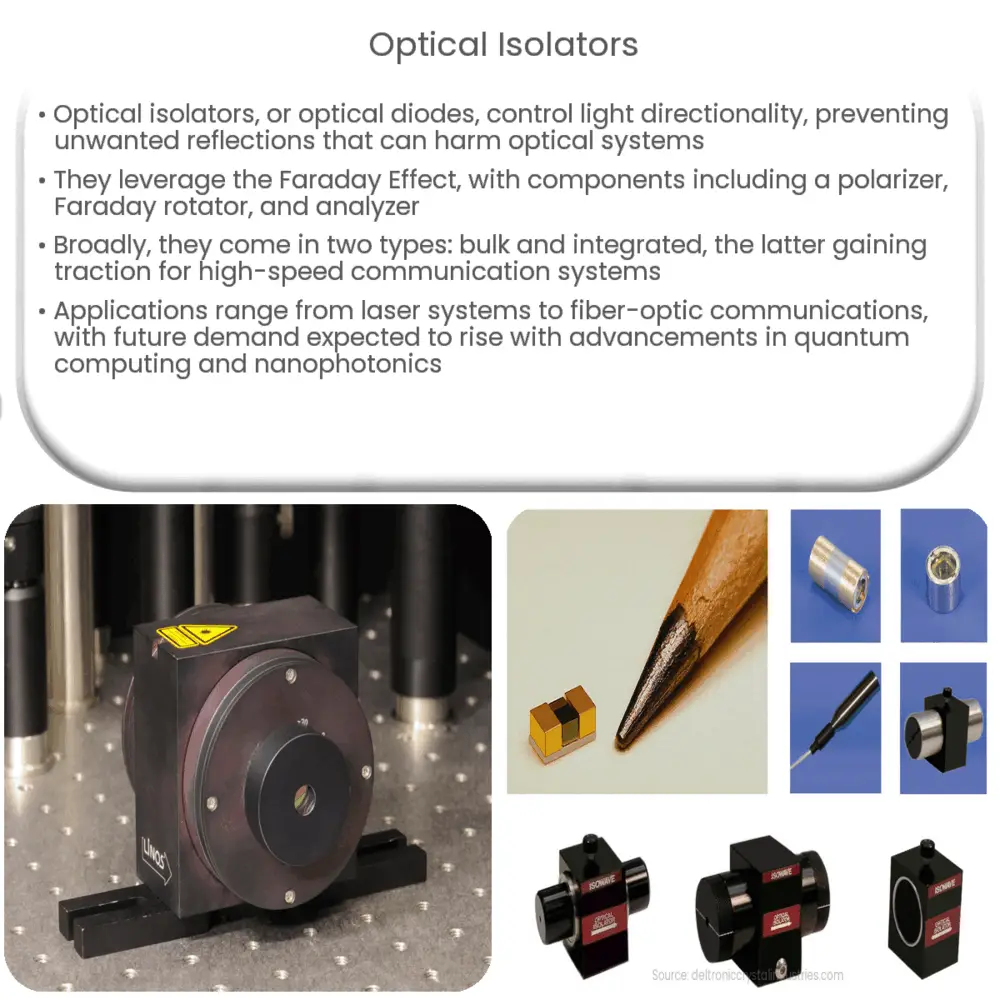
Depending on the physical principle and materials used, optical isolators can be broadly classified into two main types: bulk and integrated optical isolators. While bulk isolators are large and are used in standalone optical systems, integrated optical isolators are much smaller, designed to be used in optical integrated circuits (OICs).
The latter is typically more complex, as they often require the fabrication of several optical components (such as waveguides and phase shifters) onto a single substrate. Despite their complexity, integrated optical isolators have gained significant traction due to their compatibility with high-speed, high-density optical communication systems.
Applications of Optical Isolators
Due to their unique capabilities, optical isolators find a wide range of applications in today’s highly advanced optical systems. Some of the most prevalent applications include:
- Laser Systems: High-powered laser systems often use optical isolators to prevent damaging feedback to the laser source. The optical isolator allows the output light to proceed to the target but blocks any reflected light from reaching the laser source.
- Fiber-Optic Communications: In fiber-optic networks, optical isolators protect sensitive receivers from signals that could be reflected back along the fiber. They are also used in optical amplifiers to prevent unwanted feedback and oscillations.
- Optical Sensors: In optical sensors, isolators are used to eliminate the effects of back reflections or scattering from the measured object, which could interfere with the measurement.
Future of Optical Isolators
As optical technology continues to advance, the demand for optical isolators is projected to increase. Particularly in fields like quantum computing and nanophotonics, where the control of light is of utmost importance, the role of optical isolators will likely be further accentuated. Moreover, with continued research and development in materials science, more efficient and miniaturized optical isolators may be realized, paving the way for more advanced, high-speed, and integrated optical systems.
Conclusion
In conclusion, optical isolators are a pivotal component in the modern world’s sophisticated optical systems, providing a unique solution to control light directionality. Leveraging the Faraday Effect, these components perform the crucial role of protecting sensitive optical devices from potentially damaging reflected light. While their application is already quite broad – from laser systems to fiber-optic communications – the future holds even more possibilities. As we continue to push the boundaries of optical technology, the importance of these fascinating components will only continue to grow.