
Explore the fascinating world of nitrogen lasers, from their working principles and characteristics to diverse applications in research and industry.
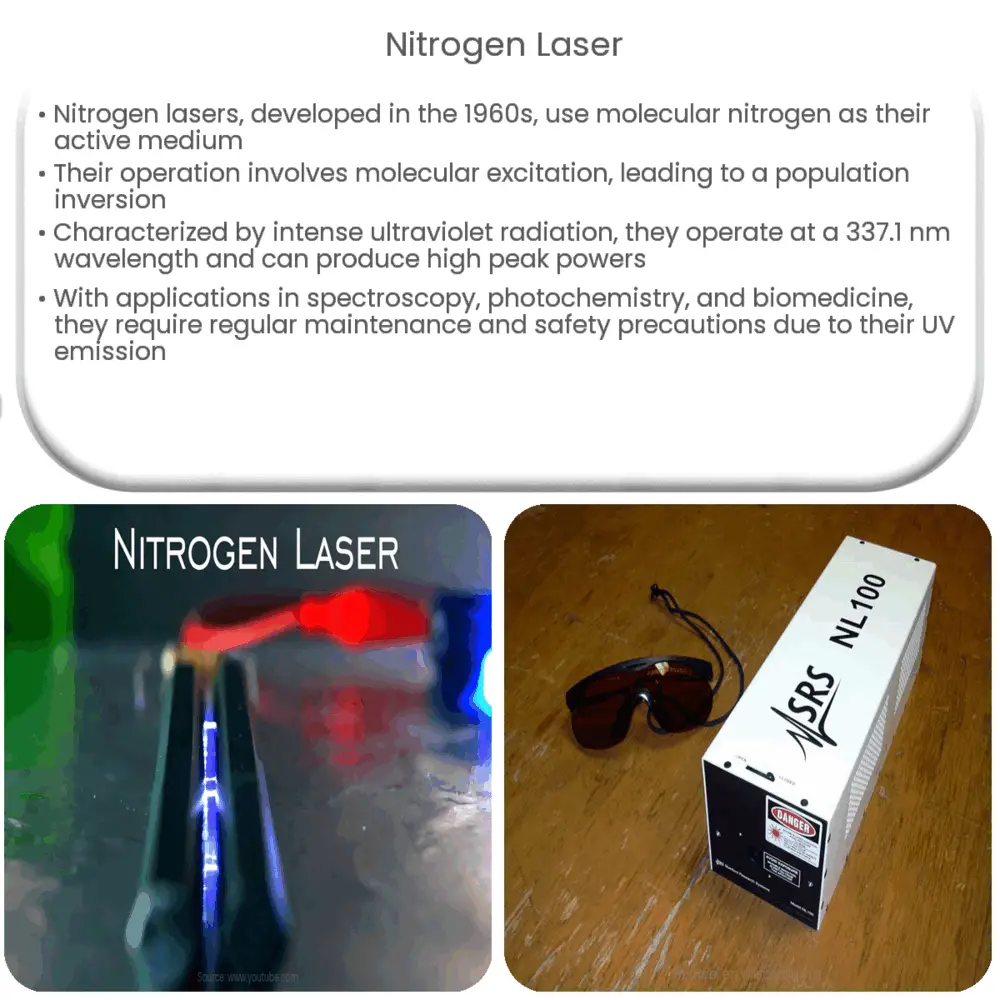
Introduction to Nitrogen Lasers
The field of optics and laser technology has seen vast advancements over the years, one of which is the nitrogen laser. The Nitrogen Laser is a type of gas laser, first developed in the 1960s, that uses molecular nitrogen as its active medium.
Working Principle of Nitrogen Lasers
Unlike other common lasers that rely on atoms as their lasing medium, a nitrogen laser’s operation is based on molecular nitrogen. The nitrogen molecules are excited to a high-energy state by an intense electric field, creating a population inversion necessary for lasing. The key process involved here is known as molecular excitation.
- Molecular Excitation: A nitrogen laser employs a high voltage to generate an electrical discharge, which excites the nitrogen molecules in the laser cavity.
- Population Inversion: Through collisional de-excitation with other nitrogen molecules, the excited nitrogen molecules form a metastable state, which leads to a population inversion.
Characteristics of Nitrogen Lasers
Nitrogen lasers are known for producing intense ultraviolet radiation. They are pulsed lasers, meaning they emit light in short, intense bursts rather than a continuous beam. These lasers typically operate at a wavelength of 337.1 nanometers, which is in the ultraviolet range.
- Wavelength: The primary output of a nitrogen laser is at a wavelength of 337.1 nm, well within the ultraviolet spectrum. However, several weak lines in the infrared and visible spectrum may also be observed.
- Pulse Duration: The pulse duration for a nitrogen laser is typically in the picoseconds (10-12 seconds) to nanoseconds (10-9 seconds) range.
- High Peak Power: Nitrogen lasers are characterized by very high peak powers in the megawatt range, despite their relatively low average power output.
While the basic principles of nitrogen lasers may seem straightforward, their design, construction, and operation are complex and require a solid understanding of laser physics and engineering. These unique lasers have found applications in a wide variety of fields, from spectroscopy to photochemistry, and continue to be an area of active research.
Applications of Nitrogen Lasers
Nitrogen lasers’ unique characteristics make them suitable for a wide range of applications. The ultraviolet light that they produce can be used for various purposes.
- Spectroscopy: In spectroscopy, nitrogen lasers are used to induce fluorescence in different materials. This is particularly useful in determining the composition and characteristics of a sample.
- Photochemistry: The ultraviolet light from nitrogen lasers can be used to initiate chemical reactions, particularly those that require high-energy photons to break chemical bonds.
- Biomedical Applications: In biomedical research, nitrogen lasers are used for fluorescence microscopy and DNA sequencing, among other applications.
- Optical Pumping: Nitrogen lasers can serve as optical pumps to excite other lasing media, such as dye lasers.
Maintenance and Safety Considerations
Like any piece of high-tech equipment, nitrogen lasers require regular maintenance to ensure their proper functioning. This can include realigning optical components, cleaning the laser cavity, and replacing the nitrogen gas as needed.
- Maintenance: Regular cleaning and inspection of the laser cavity, mirrors, and other optical components are necessary to maintain the performance of a nitrogen laser.
- Safety: Given that nitrogen lasers produce intense ultraviolet light, it is essential to take proper safety precautions when operating these lasers. This includes wearing appropriate protective eyewear and avoiding direct skin exposure to the laser beam.
Conclusion
In conclusion, nitrogen lasers are a remarkable piece of technology with a broad range of applications in various fields. Their unique characteristics, such as high peak power and ultraviolet emission, make them invaluable tools in research and industry. Despite their complexity, with proper understanding, maintenance, and safety measures, they can be effectively used to further advance scientific and technological development.