
Explore the essentials of multimeters, their types, specifications, and safe usage. Ideal for beginners, DIY enthusiasts, and professionals alike.
Introduction to Multimeters
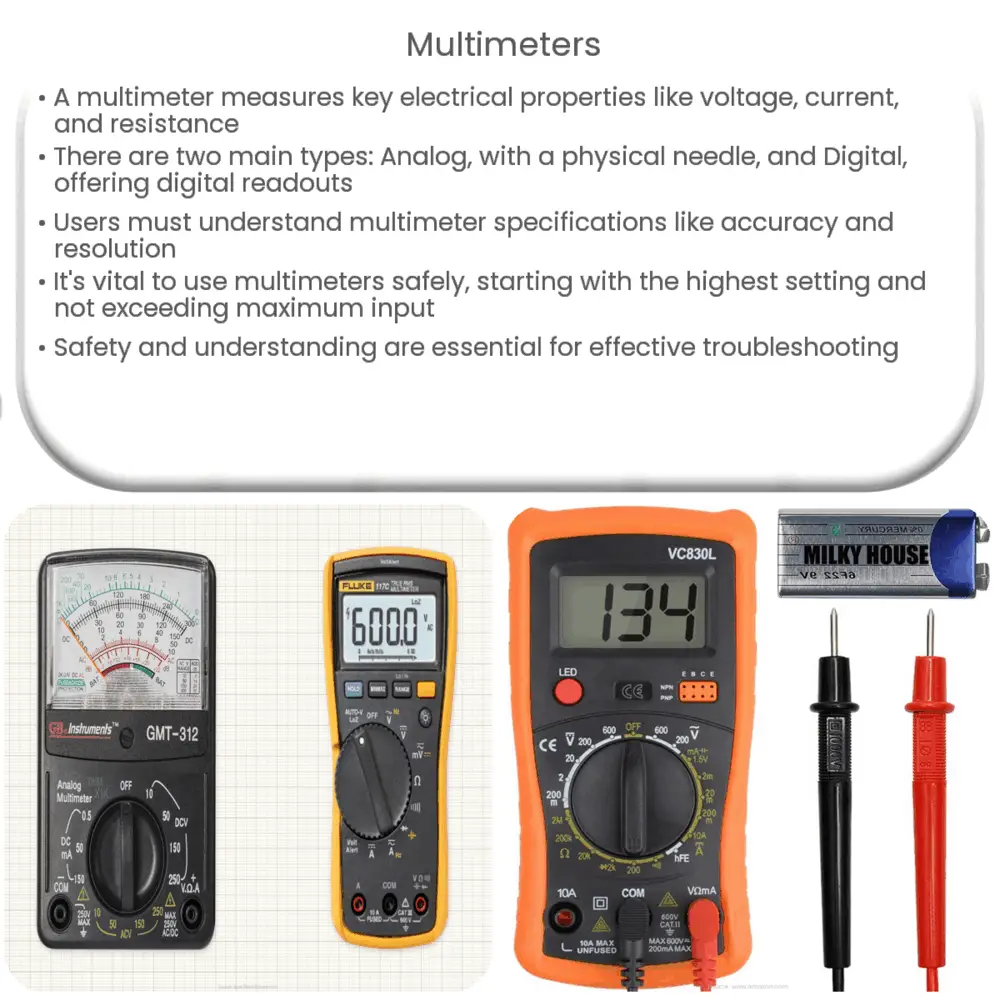
A multimeter, also known as a volt-ohm meter, is a versatile device used in electronics and electrical engineering. Primarily, it is used to measure three key electrical characteristics: voltage, current, and resistance.
Types of Multimeters
- Analog Multimeters: These are the original type of multimeter, featuring a physical needle that moves over a scale. They are best for detecting slow voltage changes because you can see the needle move in real time.
- Digital Multimeters: More common today, digital multimeters (DMMs) provide digital readouts, improving accuracy and allowing for additional features.
Key Measurements
- Voltage: This is the potential difference between two points in an electrical circuit. Multimeters can measure both direct current (DC) and alternating current (AC) voltages.
- Current: Measured in amperes (A), this is the flow of electricity through a conductor. Like voltage, multimeters can measure both AC and DC currents.
- Resistance: Measured in ohms (Ω), this is the opposition to the flow of an electric current. A multimeter can help to check for continuity and detect faults or breaks in a circuit.
Understanding Multimeter Specifications
Multimeters come in a range of models, each with their own specifications. Here are some important specifications you should understand:
- Accuracy: This is usually expressed as a percentage and indicates how close the multimeter’s measurement will be to the actual value. More expensive multimeters typically have a higher accuracy.
- Resolution: This is the smallest change in an input signal that the multimeter can detect. It is often given in digits or counts.
- Safety Rating: Multimeters are rated according to their ability to withstand voltage spikes. These ratings are denoted as CAT I, II, III, or IV, with CAT IV being the highest.
Understanding multimeters and their specifications is key to selecting the right tool for your needs, whether you’re a professional electrician, a hobbyist, or a DIY enthusiast. In the next part, we will look at how to use a multimeter safely and effectively.
Using a Multimeter
To use a multimeter, you need to understand its basic functionality. Here’s a step-by-step guide:
- Setting the Meter: Begin by setting the meter to the measurement you want to take. For example, if you want to measure voltage, you need to turn the dial to either the DC or AC voltage section.
- Connecting the Probes: Next, connect the probes to the device you’re testing. The red probe goes to the positive side, and the black one goes to the negative side. If you’re uncertain, always refer to the device’s manual.
- Taking the Measurement: Once the probes are connected, you can read the measurement on the multimeter’s display. Remember, if you’re not getting a reading, double-check your settings and connections.
Safety Considerations
When using a multimeter, safety is paramount. Here are some safety tips:
- Always Start with the Highest Setting: When you’re not sure of the expected reading, start with the highest setting to prevent damaging the multimeter.
- Use the Correct Probes: Not all probes are suitable for all measurements. Make sure you’re using the right ones.
- Never Exceed the Maximum Input: Every multimeter has a maximum input value. Exceeding this could damage the device or even cause personal injury.
Conclusion
In conclusion, a multimeter is an essential tool in electronics and electrical engineering. It can measure various electrical properties like voltage, current, and resistance, making it an indispensable tool for troubleshooting and maintaining electrical systems. Understanding its types, specifications, and safe usage are crucial. Whether you are a professional or a DIY enthusiast, a multimeter is a valuable addition to your toolkit.
Remember, safety is paramount when using a multimeter. Always read the user manual and adhere to the safety guidelines. With careful use and understanding, a multimeter can help you diagnose and solve a wide range of electrical problems.



