
Explore the function, types, applications, challenges, and future of Motor Position Regulators in our detailed guide.
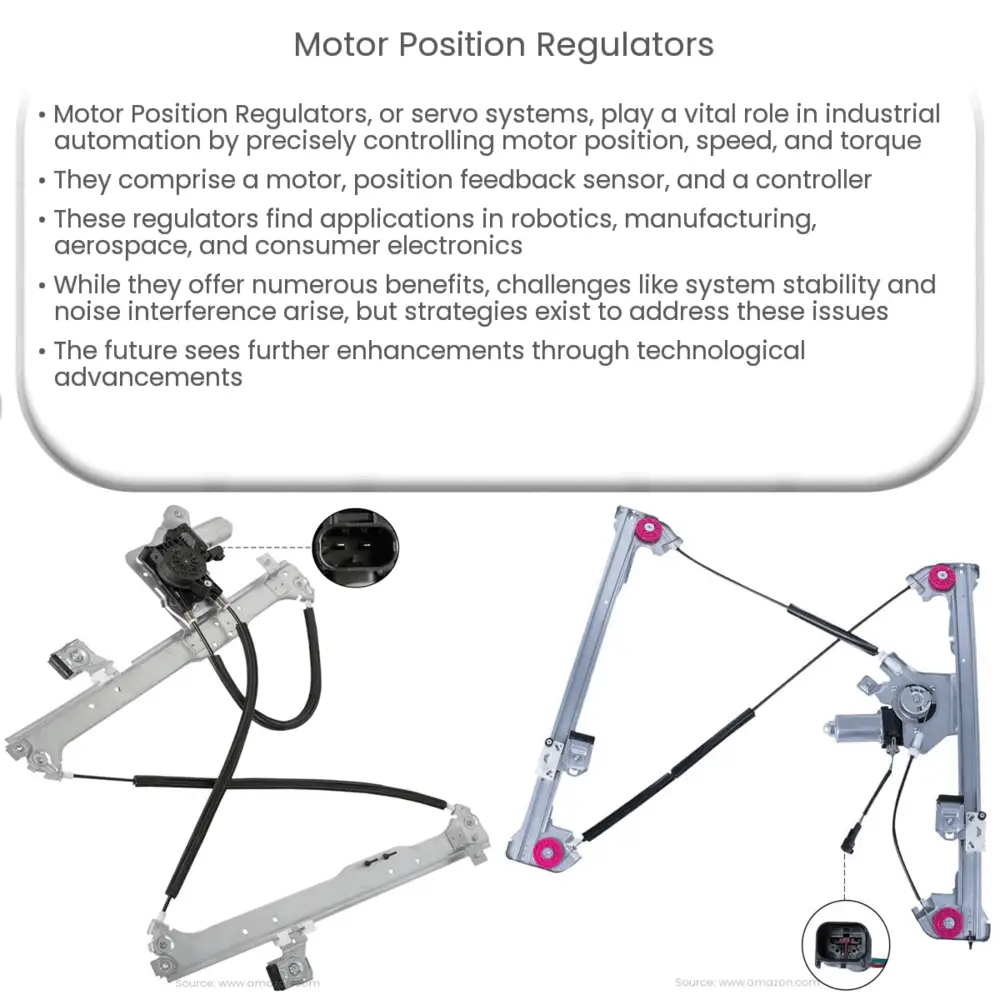
Introduction to Motor Position Regulators
Motor Position Regulators, also referred to as servo systems, have a crucial role in industrial automation. They are designed to maintain precise control over motor position, speed, and torque, thereby ensuring efficiency and accuracy in various applications.
How do Motor Position Regulators Work?
Motor Position Regulators consist of several integral components including a motor, a sensor for position feedback, and a controller. The controller directs the motor’s movements and uses feedback from the sensor to correct any deviations from the desired position, thereby maintaining accurate control over the motor’s operation.
Types of Motor Position Regulators
- Proportional Regulators: These regulators adjust the control signal proportionally to the distance from the desired position. However, they may not achieve perfect accuracy due to steady-state error.
- Integral Regulators: They are designed to eliminate steady-state errors by integrating the position error over time and adjusting the control signal accordingly.
- Derivative Regulators: Also known as rate controllers, they predict future errors by calculating the rate of change of the error, providing an efficient response to rapid changes in the system.
Applications of Motor Position Regulators
- Robotics: In robotics, servo systems help to control the motion and positioning of robotic arms and legs.
- Automated manufacturing: In production lines, they are used to ensure precise positioning of tools and products.
- Aerospace: They help to control and adjust the movements of aerodynamic surfaces in aircraft.
- Consumer Electronics: Servo systems are used in devices like cameras for autofocus and image stabilization.
Given the wide-ranging applications and the precision offered by these regulators, they are indispensable in a variety of sectors. With ongoing advancements in technology, their capabilities are expected to increase, further broadening their scope of applications.
Challenges in Implementing Motor Position Regulators
While the benefits of motor position regulators are undeniable, it is important to note that their implementation comes with certain challenges. These involve system stability issues, noise interference, and need for precise tuning. Understanding these challenges helps to devise better strategies for system design and operation. The following section dives deeper into these challenges, exploring how they can be mitigated.
Overcoming Challenges in Motor Position Regulator Implementation
In order to counter the challenges associated with Motor Position Regulators, several strategies can be adopted.
- System Stability: Choosing a suitable type of regulator and proper tuning of the regulator parameters can significantly improve system stability. Advanced control strategies like adaptive control or robust control can be employed for systems with varying parameters.
- Noise Interference: Filters can be integrated into the system to minimize the impact of noise. Alternatively, shielded cables and appropriate grounding practices can be used to prevent electromagnetic interference.
- Precise Tuning: Digital controllers with auto-tuning capabilities can simplify the tuning process and improve the performance of the regulator. Advanced tuning methods, such as Ziegler-Nichols or Cohen-Coon, can also be employed for better control precision.
Future of Motor Position Regulators
The future of motor position regulators looks promising, with continuous advancements in technology set to propel their capabilities further. With the increasing adoption of AI and machine learning techniques, predictive control strategies can be developed for improved system performance and operational efficiency. Additionally, the growing trend towards miniaturization could potentially lead to the development of smaller, more efficient motor position regulators suitable for a broader range of applications.
Conclusion
In conclusion, motor position regulators are pivotal components in a wide range of industries, facilitating precise control of motor position, speed, and torque. While their implementation does come with certain challenges such as system stability issues, noise interference, and need for precise tuning, there are several strategies available to mitigate these hurdles. As we move towards the future, advancements in technology are set to provide even more enhanced capabilities, making these regulators even more efficient and versatile. Understanding the intricacies of motor position regulators is key to harnessing their full potential and applying them effectively in various applications.



