
Motor Diagnostics Equipment

Explore the importance, types, and emerging trends in motor diagnostics equipment, and learn how to choose the right tool for your needs.
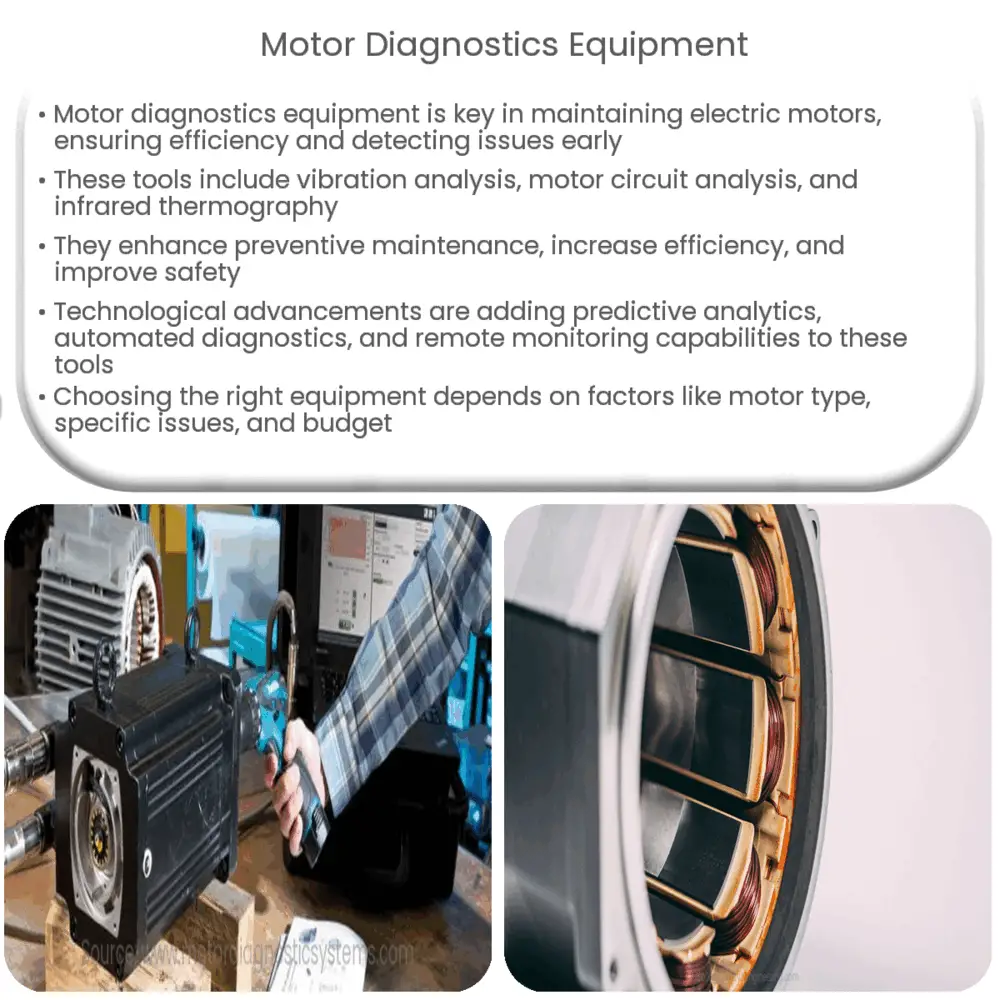
Motor Diagnostics Equipment

Understanding Motor Diagnostics Equipment

Motor diagnostics equipment plays a crucial role in the management of electric motors, ensuring they run efficiently and detecting potential issues before they turn into costly problems. These tools not only save time and money but also improve safety by avoiding unexpected failures.

Types of Motor Diagnostics Equipment

There are several types of motor diagnostics equipment available in the market, each designed to measure different parameters and identify various issues. Some of the most common ones include:

  • Vibration Analysis Equipment: This tool detects imbalances and misalignments in the motor by analyzing its vibration patterns.
  • Motor Circuit Analysis (MCA) Equipment: MCA tools assess the motor’s electrical circuits, identifying issues such as insulation breakdown, weak connections, and short circuits.
  • Infrared Thermography: This equipment detects heat patterns in the motor, pointing out areas of excessive heat that may indicate overloading or poor ventilation.
  • Importance of Motor Diagnostics Equipment

    Implementing motor diagnostics tools is not only about preventive maintenance; it’s about optimizing performance, increasing the lifespan of the motor, and ultimately, saving resources. Let’s delve into some of the reasons why these tools are so crucial:

  • 1 Preventive Maintenance: This equipment allows maintenance teams to identify issues before they result in motor failure. By catching problems early, it helps prevent costly repairs or replacements.
  • 2 Increased Efficiency: Regular diagnostics can identify inefficiencies in motor performance, such as excessive energy consumption, allowing for adjustments that can lead to significant energy savings.
  • 3 Safety: By identifying potential failures in advance, these tools contribute to safer working conditions, preventing unexpected breakdowns that could lead to accidents.
  • Motor diagnostics equipment is an invaluable asset for any facility that relies on electric motors. By providing detailed insights into motor performance and health, these tools empower businesses to maintain their motors effectively, maximizing productivity and reducing operational costs.

    Emerging Trends in Motor Diagnostics

    As technology evolves, so does motor diagnostics equipment. With advancements in artificial intelligence and machine learning, diagnostic tools are becoming more sophisticated and accurate, offering a host of benefits:

  • Predictive Analytics: Modern diagnostics tools can predict potential issues, providing early warnings so that preventive measures can be taken in time.
  • Automated Diagnostics: The incorporation of AI and machine learning allows for automated diagnostics, reducing the need for manual intervention and increasing accuracy.
  • Remote Monitoring: With the integration of Internet of Things (IoT) technology, diagnostics can be carried out remotely, providing real-time updates about the health of motors across different locations.
  • Choosing the Right Motor Diagnostics Equipment

    Selecting the right motor diagnostics equipment depends on several factors. Firstly, the type and size of the motor need to be taken into account. Secondly, the specific issues that the equipment is expected to detect should be considered. Lastly, the budget allocated for this purpose also plays a critical role.

  • 1 Type and Size of Motor: Different motors may require different diagnostics tools. For instance, larger motors may require more sophisticated equipment.
  • 2 Specific Issues: Certain tools are better at detecting specific issues. If a motor frequently experiences a particular problem, a diagnostics tool that can effectively identify that issue should be prioritized.
  • 3 Budget: While more advanced tools might offer comprehensive diagnostics, they are often more expensive. It’s important to balance the need for detailed analysis with budget constraints.
  • Conclusion

    In conclusion, motor diagnostics equipment is a cornerstone of effective motor management. It not only prevents costly motor failures but also optimizes performance, ensuring that motors operate at their peak efficiency. With the advent of AI and IoT technologies, these tools are becoming even more powerful, capable of providing predictive insights and facilitating remote monitoring. As such, investing in the right motor diagnostics equipment is crucial for any business that relies heavily on electric motors, as it significantly contributes to operational efficiency and bottom-line savings.

    header - logo

    The primary purpose of this project is to help the public to learn some exciting and important information about electricity and magnetism.

    Privacy Policy

    Our Website follows all legal requirements to protect your privacy. Visit our Privacy Policy page.

    The Cookies Statement is part of our Privacy Policy.

    Editorial note

    The information contained on this website is for general information purposes only. This website does not use any proprietary data. Visit our Editorial note.

    Copyright Notice

    It’s simple:

    1) You may use almost everything for non-commercial and educational use.

    2) You may not distribute or commercially exploit the content, especially on another website.