
Explore the role of motor current sensors in automation and control systems, their types, applications, and future trends.
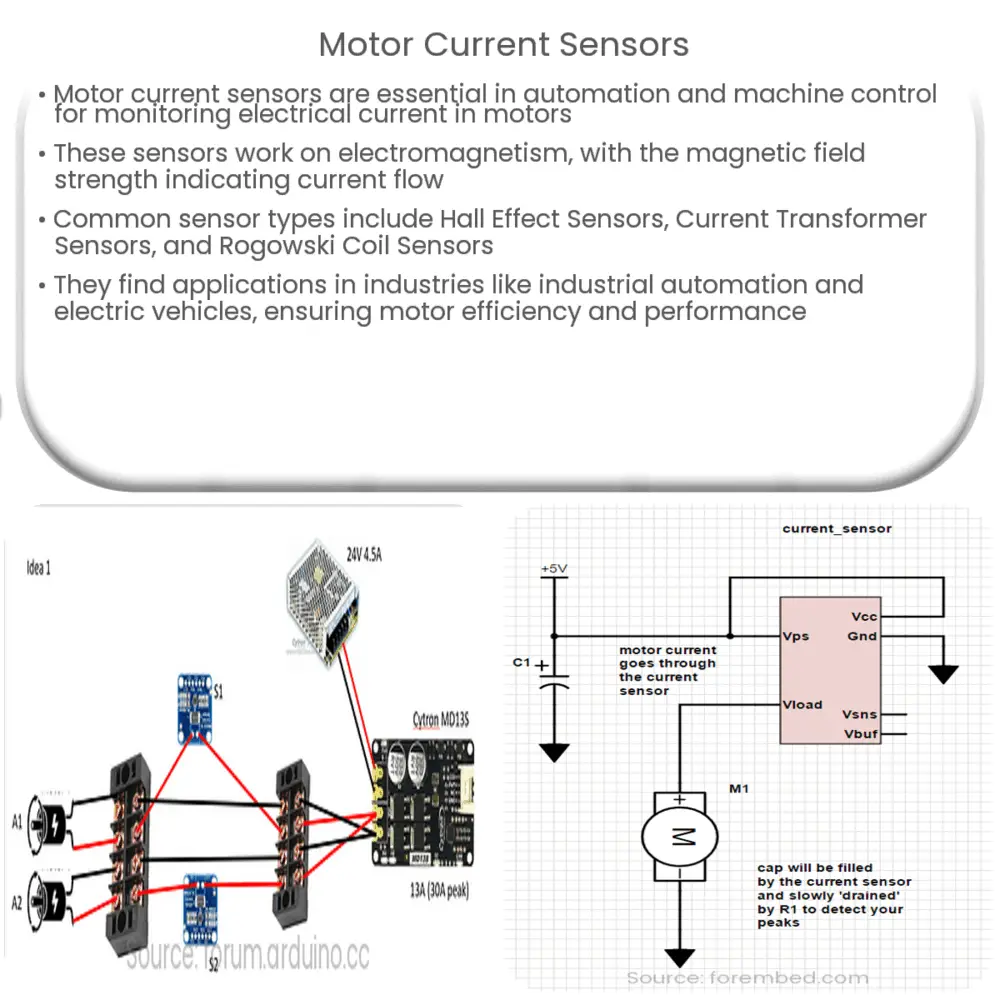
Understanding Motor Current Sensors
Motor current sensors play a crucial role in the modern world of automation and machine control. These sensors, as their name suggests, are primarily used to monitor the electrical current flowing through a motor. This monitoring helps to ensure the optimal performance and longevity of the equipment, allowing for more efficient and reliable operations.
Working Principle of Motor Current Sensors
At the heart of a motor current sensor is the principle of electromagnetism. These devices detect the magnetic field produced by the current flowing through the motor’s conductor. The strength of this magnetic field is proportional to the amount of current flowing, thus providing a measure of the motor’s electrical load.
Types of Motor Current Sensors
- Hall Effect Sensors: These are the most common types of motor current sensors. They work based on the Hall effect, a phenomenon where a voltage difference is created perpendicular to the direction of current and magnetic field. The sensor then interprets this voltage difference as a measure of current.
- Current Transformer Sensors: These sensors work by inducing a secondary current proportional to the primary current flowing through the motor. The secondary current is then measured to estimate the motor current.
- Rogowski Coil Sensors: Rogowski coils work on the principle of electromagnetic induction. They produce a voltage that is proportional to the rate of change of current in the motor.
Applications of Motor Current Sensors
Motor current sensors find a wide range of applications across various industries. In industrial automation, for example, these sensors are used to prevent motor overload and to detect abnormal conditions like phase loss or unbalance. They are also used in electric vehicles to monitor the performance of the motor and to ensure efficient energy usage.
Importance of Motor Current Sensors
The importance of motor current sensors can’t be underestimated. They not only provide valuable data that aids in the preventative maintenance of motors, but also help to improve the overall efficiency of machines. By monitoring and controlling the current, these sensors can prevent damage to the motor, thus reducing downtime and repair costs.
The Future of Motor Current Sensors
As we move further into the era of automation and digitalization, the role of motor current sensors is set to become even more significant. With advancements in sensor technology and the increased adoption of the Internet of Things (IoT), these sensors are becoming more accurate, smaller, and capable of providing real-time data for better decision-making.
The emergence of smart sensors, capable of processing and analyzing data on the edge, promises to revolutionize how we monitor and control motors. These sensors can provide real-time insights into the motor’s performance, predict potential failures, and suggest preventative actions to enhance the motor’s lifespan.
Choosing the Right Motor Current Sensor
Selecting the right motor current sensor is essential to ensure optimal motor performance. Various factors should be considered, such as the type of motor, the operating environment, the current range, the accuracy requirements, and the available space for the sensor.
It’s also important to consider the sensor’s compatibility with the motor control system. The sensor should be able to communicate seamlessly with the control system to provide accurate, timely data for effective motor management.
Conclusion
In conclusion, motor current sensors are pivotal components in the realm of automation and control systems. They offer invaluable benefits, including enhancing motor efficiency, preventing damage, and reducing downtime, by providing real-time monitoring of motor current.
With rapid advancements in sensor technology and the growing trend towards smart manufacturing and IoT, the importance of these sensors is set to increase in the future. Whether it’s in industrial automation, electric vehicles, or any application that relies on electric motors, current sensors will continue to play a vital role in ensuring optimal performance and efficiency.



