
MEMS humidity sensors offer compact, low-power, and cost-effective solutions for various applications, from agriculture to wearable tech.
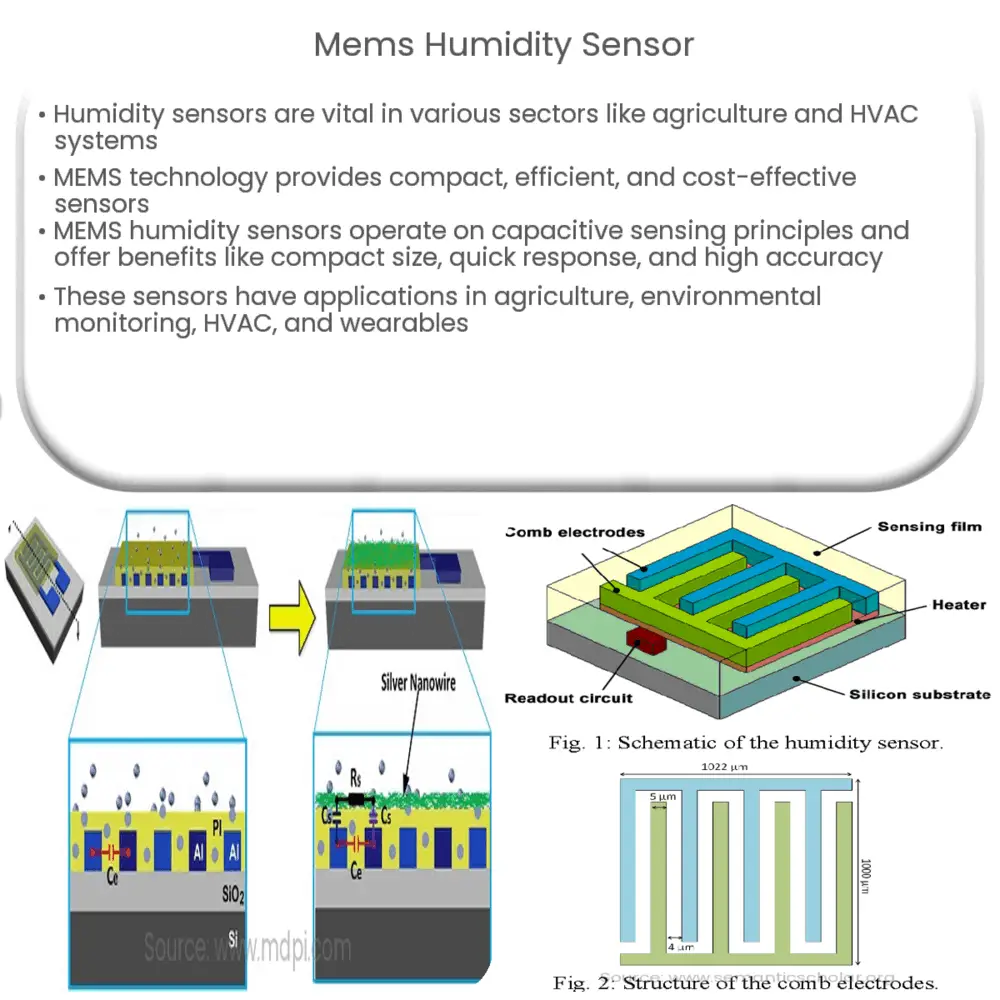
Introduction to MEMS Humidity Sensors
Humidity sensors play a critical role in various industries, from agriculture and environmental monitoring to HVAC systems and weather forecasting. As the demand for smaller, more efficient, and cost-effective sensors grows, MEMS (Micro-Electro-Mechanical Systems) technology has emerged as a promising solution. In this article, we will discuss the advantages of MEMS humidity sensors and their applications in different sectors.
Understanding MEMS Technology
MEMS technology involves the integration of mechanical elements, sensors, actuators, and electronics on a single silicon substrate. This miniaturization process allows for the creation of highly compact, lightweight, and low-power devices. Over the past few decades, MEMS technology has made significant advancements, leading to its adoption in various applications, including pressure sensors, accelerometers, and humidity sensors.
How MEMS Humidity Sensors Work
MEMS humidity sensors typically operate based on capacitive sensing principles. These sensors consist of a thin layer of a moisture-sensitive material, such as a polymer or metal oxide, sandwiched between two electrodes. When the humidity level in the surrounding environment changes, the amount of moisture absorbed by the sensitive material also changes. This, in turn, alters the capacitance between the electrodes, which can be measured and converted into a humidity reading.
There are also resistive-based MEMS humidity sensors, which work by monitoring the change in resistance of a humidity-sensitive material in response to varying moisture levels. However, capacitive sensors are generally preferred due to their higher sensitivity, accuracy, and faster response times.
Advantages of MEMS Humidity Sensors
MEMS humidity sensors offer several advantages over traditional humidity sensing technologies, such as bulkier capacitive or resistive sensors:
- Compact Size: MEMS sensors are significantly smaller than conventional sensors, making them ideal for space-constrained applications or for embedding in portable devices.
- Lower Power Consumption: Due to their small size and efficient design, MEMS sensors consume less power, which is particularly important for battery-powered devices and energy-sensitive applications.
- Faster Response Time: The small size and thin sensing layers of MEMS sensors enable them to respond more quickly to changes in humidity, providing real-time monitoring and improved accuracy.
- High Sensitivity and Accuracy: Advanced manufacturing processes and materials have allowed for the development of MEMS sensors with high sensitivity and accuracy, rivaling or surpassing that of traditional humidity sensors.
- Cost-effective: MEMS sensors can be mass-produced using standard semiconductor fabrication techniques, making them more affordable and accessible for a wide range of applications.
Applications of MEMS Humidity Sensors
With their unique advantages, MEMS humidity sensors have found applications in various industries and sectors:
- Agriculture: Monitoring soil moisture and environmental conditions in greenhouses and fields to optimize crop growth and yield.
- Environmental Monitoring: Tracking humidity levels in natural habitats to study the impact of climate change and other environmental factors on ecosystems.
- HVAC Systems: Controlling indoor humidity levels to ensure occupant comfort and prevent the growth of mold and other allergens.
- Weather Forecasting: Collecting humidity data for weather prediction models and early warning
systems for severe weather events. - Industrial Processes: Ensuring optimal humidity levels in manufacturing processes that require precise environmental control, such as pharmaceuticals, electronics, and food production.
- Automotive: Monitoring cabin humidity levels for climate control systems and detecting window fogging to improve driver safety and comfort.
- Smart Home Devices: Integrating MEMS humidity sensors in smart thermostats and air purifiers to maintain healthy and comfortable indoor environments.
- Wearable Technology: Embedding humidity sensors in smartwatches and fitness trackers to monitor environmental conditions and provide personalized health and wellness recommendations.
Challenges and Future Developments
Despite their numerous advantages, MEMS humidity sensors still face some challenges. One key issue is long-term stability, as the performance of the sensor can drift over time due to material aging, contamination, or external stress. Researchers and manufacturers are working to improve the stability and reliability of these sensors through advanced materials, protective coatings, and calibration techniques.
Another area of focus for future development is improving sensor performance in harsh environments, such as high temperatures, high humidity levels, or the presence of corrosive gases. By developing more robust and resilient sensors, MEMS technology can be applied in even more diverse and demanding applications.
Conclusion
MEMS humidity sensors have made significant strides in recent years, offering a compact, low-power, and cost-effective solution for a wide range of applications. As researchers and manufacturers continue to improve the performance, stability, and resilience of these sensors, their adoption is likely to grow, bringing the benefits of MEMS technology to even more industries and sectors. With their unique advantages and expanding applications, MEMS humidity sensors are set to play an increasingly important role in our daily lives and the world around us.