
The mechanical gyroscope is a spinning device that maintains orientation, used in navigation, electronics, VR, and robotics.
Mechanical Gyroscope: The Unsung Hero of Modern Technology
Introduction
The mechanical gyroscope, a device that has been around for over a century, has played a crucial role in advancing modern technology. Its applications range from navigation and stabilization systems to smartphone sensors and virtual reality headsets. This article will delve into the fascinating history of the mechanical gyroscope, discuss its key components and principles, and explore its numerous applications across various industries.
A Brief History of the Mechanical Gyroscope
The invention of the mechanical gyroscope can be traced back to French physicist Leon Foucault in 1852. He developed the device to demonstrate the Earth’s rotation without the need for astronomical observations. The term “gyroscope” was derived from the Greek words “gyros,” meaning “circle” or “rotation,” and “skopien,” meaning “to observe. Throughout the years, the mechanical gyroscope has evolved from a scientific instrument to a vital component in various technological applications.
Components and Principles of the Mechanical Gyroscope
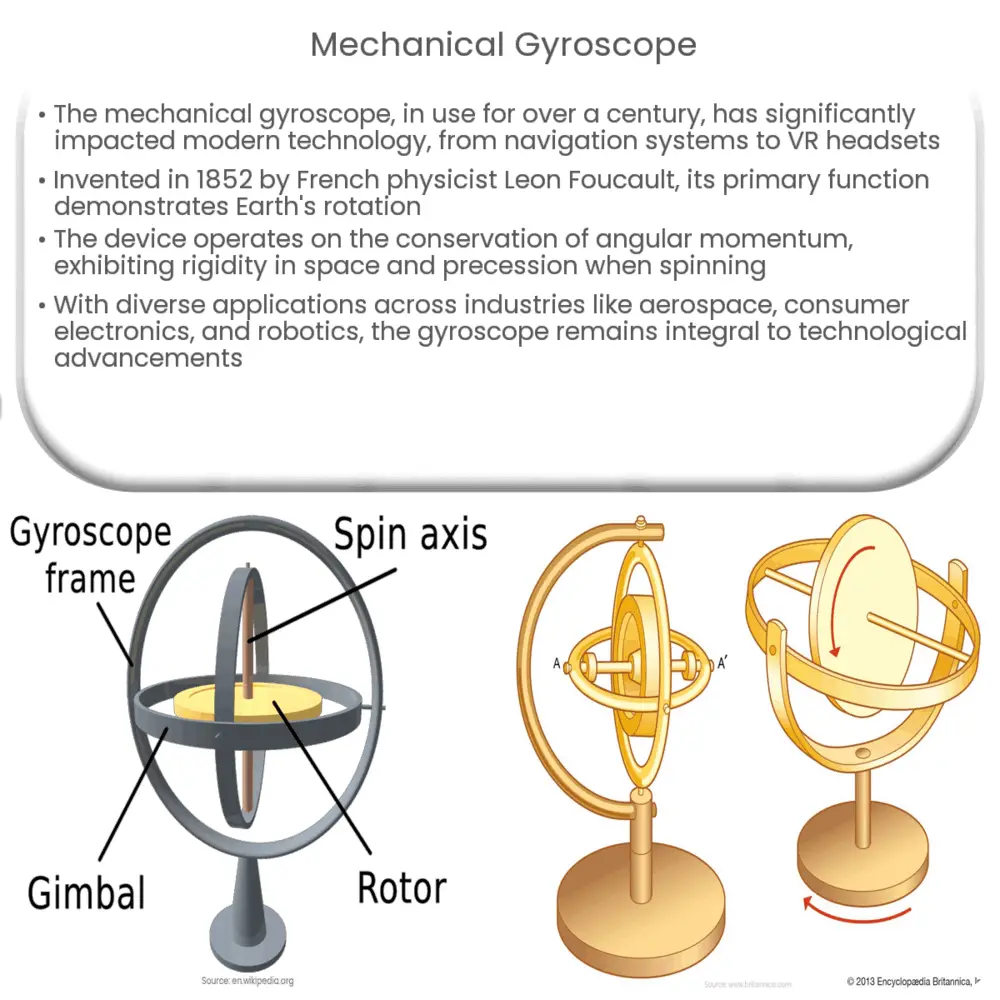
A mechanical gyroscope consists of a spinning wheel or disk, also known as the rotor, mounted on a frame. The frame, which allows for freedom of movement in two or three planes, comprises a gimbal system. The basic principle behind a gyroscope is the conservation of angular momentum, a property that states that a spinning object will continue to spin about its axis unless acted upon by an external torque.
When the rotor spins at a high speed, the gyroscope exhibits two main properties: rigidity in space and precession. Rigidity in space refers to the gyroscope’s ability to maintain its orientation in relation to the fixed points in space. Precession, on the other hand, occurs when an external force is applied to the gyroscope, causing it to change its orientation at a right angle to the direction of the applied force.
Applications of the Mechanical Gyroscope
Over the years, mechanical gyroscopes have found applications across various industries. Some notable examples include:
- Navigation and Stabilization Systems: Gyroscopes have been used in ships, aircraft, and spacecraft for stabilization and navigation purposes. They help determine the orientation of the vessel and provide data for autopilot systems.
- Consumer Electronics: Gyroscopic sensors are now commonplace in smartphones, tablets, and gaming controllers, enabling features such as screen rotation, motion sensing, and gesture recognition.
- Virtual Reality: Gyroscopes play a crucial role in virtual reality headsets, tracking the user’s head movement and providing accurate, immersive experiences.
- Automotive Industry: Gyroscopes are used in automotive systems to improve vehicle stability, particularly in electronic stability control systems that help prevent skidding and loss of control.
Robotic Systems
Robotic Systems: Mechanical gyroscopes are crucial in the development and operation of various robotic systems. They help stabilize and maintain the orientation of robots, particularly in challenging environments such as space or underwater exploration. Autonomous drones and self-balancing robots are prime examples of how gyroscopes enhance the performance and reliability of robotic systems.
Scientific Research
Scientific Research: Mechanical gyroscopes continue to play a significant role in scientific research, particularly in the study of physics, engineering, and material science. Their unique properties make them ideal for investigating topics such as angular momentum, centripetal force, and the behavior of rotating systems. Gyroscopes are also used in advanced research projects, such as the Gravity Probe B mission, which aimed to test Einstein’s General Theory of Relativity.
Future Developments and Challenges
As technology continues to advance, so does the potential for new and innovative applications of mechanical gyroscopes. Researchers are exploring ways to improve the performance, accuracy, and reliability of these devices, particularly in high-precision applications such as space exploration and advanced navigation systems. Miniaturization and integration with other sensors, such as accelerometers and magnetometers, are among the challenges faced in developing next-generation gyroscopes.
Conclusion
The mechanical gyroscope, a device with a rich history and an extensive range of applications, remains an essential component in modern technology. Its unique properties of rigidity in space and precession have made it indispensable in various industries, including aerospace, consumer electronics, virtual reality, and robotics. As our understanding of these properties expands, and technological advancements continue, the mechanical gyroscope will undoubtedly play a crucial role in shaping the future of innovation.



