
Magnetostrictive Magnetic Gears offer contactless power transmission with reduced friction, increased efficiency, and lower noise levels.
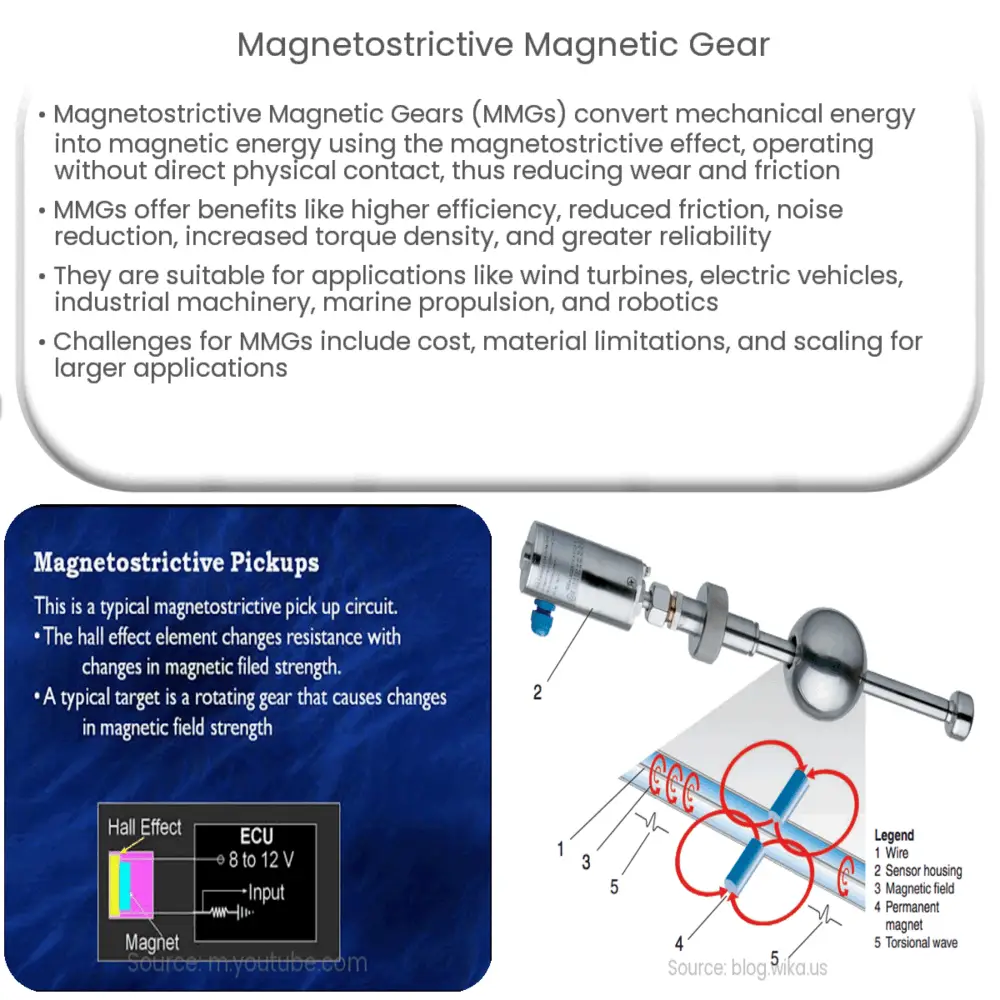
Magnetostrictive Magnetic Gear: The Future of Power Transmission
Introduction
Magnetic gears have gained significant attention in recent years as an innovative solution for power transmission systems. One particularly promising development in this field is the Magnetostrictive Magnetic Gear (MMG), which offers numerous benefits over traditional mechanical gears. This article will provide an overview of MMGs, their working principles, and advantages over conventional gear systems.
What is a Magnetostrictive Magnetic Gear?
A Magnetostrictive Magnetic Gear (MMG) is a type of magnetic gear that utilizes the magnetostrictive effect to convert mechanical energy into magnetic energy and vice versa. The magnetostrictive effect refers to the change in the shape or dimensions of a material when subjected to a magnetic field. MMGs operate without direct physical contact between the driving and driven components, resulting in reduced friction, wear, and maintenance requirements.
Working Principle of Magnetostrictive Magnetic Gears
The operation of an MMG involves three primary components: the input (driving) magnetic rotor, the output (driven) magnetic rotor, and the magnetostrictive intermediate component. The input rotor contains a series of permanent magnets, while the output rotor has a set of magnetic poles. The magnetostrictive component, typically composed of a ferromagnetic material, is located between the input and output rotors.
When a torque is applied to the input rotor, the magnetic field generated by its permanent magnets interacts with the magnetostrictive component, causing it to change shape. This shape change generates a secondary magnetic field, which in turn interacts with the magnetic poles on the output rotor. The resulting force causes the output rotor to rotate, effectively transmitting torque from the input to the output rotor without physical contact.
Advantages of Magnetostrictive Magnetic Gears
Magnetostrictive Magnetic Gears offer several advantages over conventional mechanical gears:
- Reduced friction and wear: As there is no physical contact between the input and output rotors, MMGs experience significantly less friction and wear than traditional gears, resulting in longer service life and reduced maintenance requirements.
- High efficiency: The non-contact nature of MMGs minimizes energy losses due to friction, leading to higher overall efficiency in power transmission.
- Increased torque density: MMGs can achieve a higher torque density (torque per unit volume) compared to conventional gears, making them suitable for compact applications with limited space.
- Noise reduction: With the absence of mechanical contact and friction, MMGs operate with reduced noise levels, making them ideal for applications where noise is a critical concern.
- Improved reliability: The non-contact operation and reduced wear of MMGs contribute to increased reliability and reduced downtime.
Applications of Magnetostrictive Magnetic Gears
Given their numerous advantages, Magnetostrictive Magnetic Gears are well-suited for a wide range of applications, including:
- Wind turbines: MMGs can improve the efficiency and reliability of wind turbine gearboxes by reducing friction, wear, and noise levels. This can lead to increased energy generation and reduced maintenance costs.
- Electric vehicles: MMGs can be employed in electric vehicle drivetrains to increase torque density and overall efficiency, potentially leading to reduced energy consumption and longer driving ranges.
- Industrial machinery: In various industrial applications, MMGs can replace conventional gears to reduce noise levels, improve reliability, and extend the service life of machinery.
- Marine propulsion: MMGs can be integrated into marine propulsion systems to increase efficiency and reduce noise levels, contributing to the overall performance and environmental impact of vessels.
- Robotics: The high torque density and compact design of MMGs make them suitable for robotic applications where precision, low noise, and high reliability are essential.
Challenges and Future Development
Despite their numerous advantages, Magnetostrictive Magnetic Gears still face certain challenges that must be addressed before they can achieve widespread adoption:
- Cost: The materials and manufacturing processes required for MMGs can be expensive, particularly when compared to traditional gears. Further research and development are needed to reduce costs and make MMGs more accessible for various applications.
- Material limitations: The performance of MMGs depends on the magnetostrictive materials used. Developing new materials with improved magnetostrictive properties can help enhance the performance of MMGs and broaden their range of applications.
- Scaling: While MMGs have shown promise at smaller scales, scaling up their design for larger applications remains a challenge. Further research and development are necessary to address this issue and expand the potential use cases for MMGs.
In conclusion, Magnetostrictive Magnetic Gears represent a promising advancement in power transmission technology. Their numerous advantages, including reduced friction and wear, increased efficiency, and lower noise levels, make them an attractive alternative to conventional gears in a variety of applications. Continued research and development in this field will likely lead to improved materials and designs, addressing current challenges and paving the way for broader adoption of this innovative technology.