
Explore the fascinating world of magnetic field mappers: their operation, applications across diverse fields, and future prospects.
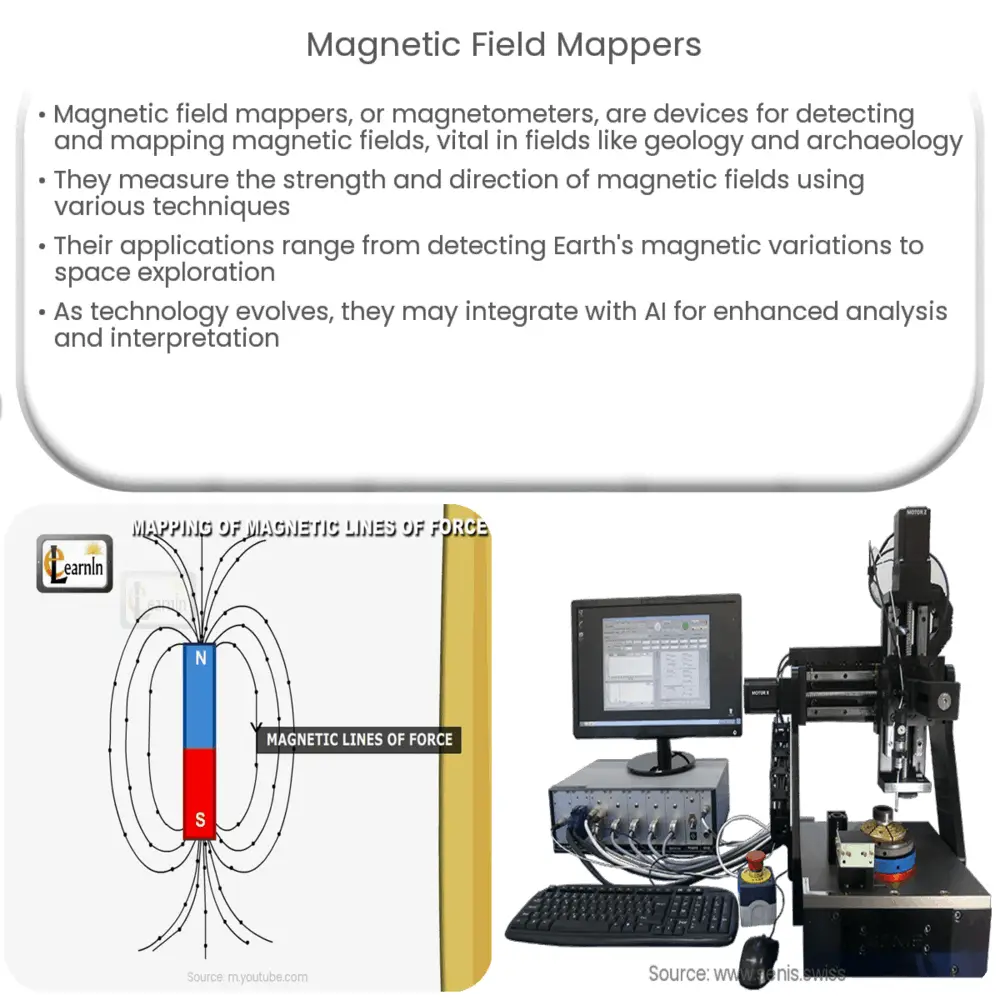
Magnetic Field Mappers: A Detailed Overview
Magnetic field mappers, also known as magnetometers, are highly sophisticated devices designed for detecting and mapping magnetic fields. They have been pivotal in numerous fields such as geology, archaeology, and even space exploration. In this article, we will delve into the technology behind these devices, their applications, and their impact on our understanding of the world around us.
The Science Behind Magnetic Field Mappers
Magnetic fields are invisible areas of influence around a magnetic force, like a magnet or the earth itself. These fields can be mapped using specific tools, primarily magnetometers, which are designed to measure the strength and, in some cases, the direction of a magnetic field.
- Fluxgate Magnetometers: Fluxgate magnetometers operate based on the principle of magnetic saturation. They comprise a ferromagnetic core wrapped with two coils of wire. When an external magnetic field is present, it disrupts the symmetry of the induced voltage, which can then be measured to determine the strength of the field.
- Proton Precession Magnetometers: These mappers use the phenomenon of proton precession. When hydrogen atoms are subjected to a strong magnetic field, the protons align with it. Once the field is removed, the protons precess, or wobble, at a frequency directly proportional to the field’s strength. This frequency is then measured to map the field.
- Optically Pumped Magnetometers: These magnetometers leverage the quantum property of atoms. When certain atoms are excited by light, their electrons can occupy a higher energy state. The rate at which these electrons return to their ground state is influenced by the presence of a magnetic field, thereby allowing its measurement.
Applications of Magnetic Field Mappers
Magnetic field mappers find extensive use in various industries and research fields. In geology, they are used to detect variations in the Earth’s magnetic field, helping geologists locate mineral deposits, understand plate tectonics, and study the Earth’s inner structure. In archaeology, magnetometers allow researchers to detect buried archaeological features without excavation, as these often cause anomalies in the local magnetic field.
Furthermore, space exploration and planetary science also heavily rely on magnetic field mapping. For example, NASA has employed magnetometers in its Mars rovers to study the Red Planet’s magnetic field, contributing to our understanding of its geological history.
Significance of Magnetic Field Mappers in Space Exploration
Space probes equipped with magnetometers have been essential in the exploration of our solar system. From the Apollo missions that studied the Moon’s faint magnetic field to the Voyager spacecraft that ventured into interstellar space, these magnetic field mappers have provided invaluable data about the magnetic environments of various celestial bodies. This has helped scientists better understand phenomena like the solar wind, planetary magnetospheres, and the interaction of magnetic fields with cosmic radiation.
Future of Magnetic Field Mappers
As we advance further into the age of technology, the capabilities of magnetic field mappers are expected to evolve significantly. Potential advancements may include increased sensitivity, miniaturization for better portability, and the development of new types of magnetometers based on emerging scientific principles.
Furthermore, the integration of artificial intelligence (AI) with magnetometers could revolutionize the way we analyze and interpret magnetic data. AI algorithms could potentially identify patterns and anomalies in magnetic data more efficiently and accurately than human analysis, leading to faster, more precise magnetic mapping.
Conclusion
In conclusion, magnetic field mappers, while operating quietly in the background, play a significant role in many areas of science and industry. From uncovering the secrets of archaeological sites to revealing the mysteries of distant celestial bodies, these devices have proved to be indispensable tools in our quest for knowledge. As technology continues to advance, magnetic field mappers will undoubtedly become even more crucial in our exploration and understanding of the world around us and the universe beyond.



