
Lithium tantalate is a versatile ferroelectric material with applications in electronics, optics, energy storage, and biomedical devices.
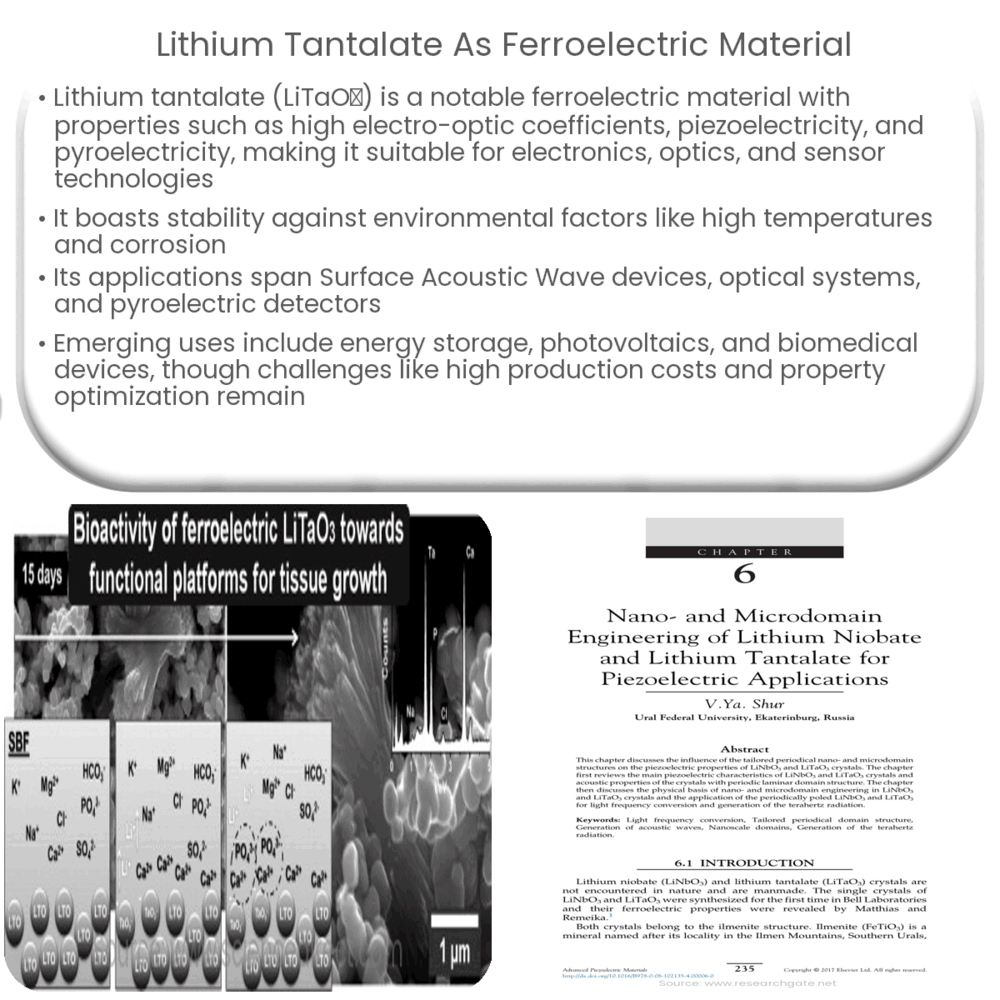
Lithium Tantalate as Ferroelectric Material
Lithium tantalate (LiTaO3), a ferroelectric material, has gained significant attention in the scientific community due to its unique properties and wide range of potential applications. In this article, we will explore the characteristics of lithium tantalate, its ferroelectric properties, and the various applications in which it can be utilized.
Characteristics of Lithium Tantalate
Lithium tantalate is a crystalline material belonging to the family of perovskite structures. It exhibits a variety of desirable properties such as high electro-optic coefficients, non-linear optical properties, piezoelectricity, and pyroelectricity. These attributes make LiTaO3 suitable for numerous applications in electronics, optics, and sensor technologies.
One of the main reasons for the growing interest in lithium tantalate is its stability. LiTaO3 is chemically stable and resistant to a wide range of environmental conditions, including high temperatures, humidity, and corrosive environments. This makes it a prime candidate for applications in harsh environments where other ferroelectric materials may not be suitable.
Ferroelectric Properties
Ferroelectric materials are characterized by their ability to exhibit spontaneous electric polarization, which can be reversed by the application of an external electric field. This unique property allows these materials to be used in a variety of electronic devices, such as capacitors, memory devices, and sensors. Lithium tantalate is a ferroelectric material that exhibits a high Curie temperature (the temperature above which a ferroelectric material loses its spontaneous polarization) of around 600-700°C, making it suitable for high-temperature applications.
Moreover, the combination of LiTaO3‘s ferroelectric properties with its high electro-optic coefficients and non-linear optical properties enables the development of advanced photonic devices. For instance, the Pockels effect, a linear electro-optic effect, can be exploited in lithium tantalate to create high-speed modulators and switches in optical communication systems.
Applications of Lithium Tantalate
Given its unique properties, lithium tantalate has found a variety of applications in different fields. Some of the most common applications include:
- Surface Acoustic Wave (SAW) Devices: Due to its piezoelectric properties, LiTaO3 can be used in the fabrication of SAW devices, which are commonly used in filters, resonators, and sensors in various industries, such as telecommunications, automotive, and aerospace.
- Optical Devices: The electro-optic and non-linear optical properties of lithium tantalate make it an ideal material for a range of photonic devices, including optical modulators, switches, and waveguides. These devices are crucial components in modern communication systems and other optical applications.
- Pyroelectric Detectors: Lithium tantalate’s pyroelectric properties allow it to detect changes in temperature, making it suitable for the development of infrared sensors and thermal imaging devices.
In conclusion, lithium tantalate is a versatile ferroelectric material with a multitude of potential applications. Its unique combination of properties, such as high electro-optic coefficients, piezoelectricity, and pyroelectricity, make it an attractive material for researchers and engineers working in various industries.
Emerging Applications
As research into lithium tantalate continues to progress, new and exciting applications are emerging, further expanding its potential impact across various industries. Some of these emerging applications include:
- Energy Storage: Due to its high dielectric constant and ferroelectric properties, LiTaO3 is being studied for use in energy storage devices, such as supercapacitors and rechargeable batteries. Its potential for high energy density and fast charge-discharge cycles makes it an attractive candidate for next-generation energy storage solutions.
- Photovoltaics: Lithium tantalate’s ferroelectric properties, combined with its wide bandgap, have led researchers to explore its potential use in solar cells. The material’s ability to separate and transport charge carriers could improve the efficiency of photovoltaic devices, making it a promising candidate for future solar cell technologies.
- Biomedical Applications: The piezoelectric and pyroelectric properties of LiTaO3 have sparked interest in its potential use in biomedical devices, such as biosensors, drug delivery systems, and tissue engineering scaffolds. The material’s biocompatibility and ability to generate electric fields in response to mechanical stress or temperature changes may enable the development of innovative medical technologies.
Challenges and Future Prospects
Despite the numerous potential applications of lithium tantalate, certain challenges need to be addressed to unlock its full potential. One of the main challenges is the high cost of LiTaO3 production, primarily due to the limited availability of tantalum resources and the complex crystal growth processes required for producing high-quality lithium tantalate crystals. Researchers are working on developing more cost-effective production methods to make this material more accessible and commercially viable.
Another challenge lies in improving the material’s properties to better suit specific applications. For instance, research is ongoing to optimize the ferroelectric, piezoelectric, and electro-optic properties of lithium tantalate through various techniques, such as doping, compositional engineering, and defect control. These advancements could significantly enhance the performance of LiTaO3-based devices in their respective applications.
In conclusion, lithium tantalate is a promising ferroelectric material with a broad range of potential applications across various industries. As research into LiTaO3 progresses and new techniques are developed to address existing challenges, it is expected that lithium tantalate will play an increasingly important role in the fields of electronics, optics, energy, and biomedical technologies. The future prospects for this versatile material are bright, and its potential impact on our daily lives is immense.



