
Explore the world of liquid crystal temperature sensors, their types, unique properties, and widespread applications across industries.
Introduction to Liquid Crystal Temperature Sensors
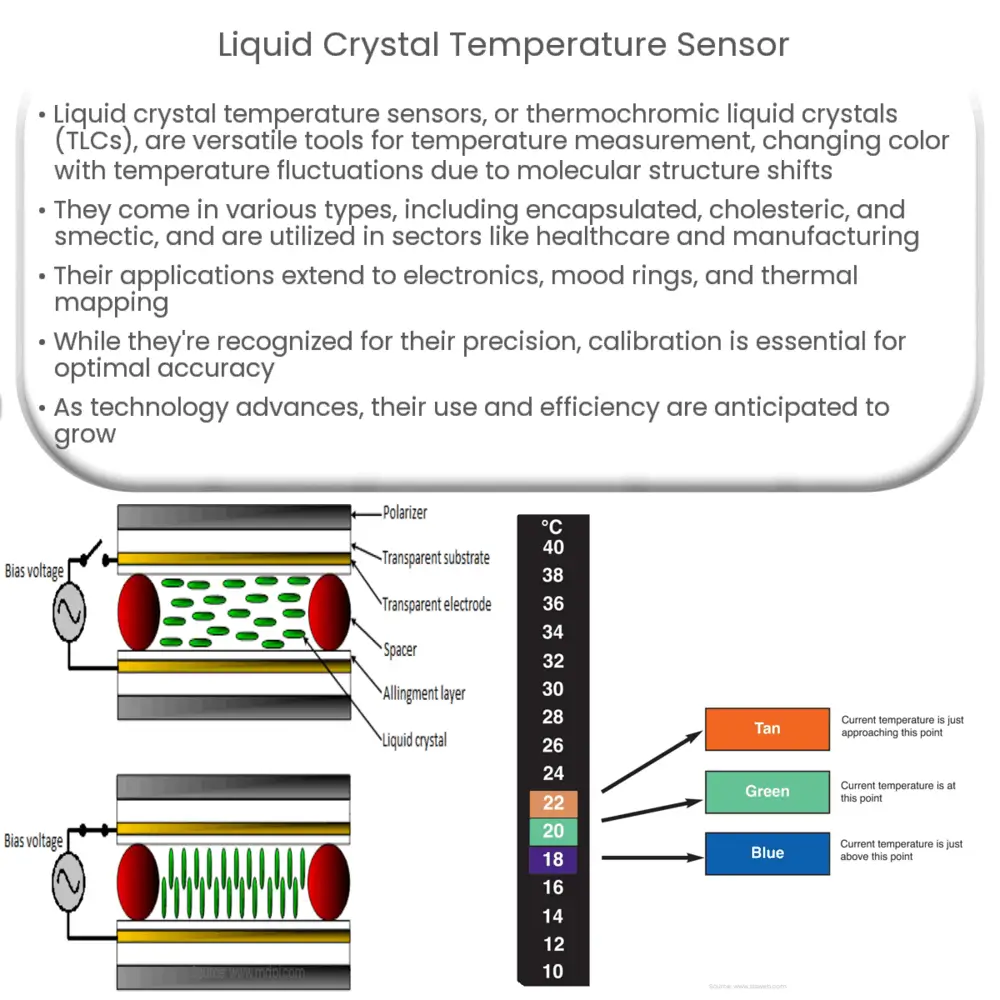
Liquid crystal temperature sensors, also known as thermochromic liquid crystals (TLCs), are fascinating and versatile tools used to measure temperature. They are formed from organic substances that exhibit both liquid and solid properties. Their unique behavior and characteristics make them ideal for various applications in temperature sensing.
The Science Behind Liquid Crystal Temperature Sensors
Liquid crystals are peculiar states of matter that have properties between those of conventional liquids and solid crystals. When exposed to varying temperature ranges, these substances change color, hence their use in temperature sensing. The science behind this is rooted in the liquid crystals’ ability to manipulate light due to their unique molecular structure.
- Color Change: As temperature changes, the molecular structure of the liquid crystal substance realigns. This realignment changes the wavelengths of light that are reflected by the substance, causing a visible color change.
- Sensitivity: These sensors are highly sensitive to temperature changes. Even a slight variation can cause a noticeable change in color, providing an immediate and accurate reading.
Types of Liquid Crystal Temperature Sensors
- Encapsulated Liquid Crystals: These sensors contain liquid crystals within small, sealed capsules. They are commonly used in applications that require a wide temperature range and high sensitivity.
- Cholesteric Liquid Crystals: This type of liquid crystal sensor is often used in thermometers due to its ability to display a wide range of vibrant colors with temperature changes.
- Smectic Liquid Crystals: These are used in more specialized applications, offering highly accurate temperature readings. Their molecular structure makes them ideal for high-resolution thermal imaging.
Applications of Liquid Crystal Temperature Sensors
Liquid crystal temperature sensors find a wide range of applications due to their unique properties. They are used in industries such as healthcare, manufacturing, and even in daily household appliances.
- Healthcare: These sensors are used in forehead thermometers due to their high sensitivity and non-invasive nature.
- Manufacturing: In the manufacturing sector, they help monitor machinery temperature to prevent overheating and ensure optimal operation.
Further Applications and Benefits
- Electronics: Liquid crystal temperature sensors are used in electronic devices to monitor and manage heat, enhancing performance and durability. For instance, they are used in computer processors to prevent overheating.
- Mood Rings: One of the more recreational uses of these sensors is in mood rings, where the color change is used to indicate different ‘moods’ based on the wearer’s body temperature.
- Thermal Mapping: In the field of research and development, these sensors are used for thermal mapping and hot spot detection in a variety of fields.
The Accuracy of Liquid Crystal Temperature Sensors
One of the critical aspects of any temperature sensor is its accuracy. Liquid crystal temperature sensors are known for their high accuracy. However, it’s important to note that accuracy can be influenced by external factors such as the angle of observation and ambient light conditions. Proper calibration is crucial for ensuring the most accurate readings.
Future of Liquid Crystal Temperature Sensors
With the advancement of technology and a growing focus on accurate, non-invasive temperature monitoring, the use of liquid crystal temperature sensors is expected to increase. Researchers are exploring ways to improve the sensitivity and accuracy of these sensors and to extend their temperature ranges. Furthermore, as nanotechnology progresses, we can expect to see even smaller, more efficient sensors that can be integrated into a variety of devices and materials.
Conclusion
In conclusion, liquid crystal temperature sensors offer an innovative approach to temperature monitoring. Their unique characteristics, combined with their versatility and high sensitivity, make them invaluable in numerous applications across various industries. As technology continues to evolve, we can anticipate even more uses for these fascinating sensors, making them an integral part of our future technological landscape.



