
Explore the inner workings, benefits, limitations, and applications of Light Emitting Diodes (LEDs), and how they’re shaping our future.
Understanding Light Emitting Diodes (LEDs)
Light Emitting Diodes, commonly known as LEDs, are an integral part of our daily lives. From our smartphones and computers to televisions and streetlights, LEDs are everywhere. But what exactly are these technological wonders, and how do they work?
Defining LEDs
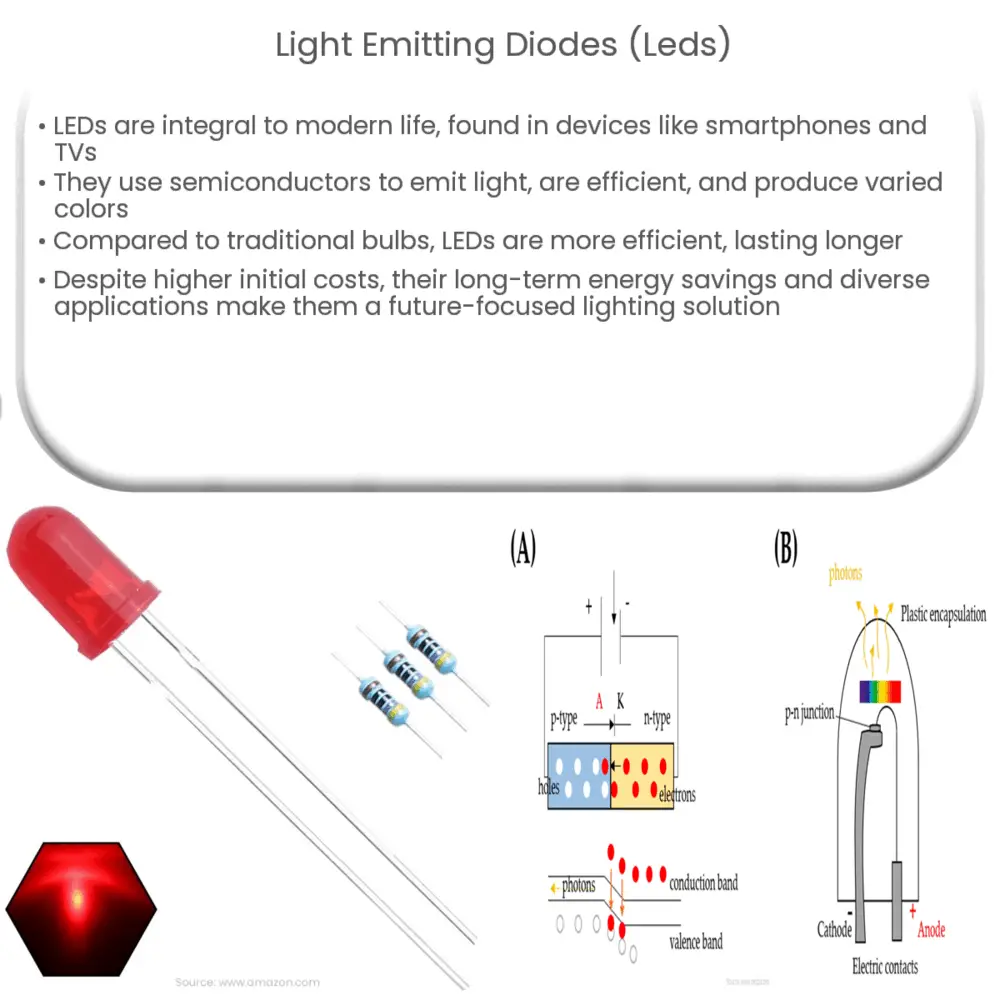
LED is a type of diode that emits light when an electric current is passed through it. Unlike traditional incandescent bulbs, LEDs use semiconductors to generate light, offering superior efficiency and longevity. The technology is also unique due to its ability to produce a range of colors without the use of color filters, a trait inherent to the LED design.
The Mechanism of LEDs
At the heart of each LED is a semiconductor. An LED’s core comprises two types of semiconductors: the P-type, which has positive charges (holes), and the N-type, with negative charges (electrons). These two layers are sandwiched together, and when voltage is applied, the electrons and holes combine in the junction, releasing energy in the form of light.
- The light’s color depends on the energy gap of the semiconductor. This is why LEDs can emit different colors of light.
- LEDs are highly efficient because almost all the energy they consume is converted into light, with very little heat waste.
LEDs vs Traditional Light Bulbs
LEDs have many advantages over traditional incandescent and fluorescent lighting. These include:
- Efficiency: LEDs consume far less power than traditional bulbs. A typical LED converts about 90% of its electrical energy into light, while a standard incandescent bulb only converts about 5%, with the rest wasted as heat.
- Longevity: LEDs last up to 25 times longer than incandescent lights. This is because they do not have a filament that can burn out.
Overall, the discovery and development of LEDs have revolutionized the lighting industry, leading to more efficient and sustainable solutions for illumination. However, despite their many benefits, LEDs also have some drawbacks, which will be explored in the next section.
Limitations of LEDs
Despite their significant advantages, LEDs also have a few limitations:
- Cost: Initially, the cost of LEDs is higher than traditional light sources. However, this is mitigated over time by their lower maintenance and energy costs.
- Temperature Dependency: LEDs are temperature sensitive. Excessive heat or cold can affect their performance and reduce their lifespan.
- Color Quality: While LEDs offer a wide range of colors, the quality of light can sometimes be perceived as less ‘warm’ than traditional incandescent lights.
LEDs in Various Applications
LEDs have revolutionized various fields, including:
- Home Lighting: LEDs are increasingly becoming the preferred choice for home lighting because of their efficiency and long lifespan.
- Displays: They are widely used in TV screens, computer monitors, smartphones, and digital billboards.
- Indicators and Signages: LEDs are used in traffic lights, vehicle brake lights, and in signages because of their brightness and visibility.
Future of LEDs
Advancements in LED technology continue to offer new possibilities. Researchers are exploring new materials and designs to make LEDs even more efficient and durable. With the focus on sustainability and energy efficiency, it’s clear that LEDs have a bright future ahead.
Conclusion
Light Emitting Diodes, or LEDs, have transformed the way we light our world. From their energy efficiency to their long lifespan and versatility, LEDs are clearly the light sources of the future. Despite their initial costs, the long-term benefits they offer in terms of energy savings and reduced maintenance make them an attractive choice for lighting solutions. As LED technology continues to evolve, we can expect to see even more applications and improvements, illuminating our lives for decades to come.



