
Explore the functionality, types, and applications of level sensors. Understand their role in various industries, selection process, maintenance, and future advancements.
Understanding Level Sensors
Level sensors are crucial elements in a wide range of industries, enabling efficient and accurate measurement of liquid and solid levels in various containers or environments. With their sophisticated technology, these sensors contribute to the optimization of processes in sectors such as manufacturing, oil and gas, water treatment, and food processing, among others.
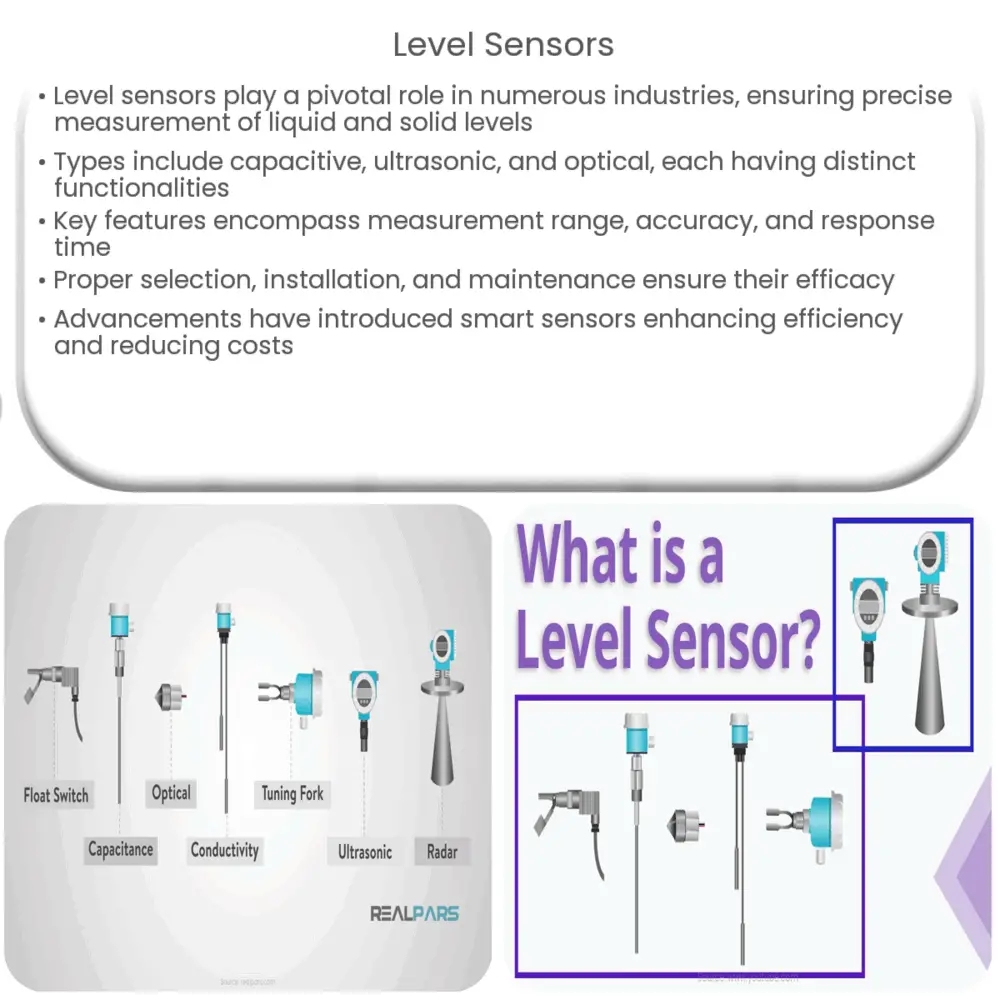
Types of Level Sensors
- Capacitive: These sensors function based on the electrical capacitance of the material being measured. Changes in the material’s level lead to variations in capacitance, which are then detected and converted into level measurements.
- Ultrasonic: Ultrasonic sensors work by emitting sound waves and measuring the time it takes for the echo to return. The distance of the material from the sensor is calculated based on the time of flight of the sound waves, providing an accurate level measurement.
- Optical: Optical level sensors use infrared light to detect the presence or absence of the material at a specific point. They are typically used in applications where a single point level measurement is sufficient.
Key Features of Level Sensors
Level sensors come with a variety of features designed to meet different requirements. Some of these include:
- Measurement Range: This refers to the maximum and minimum levels that a sensor can accurately measure. Different sensors have different ranges, making them suitable for different applications.
- Accuracy: The accuracy of a sensor is a measure of how close its readings are to the actual level. High-accuracy sensors are essential in applications where precise level measurement is critical.
- Response Time: This is the time it takes for a sensor to detect a change in level and update its output. A faster response time can be beneficial in rapidly changing environments.
Applications of Level Sensors
Level sensors have a wide range of applications in various industries. For example, in the oil and gas industry, they are used for monitoring the level of oil in tanks to prevent overflows. In wastewater treatment plants, they help in monitoring and controlling the level of water in different stages of the treatment process. In the food and beverage industry, level sensors are used for controlling the level of ingredients in vats, ensuring consistency in product quality.
Selection and Installation of Level Sensors
Selecting the right level sensor for a specific application is crucial for achieving accurate and reliable measurements. Factors to consider during selection include the type of material to be measured, the required measurement range, the desired accuracy, and the environmental conditions. The installation process also plays a significant role in the performance of the sensor. It is important to install the sensor at the right location and angle, and to calibrate it properly.
Maintenance of Level Sensors
Regular maintenance is essential for the long-term performance and reliability of level sensors. This includes periodic cleaning, especially for sensors that are used with dirty or sticky materials. Calibration should also be checked and adjusted regularly to ensure that the sensor continues to provide accurate measurements. In some cases, parts of the sensor may need to be replaced over time.
Advancements in Level Sensor Technology
With the advancement in technology, level sensors have also evolved over the years. Today, we have smart level sensors that can self-calibrate, diagnose problems, and communicate with other devices in a network. These sensors can be remotely monitored and controlled, leading to improved efficiency and reduced maintenance costs. Further advancements in level sensor technology are expected in the future, driven by the increasing demand for more accurate, reliable, and cost-effective level measurement solutions.
Conclusion
In conclusion, level sensors are an essential component in a wide range of industries, contributing significantly to process optimization, safety, and efficiency. Understanding the different types of level sensors, their features, and their applications can help in selecting the right sensor for a specific task. With advancements in technology, the capabilities of these sensors are continually improving, paving the way for more innovative applications and improved process control in the future.



