
Explore the world of infrared thermometers, their working principle, types, uses, advantages, and limitations. Understand their crucial role in various fields.
Understanding Infrared Thermometers
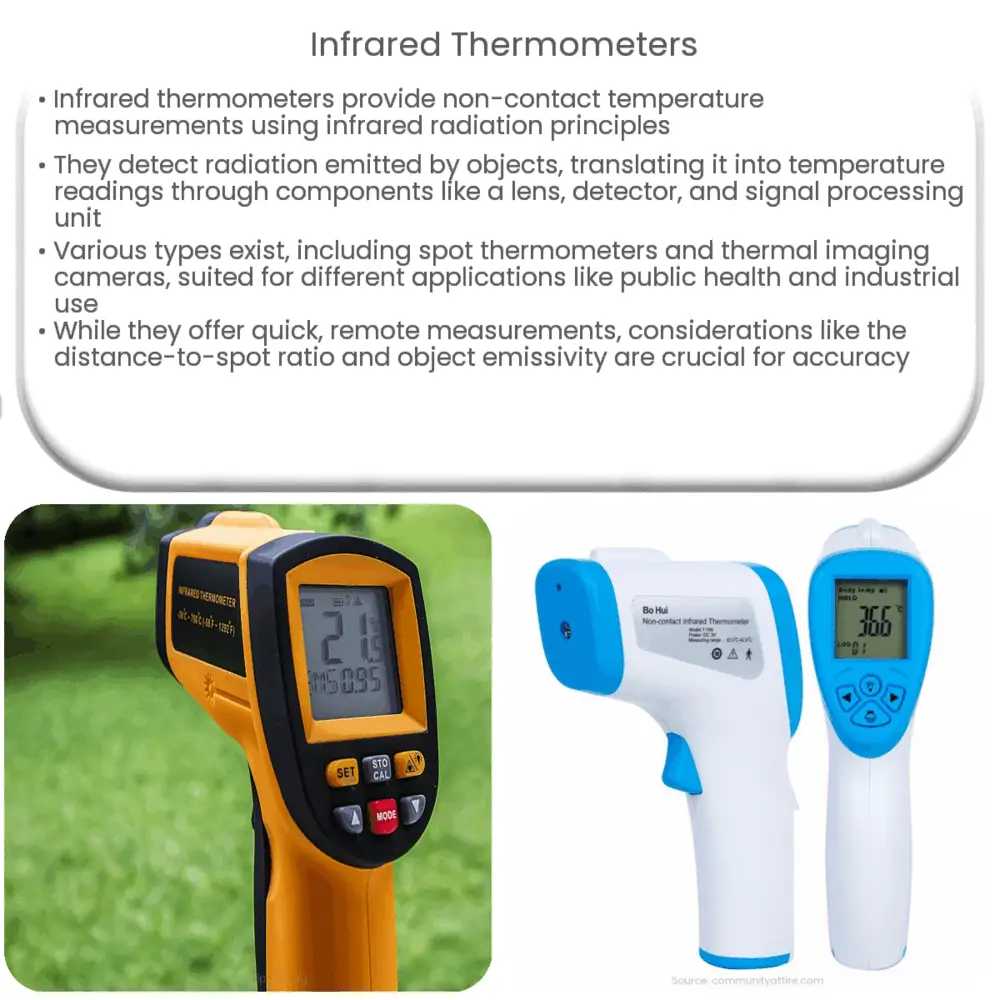
Infrared thermometers are non-contact temperature measurement devices that operate on the principle of infrared radiation. They are a product of the remarkable advancements in the field of temperature sensing and measurement technology.
How Do Infrared Thermometers Work?
At their core, infrared thermometers work by detecting and measuring the infrared radiation emitted by all objects. Every object with a temperature above absolute zero (-273.15°C) emits a certain amount of infrared radiation. This radiation is then captured and measured by the infrared thermometer, which subsequently calculates and displays the temperature of the object in question.
The Components of an Infrared Thermometer
- Lens: This component helps to focus the infrared radiation from the object onto the detector.
- Detector: Often referred to as the thermopile, it absorbs the infrared radiation and turns it into an electrical signal.
- Signal Processing Unit: This unit converts the electrical signal into a temperature reading which is then displayed on the device.
Types of Infrared Thermometers
There are various types of infrared thermometers available today, each designed for specific applications. The most common types include:
- Spot Infrared Thermometers: These are also known as laser thermometers and they measure the temperature at one spot on a surface.
- Infrared Line Scanning Systems: These systems are designed to measure the temperature across a line instead of a single spot.
- Infrared Thermal Imaging Cameras: These devices measure temperature over a large area and create a two-dimensional image called a thermogram.
Uses of Infrared Thermometers
Infrared thermometers have a wide range of applications. They are commonly used in many industrial and commercial environments, including manufacturing, food service, HVAC systems, and automotive repair. In addition, they’ve found significant use in the healthcare sector, particularly in light of the COVID-19 pandemic, where they were used extensively to detect possible fevers among the populace.
Advantages of Infrared Thermometers
One of the key advantages of infrared thermometers is their ability to measure temperature from a distance, without needing to make direct contact with the object. This is particularly beneficial in situations where the objects are in hard-to-reach places, moving, or too hot to touch. Furthermore, they provide quick and accurate measurements, which make them an excellent tool in various fields.
Limitations of Infrared Thermometers
Despite their numerous advantages, infrared thermometers also have certain limitations. Firstly, they can only measure surface temperature and not the internal temperature of an object. They may also be affected by environmental conditions such as dust, fog, or high ambient temperature. Additionally, the accuracy of measurements can be affected by the emissivity of the surface being measured. Emissivity is the measure of an object’s ability to emit infrared energy. Different materials have different emissivity values and the infrared thermometer needs to be calibrated accordingly to provide an accurate reading.
Important Considerations When Using Infrared Thermometers
- Distance-To-Spot Ratio: This ratio denotes the maximum distance at which the infrared thermometer can accurately measure the temperature of a given spot size. For precise readings, it’s essential to maintain the appropriate distance-to-spot ratio.
- Emissivity: Adjusting the emissivity setting on your infrared thermometer based on the material of the object you’re measuring is crucial to obtain accurate results.
- Environmental Factors: Factors such as ambient temperature, humidity, dust, and fog can affect the accuracy of infrared thermometers. It’s important to account for these when using the device.
Infrared Thermometers and Public Health
In recent years, infrared thermometers have been instrumental in public health efforts, especially during the COVID-19 pandemic. They’ve been used globally for fever screening in airports, workplaces, and public gatherings, playing a key role in curbing the spread of the virus.
Conclusion
In conclusion, infrared thermometers are indispensable tools in various fields, thanks to their non-contact and accurate temperature measurement capability. Whether it’s in industrial applications, food safety, HVAC systems, or public health, their role cannot be underestimated. Nevertheless, to make the most of these devices, understanding their working principle, advantages, limitations, and proper usage is vital. As we continue to harness the power of infrared technology, the importance and utilization of these thermometers is poised to grow even further.



