
Infrared pressure sensors offer accurate, non-contact measurements for various industries, including environmental monitoring, medical, and automotive.
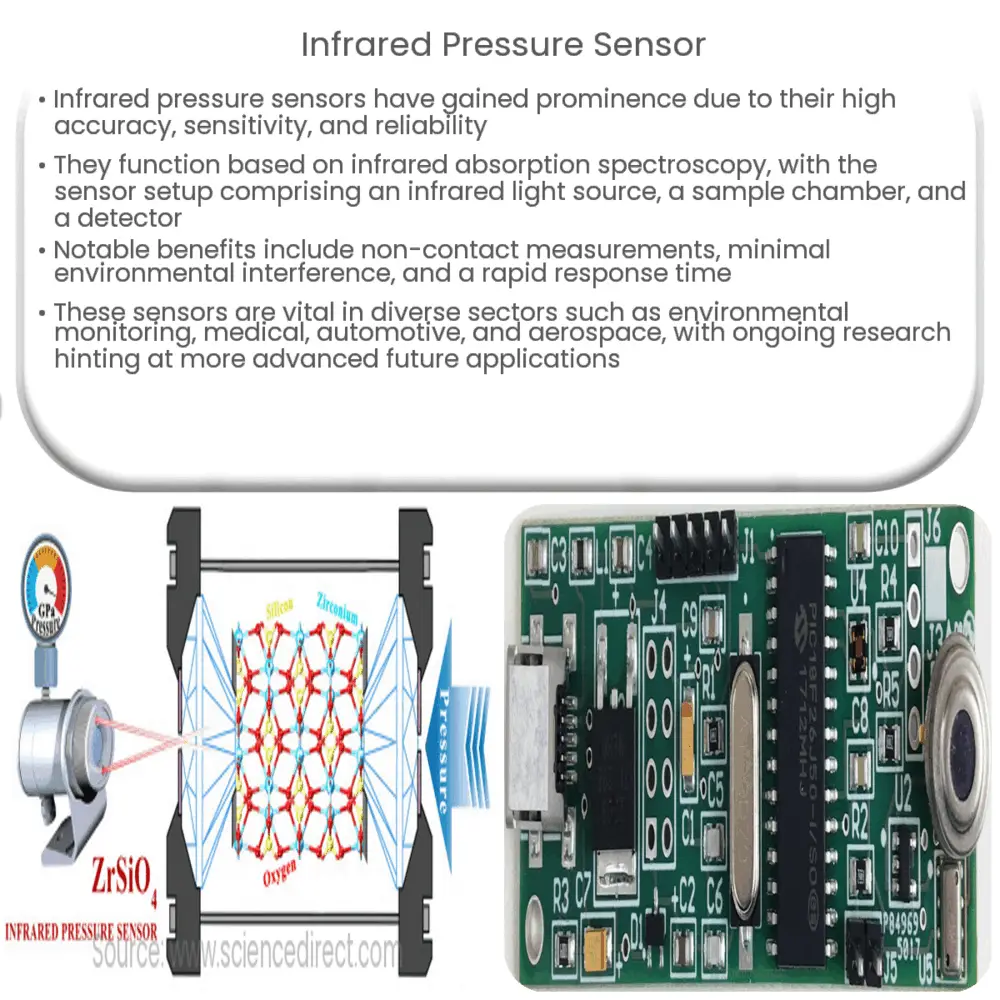
Infrared Pressure Sensors: An Overview
Introduction
In recent years, technological advancements in the field of sensors have revolutionized industries and applications across various domains. One such advancement is the development of infrared pressure sensors, which have proven to be an invaluable tool for numerous applications due to their high accuracy, sensitivity, and reliability. This article will provide an overview of infrared pressure sensors, including their working principle, advantages, and common applications.
Working Principle
Infrared pressure sensors rely on the principle of infrared absorption spectroscopy, which is the measurement of the absorption of infrared light by a material as a function of wavelength. When infrared light interacts with a gas or liquid, the molecules of the substance absorb specific wavelengths of the light, resulting in a characteristic absorption spectrum. This absorption spectrum can be used to determine the concentration of the target substance and, subsequently, the pressure of the sample.
Typically, an infrared pressure sensor comprises three main components: an infrared light source, a sample chamber, and an infrared detector. The light source emits a broad spectrum of infrared light that passes through the sample chamber, which contains the gas or liquid to be measured. As the light interacts with the sample, certain wavelengths are absorbed, and the remaining light is transmitted to the detector. The detector then converts the received light into an electrical signal that is proportional to the intensity of the absorbed light. Finally, this signal is processed by a microcontroller to calculate the pressure of the sample based on the known absorption characteristics of the target substance.
Advantages of Infrared Pressure Sensors
There are several advantages of using infrared pressure sensors compared to other types of pressure sensors, such as piezoelectric, capacitive, and strain gauge sensors. Some of these advantages include:
- High Accuracy and Sensitivity: Infrared pressure sensors can provide highly accurate and sensitive measurements, as the absorption spectrum of a substance is specific to its molecular structure. This allows for precise determination of pressure even at low concentrations.
- Non-contact Measurement: Since the infrared light does not need to be in physical contact with the sample, these sensors can be used for non-contact measurements, making them ideal for applications involving hazardous or corrosive substances.
- Minimal Interference: Infrared pressure sensors are less susceptible to interference from environmental factors, such as temperature, humidity, and vibration, which can adversely affect the performance of other types of pressure sensors.
- Fast Response Time: The response time of infrared pressure sensors is typically faster than other sensors, allowing for real-time monitoring of pressure changes in dynamic systems.
Applications of Infrared Pressure Sensors
Infrared pressure sensors have found applications in a wide range of industries and sectors, some of which include:
- Environmental Monitoring: These sensors can be used for air quality monitoring, measuring greenhouse gas emissions, and detecting leaks in pipelines.
- Medical: Infrared pressure sensors are employed in respiratory monitoring devices, sleep apnea diagnosis, and blood pressure monitoring.
- Automotive: Applications in this sector include tire pressure monitoring systems and engine management systems for optimal fuel combustion and emission control.
In conclusion, infrared pressure sensors offer a reliable, accurate, and versatile solution for pressure sensing applications across various industries. Their unique advantages, such as non-contact measurement and minimal interference, make them an
ideal choice for many challenging applications.
Industrial Processes
Infrared pressure sensors play a crucial role in monitoring and controlling industrial processes, such as chemical production, power generation, and petrochemical refining. These sensors enable real-time monitoring of process parameters, ensuring safety and improving efficiency in manufacturing processes.
Aerospace and Defense
These sensors are also used in aerospace and defense applications, such as altitude and cabin pressure monitoring in aircraft, rocket propulsion system monitoring, and leak detection in fuel systems. Their high accuracy, fast response time, and resistance to harsh environments make them suitable for the demanding requirements of these sectors.
Consumer Electronics
With the miniaturization of electronics and the growing demand for smart devices, infrared pressure sensors have found their way into consumer electronics, such as smartphones and wearable devices. These sensors enable features like air quality monitoring, gesture recognition, and activity tracking, enhancing the user experience and functionality of these devices.
Future Developments
As the demand for more accurate, sensitive, and versatile pressure sensors continues to grow, researchers are exploring new materials and technologies to improve the performance of infrared pressure sensors. Some areas of research include the development of advanced light sources and detectors, as well as novel signal processing algorithms to enhance the accuracy and resolution of pressure measurements. Additionally, the integration of artificial intelligence and machine learning techniques into these sensors could enable predictive maintenance and adaptive control systems, further enhancing their capabilities and applications.
Conclusion
Infrared pressure sensors have emerged as a key technology in various industries due to their unique advantages, such as high accuracy, non-contact measurement, and minimal interference. Their widespread use in applications ranging from environmental monitoring to aerospace and defense demonstrates their versatility and adaptability. As research and development continue, we can expect to see further improvements in the performance of these sensors, leading to even more applications and benefits in the future.



